 Wow! eBook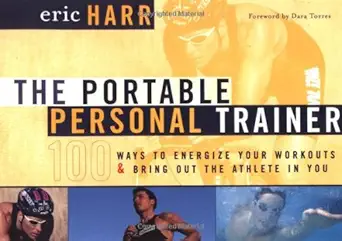
The Portable Personal Trainer: 100 Ways to Energize Your Workouts and Bring Out the Athlete in You
Author(s): Eric Harr (Author)
- Publisher: Broadway
- Publication Date: June 12, 2001
- Language: English
- Print length: 256 pages
- ISBN-10: 0767906411
- ISBN-13: 9780767906418
Book Description
Whatever your fitness level, world-class Iron Man triathlete Eric Harr shares 100 inspirational strategies to uncover your passion and improve your performance.
•See each workout as a celebration and an opportunity for personal growth (#5).
•Stop counting calories and listen to your body for nutrition information it knows what you need (#22).
•Learn why morning workouts are best–and it’s not just because you’ll burn more body fat (#35)
•Experience the power of a “breakthrough session” in your training program (#60).
•Find out the five best fat-burning secrets, and why you must be selfish about your fitness.(#s 90 and 91).
•Put less effort into your workout for world-class results (#73).
•Let go of your ego and rely on your inner strength and confidence (#84).
Gleaned from thousands of hours of training and shared wisdom from the very best athletes in the world, these simple lessons will transform your approach to getting fit, staying active, and being alive.
Editorial Reviews
From School Library Journal
Sheila Shoup, Fairfax County Public Library, VA
Copyright 2001 Cahners Business Information, Inc.
From the Inside Flap
Whatever your fitness level, world-class Iron Man triathlete Eric Harr shares 100 inspirational strategies to uncover your passion and improve your performance.
?See each workout as a celebration and an opportunity for personal growth (#5).
?Stop counting calories and listen to your body for nutrition information it knows what you need (#22).
?Learn why morning workouts are best?and it’s not just because you?ll burn more body fat (#35)
?Experience the power of a ?breakthrough session? in your training program (#60).
?Find out the five best fat-burning secrets, and why you must be selfish about your fitness.(#s 90 and 91).
?Put less effort into your workout for world-class results (#73).
?Let go of your ego and rely on your inner strength and confidence (#84).
Gleaned from thousands of hours of training and shared wisdom from the very best athletes in the world, these simple lessons will transform your approach to getting fit, staying active, and being alive.
About the Author
Excerpt. © Reprinted by permission. All rights reserved.
Twenty years from now you will be more disappointed by the things you didn’t do than by the ones you did. So throw off the bowlines. Sail away from the safe harbor. Catch the trade winds in your sails. Explore. Dream!
—Mark Twain, writer (1835-1910)
How we’ve forgotten to dream! As we get older, our goals and our visions tend to grow smaller, more manageable, more “realistic.” Our limiting beliefs are more confining than we realize. Nowhere is this truer than in our personal visions of health and exercise. We’re constantly making excuses and concessions, and over time, some of us have resigned ourselves to a lower standard of fitness than we ever intended.
It’s time to demand more from your body.
When I began training for triathlons seven years ago, I was overweight and had no background in cycling or running. Yet I decided that in one year I would be ranked in the world’s top ten. People thought I was mad. I read and reread Dave Scott’s Triathlon Training and followed his advice to the letter—so far as riding to work through torrential Caribbean downpours! Six months later I was ranked number six in the world.
You may not aspire to be a world-class athlete, but nevertheless you will benefit tremendously from this strategy. The first step to igniting your passion and opening the door to your boldest fitness goals is to set new goals that excite, inspire, and move you. Goals that reside “within your comfort zone” are unlikely to ignite your deepest passions. Setting new, passion-driven goals is the foundation of any successful fitness program.
Get outside. This exercise cannot be done indoors—to truly open up your mind to new fitness possibilities, oxygen must be coursing in your blood, your endorphins must be pumping, and your consciousness must be liberated. (In fact, I recommend you do most of the “action items” in this book while in motion, during exercise.)
Exercise at a nice, steady aerobic effort, and think about what you want from your body. When you complete your workout, pull out a fresh sheet of paper and write down your three boldest fitness goals. The trick here is to think huge. This is not about “thinking outside the box,” it’s about disregarding the box altogether. It doesn’t mean you have to achieve those goals, but the sheer act of writing down new, lofty goals will begin the process of igniting your passion and will open the door to higher personal performance.
Now that your boldest goals are on paper, scale them back ever so slightly into the realm of realism. Olympic two-hundred-meter champion Michael Johnson’s advice on goals is to make them quantitative and time based and realistic. Thinking huge first determines what’s most important to you, what’s really possible. This raises your own standards. You’ll always have your eyes on that prize, and you just never know how close to those goals you may come.
Congratulations. What you just did is how champion athletes begin their quest toward world-record performances. They just dream absolutely huge.
2. Pinpoint Your Ends Motivations
Every battle is won before it is fought.
—Sun Tzu, Fourth-century general, author of The Art of War
To enjoy long-term success in fitness, you need something to hold on to, something to motivate you, something to inspire you over the long term. If you can discover what that is, the battle of reaching your fitness goals “will have been won before it is fought.”
Staying motivated is one of the most challenging elements of any fitness program. The first step is to clarify your deep-down motivations to work out. When you do this, you change your fitness destiny because you will be motivated to exercise more consistently and with more passion.
There are “means” motivations and “ends” motivations. Most people know their means motivations, which is why they often struggle to stay motivated to exercise. Top world-class athletes understand their ends motivations, which is why they rarely struggle to stay motivated. What do I mean?
“To lose ten pounds” is a means motivation. That is simply a means to an end. You don’t really want to lose ten pounds. You want what losing ten pounds will give you, how it will make you feel. Will “I want to lose ten pounds” get you out the door every day, filled with passion and excitement for your workouts? Probably not. Your motivations must really move you. A better way to rephrase this motivation might be “Look, if I lose ten pounds, I will feel more passionate, I will look younger, and I will become a hell of a lot more attractive to the opposite sex!” Those ends motivations are more likely to inspire you to work out more often and with more passion.
Your long-term success in fitness relies on a true, rich understanding of your ends motivations. A written list of those motivations will keep your passion alive and reignite it when it fades. Sit alone in a quiet place and ask yourself why you want to achieve your bold new fitness goals. Be honest and emotionally charged as you write down those motivations, and post them where you can see them daily. When you’re feeling uninspired, refer to the list. If the list does not motivate you, it’s time to reassess what motivates you, and this may change often. Keep your list of ends motivations fresh, current, and passion driven, and it will provide you with a powerful wellspring of motivation to exercise.
3. Face Your Weaknesses
You cannot run away from a weakness; you must sometimes fight it out or perish; and if that be so, why not now and where you stand?
—Robert Louis Stevenson, writer (1850-1894)
What has held you back from reaching your fitness goals in the past? I mean the real obstacles? Identifying those stumbling blocks will move you a long way toward resolving them. In fitness, the biggest gains can be made when you turn your mental and physical weaknesses into your strengths. But facing our weaknesses is rarely fun. Now is the time.
One Olympic runner with whom I’ve trained is relentless in attacking her weaknesses, those things that hold her back from her highest athletic potential. In fact, she rarely works on her strengths. Each week she spends a few moments writing down what holds her back from better fitness, and then she outlines ways to resolve those things immediately. That is why Uta Pippig is one of the most physically, mentally, and psychologically feared athletes in the sport of running.
Write down your biggest physical or mental weaknesses as they relate to your fitness: “knee injury,” “no time,” “lack of a written program.” Then brainstorm a few ideas on how you can address those weaknesses: “Schedule a Friday meeting with Dr. Kelly,” “Cut out one hour of television viewing per day,” “Create a new written fitness program right now and stick it on the fridge.” Act on those ideas this week.
4. Write Your Plan and Post It Up
From a good beginning, all else flows.
—Dan Millman, world-class athlete and author
Now that you know why you desire to exercise, it’s time to explore how, when, and where. A personalized fitness plan designed by an expert—and you can become that expert—is a road map: it cannot ensure good weather, but it will get you to your destination.
Most people approach their fitness haphazardly. In fact, I know elite-level triathletes who have only a vague idea what exercise they should do each day. They simply throw together a mishmash of workouts and hope for the best. I am a huge fan of spontaneous workouts (see tip #19), but you will get far better results much faster by writing down your plan. Champion athletes build their confidence and successes from adhering to a master success plan. You can, too.
It’s time to create, or rework, your fitness plan. You can build a world-class fitness program in seven simple steps. Pull out a blank sheet of paper and let’s get to work!
1. Determine how many hours per week you will dedicate to your new fitness program. Be realistic. It should be no fewer than three. (If you feel that’s too much, read tip #85.)
2. Choose two to three rest days. This is vital. No matter what your level or goals, you need at least two days of rest per week. Trust me on this one.
3. Eighty percent of your time should be dedicated to continuous aerobic exercise (cycling, swimming, running, and so on) and 20 percent allocated to strength training. See appendix A for an example of a perfect training week.
4. Two of your aerobic sessions each week are your key workouts: one long workout (sixty minutes or more) and one more intense workout. You must be rested for, and recover from, these sessions to boost your fitness.
5. Keep your key workouts as far apart as possible.
6. Post your new program in a highly visible place: mine sits on my refrigerator. The secret of sticking to a new program is being able to see it every day. But that’s not enough: you must also write your workouts into your daily planners, so that nobody can take that time from you.
7. Stick to your program, but stay open to modifying it. Your body and mind are dynamic. Therefore the best fitness program is dynamic—changing constantly but subtly, to match how you are feeling each day.
A note to serious athletes: I strongly suggest you consult someone who deeply understands your sport to map out your program. I don’t believe most personal trainers at the local gym will cut it. If you were going to ascend Mount Everest, would you hire someone who studies the mountain for a living or a team of Sherpas who climb that sucker for a living? You need someone who has really “been there, done that.” An accomplished athlete in your chosen sport will show you the surest path to your summit while helping you avoid the pitfalls along the way.
5. Redefine “Ex…


