Wow! eBook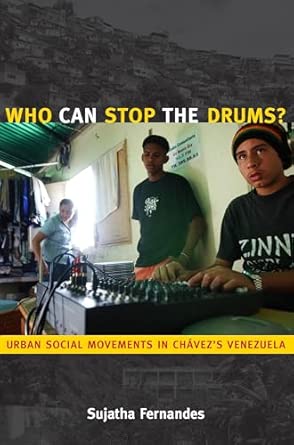
Who Can Stop the Drums?: Urban Social Movements in Chávez's Venezuela
Author(s): Sujatha Fernandes (Author)
- Publisher: Duke University Press
- Publication Date: 2 April 2010
- Language: English
- Print length: 336 pages
- ISBN-10: 0822346656
- ISBN-13: 9780822346654
Book Description
Fernandes portrays everyday life and politics in the shantytowns of Caracas through accounts of community-based radio, barrio assemblies, and popular fiestas, and the many interviews she conducted with activists and government officials. Most of the barrio activists she presents are ChÁvez supporters. They see the leftist president as someone who understands their precarious lives and has made important changes to the state system to redistribute resources. Yet they must balance receiving state resources, which are necessary to fund their community-based projects, with their desire to retain a sense of agency. Fernandes locates the struggles of the urban poor within Venezuela’s transition from neoliberalism to what she calls “post-neoliberalism.” She contends that in contemporary Venezuela we find a hybrid state; while ChÁvez is actively challenging neoliberalism, the state remains subject to the constraints and logics of global capital.
Editorial Reviews
Review
“[T]his book certainly adds a flavorful icing, one that is certainly long overdue and more than welcome, to the existing literature on Venezuela.”–J. Michael Ryan “Anthropological Quarterly”
“Fernandes elegantly places the struggles of the local poor in a larger political framework to allow readers to understand how residents make their own history by negotiating their post-neoliberal visions with their current social circumstances. Recommended.”–J. M. Santos-Hernindez “CHOICE”
“Fernandes forges a new and promising analytical approach to the study of social movements: that of examining the ‘everyday wars of position.’ … If others take up Fernandes’s research agenda, we will be rewarded with greater insight into the dynamics of contention within clientelism and revolution.”–Leslie C. Gates “Perspectives on Politics”
“Sujatha Fernandes reveals a world of activism deeply influenced by the history of Left movements in Latin America, but vulnerable to the kind of technocratic, bottom-line reasoning regrettably necessary for the state’s economic success.”–Nicholas Gamso “Social Text”
“This book is a must read for scholars interested in Venezuela, as [Fernandes] provides an historical account of the growth of Caracas and the relationship between barrio residents and the state over time. The book would also be excellent for a graduate course on social movements or social change, as well as in a methods course on ethnography as a beautiful example of how to weave together ethnographic and interview data to provide a vivid and intellectually engaging work of scholarship.”–Tiffany Linton Page “Social Forces”
“This well written and interesting book captures quite a lot about the ambiguities of urban politics, and the conditions of barrio life, in Caracas. . . . The book could certainly be recommended to students with some assurance that they would enjoy reading it. They will learn from it at the same time.”–George Philip “Bulletin of Latin American Research”
“
In the Spirit of Negro Primero is a marvelous contribution to the literature on social movements, neoliberalism, cultural politics, and Venezuela. While most analyses of the country portray Hugo Chávez as either a liberating figure fighting neoliberalism to help the poor, or an authoritarian caudillo preserving his own power while destroying liberties and human rights, Sujatha Fernandes goes far beyond such polarities. By concentrating on the experiences of poor activists in Caracas, she provides a unique and nuanced perspective on a complicated political process, and reveals the Chávez government as much more complicated and interesting than most other scholars have allowed.”–Nancy Postero, author of Now We Are Citizens: Indigenous Politics in Post-Multicultural Bolivia“Too much of the scholarly and political writing on the Venezuelan government centers on President Hugo Chávez and his style and rhetoric. In this original, timely, and important book, Sujatha Fernandes focuses on the barrio residents who form the social base of the
Chávista movement. Along the way, she demonstrates a detailed understanding of Venezuela’s culture and recent political history.”–Steve Ellner, author of Rethinking Venezuelan Politics: Class, Conflict, and the Chávez PhenomenonFrom the Back Cover
About the Author
Sujatha Fernandes is Associate Professor of Sociology at Queens College and the Graduate Center, City University of New York. She is the author of Cuba Represent! Cuban Arts, State Power, and the Making of New Revolutionary Cultures, also published by Duke University Press.
Excerpt. © Reprinted by permission. All rights reserved.
Who Can Stop the Drums?
URBAN SOCIAL MOVEMENTS IN CHVEZ’S VENEZUELABy Sujatha Fernandes
Duke University Press
Copyright © 2010 Duke University Press
All right reserved.
ISBN: 978-0-8223-4665-4
Contents
List of Illustrations……………………………………………ixAcknowledgments…………………………………………………xiIntroduction……………………………………………………11. Urban Political Histories……………………………………..392. Poverty, Violence, and the Neoliberal Turn………………………643. Personal Lives……………………………………………….874. Culture, Identity, and Urban Movements………………………….1135. Barrio-Based Media and Communications…………………………..1606. The Takeover of the Alameda Theater…………………………….2127. The New Coalitional Politics of Social Movements…………………233Conclusion……………………………………………………..257Notes………………………………………………………….267Bibliography……………………………………………………285Index………………………………………………………….301
Chapter One
Urban Political Histories
The histories of the urban shantytowns are marked on their physical spaces and preserved in the names of the barrios and the memories of their residents. On the central wall of the “Afinque de Marn,” a historic meeting place in Barrio Marn of San Agustn, there is a mural of the members of the radical musical ensemble Grupo Madera. Most members of the group died in a tragic boat accident in the Orinoco while on tour in 1980. On one side of the mural are images of three of the Ramos sisters, with their Afros, hoop earrings, and African head wraps. In popular lore, it is said that when their boat was sinking, the three sisters held hands and jumped together to their death. Above this and on the other side of the mural are the musicians in action, dancing, laughing, playing the guitar, immortalized forever as youthful and vibrant as when they were alive.
In the zone bordering the Avenida Sucre in 23 de Enero, many buildings show the bullet marks from the tragic days following the Caracazo, when widespread popular riots were faced with massive state repression. As residents describe it, the large project-like buildings in Monte Piedad and the Zona Central looked like colanders after the attack. The buildings, blocks, and walls of the parish bore the marks of the brutal offensive launched by the security forces and were a stark reminder to residents of the neighbors, cousins, friends, and other family members killed in the crossfire.
The walls of Monte Piedad Arriba contain portraits of young men who have died in prison or were killed by security forces. One portrait of a young man named Cheo contains the following phrase: “Jail is the place transformed into a school where the revolutionary deepens their ideas to later make them into reality.” Another portrait of an activist, Carlos Vielma, has the caption “Those who die for life cannot be called dead,” a quote from the revolutionary Venezuelan folksinger Ali Primera. Through murals, barrio residents commemorate the dead and incorporate their memory as part of their present.
Historical memory and narratives of resistance are central to the self-making of contemporary urban movements. Community leaders in the barrios trace their genealogy from the clandestine movements against the military regime in the 1950s, through to the period of guerrilla struggle in the 1960s, the cultural activism of the 1970s, and the emergence of new forms of urban resistance in the 1980s. At the same time, urban movements have participated in shifting clientilist relationships with the state, fostered over three decades of a redistributive welfare state, passing through a neoliberal state, and refashioned under Chvez. The approach of contemporary urban sectors to the Chvez government contains these elements of both autonomy as grounded in histories of local struggle and mutual dependency that has evolved over time. We can more fully understand this contemporary dynamic by exploring the formation of urban social movements in the barrios and their embeddedness in local political histories.
MIGRATION AND THE FORMATION OF THE BARRIOS
Caracas initially underwent some degree of urbanization under the administration of Antonio Guzmn Blanco (1870-88). But it did not experience comprehensive urbanization until the 1930s, by which time most other Latin American capitals had already been consolidated. Following the Federal War of 1859-63, the Venezuelan coffee economy expanded rapidly, making Venezuela the world’s third-largest coffee exporter by 1890. However, as the historian Arturo Almandoz describes, Caracas was mostly a commercial and bureaucratic outpost for the coffee and cocoa exporter until the emergence of the oil economy in the 1920s. Oil fueled certain administrative, legal, and infrastructure reforms in the capital under the administration of Juan Vicente Gmez (1908-35). The shift from coffee production as the economic base of the country to an oil economy also encouraged migration from rural to urban areas.
One of the first working-class neighborhoods to emerge in the west of the city was San Agustn del Sur. The architect Luis Roche was responsible for the elite, middle-class urbanizacin San Agustn del Norte in the 1920s. At this time, San Agustn del Sur was a cerro, a hillside dotted with makeshift homes. The majority of migrants residing in the cerro came from the predominantly Afro-Venezuelan, coastal regions of the state of Miranda. According to the local popular historian Antonio “Pelon” Marrero, the sectors forming in the cerro took their names from the trees and fruits found in their area: La Ceiba, La Charneca, El Mamn, El Manguito, and Los Almendrones. As urbanization proceeded in San Agustn del Norte, Roche began to claim the central avenue of San Agustn del Sur to house his construction workers, mostly Portuguese and Italian immigrants. Given growing demand for housing, the Banco Obrero was charged with the construction of housing in San Agustn del Sur during the 1920s, and they also built passageways in La Ceiba, Manguito, and Mamn, which were inaugurated in 1932. Other areas being developed in the west of Caracas included the upper-class enclave Cuidad Nueva (New City), now known as El Paraso.
Prior to the 1920s, the east of the center was mostly haciendas, or large plantation estates, and hills covered with forests of trees. The expansion of Caracas toward the east was boosted with a decree passed on April 19, 1920. As middle- and upper-class groups sought to escape from the increasingly populated center, the former haciendas in the east were urbanized. Roche, along with other entrepreneurs such as Santiago Alfonzo Rivas and Juan Bernardo Arismendi, was responsible for the construction of areas such as La Florida, El Recreo, and Los Palos Grandes. As these development projects proceeded and trees were being cut down, sawmills were built along the principal avenue of San Agustn del Sur in order to process this wood. The wood factories were run by Jewish immigrants, who brought the technology of wood processing. These factories were an important source of work for the working-class residents of San Agustn del Sur. Another source of work was the mortadella factories; the technology of meat processing was brought by the Italian immigrants. Marrero told me that mortadella was a distinctly working-class meat associated with San Agustn del Sur, as compared with the ham that was eaten by the middle classes in San Agustn del Norte. Factories were also constructed in other parts of the city. In 1907, the National Cement Factory was built in La Vega. The establishment of the cement factory served as a pole of attraction for other industries, incorporating migrants into industrial production as factory workers. A curtain factory was built in 1920, followed by a confectionery factory in 1938. Rural migrants who came to the city found jobs in these factories.
The expansion of oil production also began to increase the pace of urbanization, albeit indirectly. Charles Bergquist describes how during the labor-intensive period of oil exploration, drilling, and construction of facilities, large numbers of workers were drawn away from agricultural work and into remote oil zones. Even as labor demand in the oil fields began to decline during subsequent phases of production, oil production was stimulating economic development in the oil zones and agriculture suffered. Meanwhile, the increasing volume of foreign trade due to oil production financed a growing bureaucracy, local commercial services, public works, social programs, and development programs in the capital city of Caracas. As agriculture declined, rural migrants came to Caracas for jobs in the public sector, public works programs, and the service industry.
Caracas experienced its first major wave of rural migration in the 1930s. Migrants to the city came from all across the country, from the Andes, Miranda, Aragua, Yaracuy, and Sucre among other regions. As the chronicler Rafael Quintero recounts, the migrants would arrive at the Nuevo Circo Terminal, a few minutes’ walk from San Agustn. They would be picked up by a relative or friend, who would house them for a few days. Then they would begin to construct their own rancho, a precarious zinc roof house with walls of carton, cardboard, or wood, and they would buy chickens and pigs to raise. In this way, rural customs and life gained a foothold in the city.
One of the central institutions of barrio life was the bodega, a small grocery store up in the cerro. According to Quintero, “There you could obtain almost everything: from salted fish to fruits and nuts, pots, pans, skillets, kerosene for cooking (in that time there was no gas or electricity), coal for those who didn’t have kerosene cookers, beans, platanos, potato, yucca, sweet potato, red and white onions, mortadella, sardines and tuna in cans.” The bodegas were the center of barrio life because of the goods they provided and their generation of economic activity. But they were also spaces of social interaction: “the place to comment on the happenings of the barrio, the latest fight between Tefila and her husband where ‘they destroyed all the pots and plates around, and I don’t believe it, but they say she left with one of her cousins for Cochecito.'” People would gather at the bodega to catch up on the latest gossip. The bodega owners were also known to give goods on credit to those without funds, or loans for medical emergencies. Later, during the years of the insurgency against the dictatorship, bodega owners sympathetic to the cause aided in the formation of guerrilla units.
After the death of Gmez in 1935, his vast landholdings were inherited by the government. As a result, much of the land upon which newly arrived residents constructed their houses was the property of the government. Some owners laid claim to the property, while others bought their parcel of land from the municipality. But these were a minority, and most barrio residents were technically squatters. By 1936, special laws were enacted to organize the Federal District of Caracas and the federal territories. The Organic Law of the Federal District passed in 1936 outlined the new structure consisting of the Departamento Libertador and the urban parroquias, or parishes, which consisted of Catedral, Santa Teresa, Santa Rosala, Candelaria, San Jos La Pastora, Altagracia, San Juan, San Agustn, Sucre, and the outside regions of La Vega, El Valle, El Recreo, Antmano, and Macarao. From 1501, the Spanish Crown had divided the capital city into “ecclesiatical territories” known as parishes and controlled by priests. In the Constitution of 1811, the parish was also given a civil and political-administrative character. The recognition of new urban parishes in 1936 marked an important phase in their consolidation and development.
A second major wave of immigration took place in the 1950s, under the rule of the military leader Marcos Prez Jimnez (1950-57), who took power after a brief period of democratic rule. Prez Jimnez’s seven-year presidency was a period of rapid economic growth during which there was a doubling of oil production. Prez Jimnez pursued a policy of the New National Ideal, investing large amounts of capital in urban infrastructure. The luxury hotels, major highways, monuments, and university campus constructed by his administration were projected as symbols of modernity and progress. The government demolished several existing communities of ranchos, banned the construction of new ranchos, and constructed popular blocks as a way of addressing the need for housing for rural migrant workers. These popular housing projects were part of the National Housing Plan, directed by Carlos Ral Villanueva at the Banco Obrero. On December 2, 1955, Prez Jimnez inaugurated four groups of housing projects, which consisted of 13 buildings of 15 stories and 52 buildings of 4 stories, which contained 2,366 apartments. The buildings were built at the intersection of the center and west of the city, facing the Miraflores palace. They were baptized “2 de Diciembre,” a symbolic inauguration date that celebrated Prez Jimnez’s electoral coup of 1952. The buildings were publicized as “preferential access for families living in the unhealthy ranchos.” Subsequent buildings were inaugurated in 1956 and 1957, and at the time of the transition to democracy in 1958 many were still uninhabited.
During the 1940s and 1950s there was a burgeoning movement supported by people in the barrios against the military regime. Party militants from Accin Democrtica (Democratic Action, AD, or Adecos) and the Communist Party of Venezuela (PCV) built their support bases among popular sectors. At certain times the AD had a more confrontational antiestablishment stance than the PCV, which was more moderate in their critique of the military regime. The parish of San Agustn played an important role in the demonstrations against the regime, for its location is close to the center of the city. Barrio Marn served as a refuge for AD leaders. Luisa Alvarez, an older resident of San Agustn, recounted to me that La Charneca in San Agustn del Sur was a hideaway for AD-identified student activists from the nearby Universidad Central de Venezuela (Central University of Venezuela, UCV). The students would throw Molotov cocktails at buses and military tanks and then they would run back to hide in the cerros. San Agustn was known as “the most revolutionary parish of the capital, a real bulwark of Accin Democrtica.” During its brief stint in power from 1945 to 1948, AD made use of state resources to harness popular support and further expand its base in the barrios.
By 1957, a combination of factors, including the exclusion of middle and ascendant sectors of the military from access to power, a growing centralization of political power in the hands of the government, and Prez Jimnez’s decision not to hold multicandidate elections, eroded its support bases and catalyzed a series of coordinated opposition efforts. On January 23, 1958, military rule ended with the flight of Prez Jimnez from the capital. On this same day, thousands of people took over the apartment complex 2 de Diciembre and renamed it 23 de Enero. Soon after, the area was functioning with hardware stores, grocery stores, bread shops, shoe shops, and even delis. The fall of Prez Jimnez and the brief military-civilian junta presided over by Admiral Wolfgang Larrazbal heralded a new era for barrio residents.
DEMOCRATIC TRANSITION AND STATE-SOCIETY DYNAMICS
Over the period of the 1960s, AD consolidated its power and edged out other contenders for power such as the Communist Party. The fall of Prez Jimnez led to chaos in the streets of the capital, as people clamored for jobs and condemned the oil companies for their support of the military regime. In response, Larrazbal proposed an Emergency Plan, which provided a minimum wage to unemployed workers in Caracas and materials for public works projects in the barrios, leading to the third major wave of migration into the city. The following year the Emergency Plan was replaced by the Plan of Extraordinary Works, which sought to address unemployment through major public works programs as well as to resolve needs such as housing, education, sanitation services, and transport. In order to channel the programs into the barrios, the government created Juntas Pro-Mejoras (Improvement Councils) and Centros Comunales (Communal Centers). The Juntas Pro-Mejoras in the barrios were dominated by political parties, mainly the Communist Party and AD. The juntas organized cultural activities in the barrios, giving resources to many aspiring artists who went on to garner greater national fame and recognition.
The Communist Party had notable support in the barrios for the role that it had played in the downfall of the previous regime, and it was part of the prodemocracy umbrella organization known as the Junta Patritica (Patriotic Council), formed in 1957. In 1958 and during the first few years of President Rmulo Betancourt’s administration, political parties signed pacts including the Pact of Punto Fijo, but the Communist Party was the only party excluded from these pacts. Terry Karl refers to Venezuelan democracy after 1958 as a “pacted democracy,” because fundamental issues including a development model based on foreign capital, state intervention in processes of union bargaining, and heavy subsidization of the oil sector were decided before they could be open to public debate through the holding of elections.
Once in power, AD competed with other parties to win the support and patronage of barrio residents. The government used state resources to finance various new programs in an attempt to displace the Communist Party. These plans were launched through the Central Office of Coordination and Planning (CORDIPLAN), the National Council of the Community, the Ministry of Sanitation and Social Assistance, the National Institute of Sanitation Works (INOS), and the Foundation for the Development of the Community and Municipal Promotion (FUNDACOMUN). The plans included self-help community projects that were heavily funded by the state. The AD built up a vast network of support in the barrios, including Comits de Barrio (Barrio Committees) and Comits de Base (Base Committees). The AD government sought to utilize the Juntas Pro-Mejoras as instruments of rule. The juntas were seen as conduits to the people, and those junta leaders who were less independent and saw the party interest as greater than the community interest lasted longest in power. In the 1970s, the Juntas de Vecinos were added to these organizations, as local institutions designed to attract resources and distribute them locally. Trade union and peasant organizations were also linked to the ruling party in a corporatist fashion, as the state intervened in collective bargaining in favor of the Confederation of Venezuelan Workers (CTV) and the Venezuelan Peasants Federation. Most local organizations had links to political parties, and their demands for resources and services were channeled through the parties.
(Continues…)
Excerpted from Who Can Stop the Drums?by Sujatha Fernandes Copyright © 2010 by Duke University Press. Excerpted by permission.
All rights reserved. No part of this excerpt may be reproduced or reprinted without permission in writing from the publisher.
Excerpts are provided by Dial-A-Book Inc. solely for the personal use of visitors to this web site.