Wow! eBook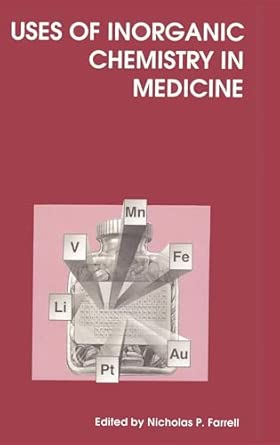
Uses of Inorganic Chemistry in Medicine
Author(s): J H McNeill (Other Contributor)
- Publisher: Royal Society of Chemistry
- Publication Date: 27 May 1999
- Language: English
- Print length: 172 pages
- ISBN-10: 0854044442
- ISBN-13: 9780854044443
Book Description
This book serves to fill an important niche, bridging bioinorganic and medicinal chemistry and will be an invaluable asset for many in the discipline.
Editorial Reviews
Review
“… an excellent volume for inspiring research students …”– “Applied Organometallic Chemistry, 14, 281-285, 2000”
“This hard-backed book is well-produced and well-referenced and is likely to be widely used by advanced undergraduates and graduate research students, hopefully not just chemists but biochemists and pharmacologists too.”– “The Alchemist – ChemWeb Website Oct 1999”
From the Back Cover
Excerpt. © Reprinted by permission. All rights reserved.
Uses of Inorganic Chemistry in Medicine
By Nicholas P. Farrell
The Royal Society of Chemistry
Copyright © 1999 The Royal Society of Chemistry
All rights reserved.
ISBN: 978-0-85404-444-3
Contents
Chapter 1 Overview Nicholas P. Farrell, 1,
Chapter 2 Biomedical Uses of Lithium Nicholas J. Birch, 11,
Chapter 3 Gold Complexes with Anti-arthritic, Anti-tumour and Anti-HIV Activity C. Frank Shaw III, 26,
Chapter 4 Nitric Oxide in Physiology and Medicine Anthony R. Butler and Peter S. Rhodes, 58,
Chapter 5 Therapeutic Aspects of Manganese(II)-based Superoxide Dismutase Mimics Randy H. Weiss and Dennis P. Riley, 77,
Chapter 6 Vanadium Compounds as Possible Insulin Modifiers Chris Orvig, Katherine H. Thompson, Margaret C. Cam and John H. McNeil, 93,
Chapter 7 Cisplatin-based Anticancer Agents Lloyd R. Kelland, 109,
Chapter 8 Dinuclear and Trinuclear Platinum Anticancer Agents Nicholas Farrell and Silvano Spinelli, 124,
Chapter 9 Oxidation Damage by Bleomycin, Adriamycin and Other Cytotoxic Agents That Require Iron or Copper David H. Petering, Jun Xiao, Sreedevi Nyayapati, Patricia Fulmer and William E. Antholine, 135,
Subject Index, 158,
CHAPTER 1
Overview
NICHOLAS P. FARRELL
Department of Chemistry, Virginia Commonwealth University, 1001 W. Main Street, Richmond, VA 23284, USA
1 Introduction
The field of inorganic chemistry in medicine may usefully be divided into two main categories – drugs which target metal ions in some form, whether free or protein-bound, and secondly, metal-based drugs where the central metal ion is usually the key feature of the mechanism of action. Metal-based drugs are a commercially important sector of the pharmaceutical business. Applications continue to grow and approaches to further clinically useful agents are ever more sophisticated. How to approach this field from a didactic and systematic manner, rather than a simple listing of clinical and potential uses, is a challenge. Nevertheless, it is important to attempt to do so to harness the diversity of inorganic chemistry to systematic developments in medicine.
Any consideration therefore of the uses of inorganic chemistry in medicine must bridge at least two areas – bioinorganic chemistry and medicinal chemistry. Bioinorganic chemistry is best considered as understanding all aspects of the role of metal ions in biology and has been traditionally heavily involved in understanding their processing, incorporation into protein and the nature and function of metalloproteins. In a ‘steady-state’ environment all essential metals are incorporated in the right place at the right time and the organism functions normally. Alternatively, genetic factors may lead to failure to incorporate and subsequent metabolic disorders may be caused by free metal ions. Advances in our understanding of how cells process metals and the genetic basis of disease is naturally expanding the traditional directions of bioinorganic chemistry toward an appreciation of its medical importance – especially with respect to the role of metalloproteins in human health and disease. Medicinal chemistry requires intimate knowledge of the metabolism and stability, as well as target interactions of the drug. Most mechanistic work is performed in tissue culture or with isolated proteins, DNA and/or RNA. In tissue culture assays to measure the efficacy of a potential drug in inhibiting cell growth, the drug is usually in direct contact with medium throughout the experiment. There is not always a direct extrapolation to the clinically relevant in vivo situation when biodistribution and pharmacokinetics play an increasingly important role in determining drug efficacy. Many compounds with exciting in vitro results have failed to display the same promise in vivo. Nevertheless the mechanistic information of tissue culture experiments is very useful and, aside from target interactions, may also inform on approaches to in vivo efficacy. Finally, medicinal chemistry distinguishes between drugs acting by a pharmacodynamic mechanism and chemotherapeutic drugs. In the former case, the drug action must be rapid and essentially reversible. A patient who submits to an anaesthetic does not expect to be deprived of feeling forever. Further, a graded response is required to balance effects – a drug to reverse a stroke must be aware of the severity of that stroke and concentrations adjusted accordingly. Chemotherapeutic agents on the other hand involve cell killing, an irreversible process.
In this volume we review aspects of the use of inorganic compounds as drugs and chemotherapeutic agents. The status with respect to some known drugs is reviewed as well as introductions to newer drugs of potential clinical significance. We do not intend to be comprehensive but rather present specific case studies for reading. In this introduction we give a broad overview of the area from a didactic point of view. In attempting to do so, four main subdivisions logically present themselves: (i) uses of chelating agents to sequester specific metal ions or metal-loproteins; (ii) inorganic-based drugs acting by a pharmacodynamic mechanism; (iii) inorganic-based chemotherapeutic agents and (iv) inorganic-based imaging agents. The reader is referred to the many comprehensive reviews in both bioinorganic and medicinal chemistry for further reading.
2 Metal Ions in Disease. The Use of Chelating Agents
It is well understood that many metals are essential for the human organism and endogenous concentrations are tabulated in most bioinorganic chemistry textbooks. However, a corollary of this situation is that uncontrolled mobilization may lead to the presence of excess free metal ion, with subsequent health problems. The classic examples are those of iron and copper overload. Wilson’s disease is an autosomal disorder of copper accumulation, which untreated is inevitably fatal. Alloyed to this is the prospect of disease occurring through adventitious exposure to toxic doses of either essential elements and non-essential elements such as cadmium, mercury and lead. The treatments for copper and iron overload are well documented and a list of clinically used chelating agents is found in most textbooks – typical examples are shown in Figure 1. Their chemistry and toxicology is also very well documented. A major consideration for the improvement of chelating agents is of course that of metal ion selectivity – few chelating agents can be stated to be specific for simply one metal ion.
Metalloproteins as Drug Targets
A more recent and related question to the specificity of chelating agents is that of metalloprotein targets. It is not surprising that many metalloproteins and metalloenzymes play vital metabolic roles as well as being critical in genetic information transfer. Drug design and discovery relies more and more on the elucidation of the three-dimensional structure of a target by X-ray crystallography or nuclear magnetic resonance methods, followed by modelling and synthesis of potential inhibitors of the protein or enzyme active site. Metalloproteins are being increasingly recognized and examined as drug targets. Ribonucleotide reductase, the diiron enzyme essential for de novo synthesis of deoxyribonucleotides for DNA synthesis has long been recognised as a drug target. The pharmaceutical and chemical properties of chelating thiosemicarbazones and their potential interference with the active site iron moieties has been an extensively studied problem.
A current and very relevant example is zinc. Zinc is the second most prominent trace metal in the human body after iron. While deficiency of zinc may cause growth effects, few noxious effects of excess zinc have been observed and zinc per se is probably one of the least toxic metals. Zinc is involved in a large number of enzymatic functions, fulfilling both structural and catalytic roles. These functions include DNA transcription and regulation as well as oxidation and hydrolysis, cleavage of peptide bonds as well as formation of phosphodiester bonds. Because zinc is not redox active its catalytic functions derive from its properties as a Lewis acid. More recently, zinc proteins have been recognised as attractive targets for chemotherapy. Especially, there are two principal areas of interest in pharmaceutical laboratories – inhibition of the matrix metalloproteinase enzymes such as collagenase as an approach to treatment of metastatic cancer and inhibition of zinc finger activity as a novel chemotherapeutic attack against HIV infectivity. These apparently diverse goals are united by the common feature that the active-site zinc is in both cases the target of attack.
Zinc and the Human Immunodeficiency Virus
Zinc Fingers as Medicinal Target
The role of zinc in transfer of genetic information is believed to be structural, deriving from the specific conformations proteins adapt upon complexation by the metal. Many transcription factors (required for RNA transcription) contain zinc. The existence of metal-binding domains in regulatory proteins was first postulated because researchers noted that the systematic repeats of cysteine and histidine residues in X3-Cys-X4-4-Cys-X12-His-X3-4-His-X4 suggested a role for metal-binding. 9 Model building suggested that zinc binding to His and Cys folded the protein into a conformation, which repeated looked like ‘fingers’. X-ray crystallographic evidence has now been obtained for such structures.
The human immunodeficiency virus type 1 (HIV-1) is the etiologic agent of acquired immune deficiency syndrome (AIDS). Effective therapies for AIDS are still urgently required, despite the intense efforts and screening of nearly 220,000 natural and synthetic agents during the last fifteen years. Currently, combination therapy using especially purine and pyrimidine analogs such as ddC, ddI and AZT in conjunction with protease inhibitors is a very promising approach to achieve permanent therapeutic effects. Part of the rationale behind combination therapy has been to use drugs which act on different parts of the viral cycle, thus limiting development of resistance. However, new effective therapies producing long-lasting permanent effects against HIV infectivity are still urgently needed. As such, new targets within the viral cycle need to be identified and understood on a molecular basis to allow development of drug design strategies.
A relatively recent target for drug design has been the zinc fingers of the nucleocapsid protein. A principal approach has been to design chelating agents such as dithiobisbenzamides (DIBAs; Figure 2), which chemically modify the zinc finger cysteine residues resulting in zinc ejection from the fingers with resultant inhibition of HIV replication. While these results are highly promising, they are not optimal as yet but serve as a basis for further rational target-based drug design.
Matrix Metalloproteinases (MMPs)
Matrix metalloproteinases are involved in extracellular matrix degradation during cell migration. Normal processes include wound healing, bone remodeling and embryo development. All these functions are highly regulated. The MMP activity is inhibited in normal tissue by endogenous tissue inhibitors of metalloproteinases (TIMPs). Abnormal regulation (elevated peptidase activity) occurs in rheumatoid arthritis and invasion and metastasis of neoplastic cells. The MMPs cleave one or more components of the extracellular matrix – for example collagenase cleaves a specific glycine-leucine bond in collagen. The role of matrix metalloproteinases in metastasis has sparked intense interest as a target of chemotherapeutic intervention – very briefly, inhibition of the abnormal regulation of MMPs would in principle retard or eliminate metastasis. The medicinal approach to drug development is to develop as inhibitors substrate analogs which will competitively bind to the zinc active site. The first drug to enter clinical trials from this approach is batimastat (Figure 3). This area is a very active one in drug development and almost all pharmaceutical companies have drug development programs. The coming years should see significant advances in drug efficacy and the validation of this approach.
Thus, even in consideration of chelating agents we see that detailed knowledge of metalloprotein structure leads to new approaches to specific chelating agents. Indeed a most interesting case is posed by approaches to attacking zinc-finger sites with metal-based compounds such as authiomalate. In this approach the cysteines of the zinc fingers are the specific targets and metal-ligand replacement is a viable goal.
3 Modulation of Cellular Responses by Metal-containing Drugs
Inorganic drugs may be recognised as acting through a pharmacodynamic mechanism – modulating cellular responses. Clinically used examples discussed in this volume are Li2CO3 (Chapter 2) and gold-based antiarthritic drugs (Chapter 3). The further potential for gold-based chemotherapeutic agents is summarized in Dr Shaw’s contribution. Since the recognition of the messenger role of the small inorganic molecule NO in the early 1990s, a significant body of data has been accumulated (Chapter 4). From the perspective of inorganic drugs in medicine, the understanding of the importance of NO also made clear how the vasodilating properties of nitroprusside are manifested – through release of NO. Sodium nitroprusside is used in cases of severe heart failure and is a short-acting hypotensive drug with a duration lasting 1-10 minutes. This consideration is an excellent example of the difference between pharmacodynamic and chemotherapeutic drugs. Interesting developments may be expected as inorganic chemists design newer M-NO molecules with appropriate release rates as well as molecules which may scavenge endogenous NO or its potentially damaging oxidation products such as peroxynitrite. Chapters 5 and 6 introduce two exciting and potentially significant advances in the stable of metal-based drugs – manganese-based superoxide dismutase mimics (Chapter 5) and vanadium-based insulin mimetics (Chapter 6).
4 Metal-based Chemotherapeutic Drugs
Chemotherapy is the use of drugs to injure an invading organism without injury to the host. This definition therefore covers the antibacterial, antiviral and anticancer agents. In the first two, the invading organism is clearly distinct from the host. In the case of cancer, a family of diseases characterized by uncontrolled cellular proliferation, the organism is strictly not different but the treatment has a common aim, that of elimination of the unwanted cells. Thus, chemotherapeutic drugs, in contrast to pharmacodynamic drugs, must induce an irreversible cytotoxic effect.
By far the greatest success of inorganic chemotherapy is the advent of cisplatin and carboplatin into the clinic. The current status is outlined in Chapter 7 by Kelland. In the platinum field, the strict reliance on analog development based on the cisplatin structure has produced many promising compounds but, again, few are likely to advance to full clinical use. All direct structural analogs of cisplatin produce a very similar array of adducts on target DNA and it is therefore not surprising that they induce similar biological consequences. This latter consideration led us to formulate the hypothesis that development of platinum compounds structurally dissimilar to cisplatin may, by virtue of formation of different types of Pt-DNA adducts, lead to compounds with a spectrum of clinical activity genuinely complementary to the parent drug. We considered that future discovery of clinically useful platinum agents was likely to arise with ‘non-classical’ structures. This has been successful to the point that, at time of writing, a novel trinuclear platinum agent has just entered clinical trials. Chapter 8 summarizes the chemical and biological activity of this important new agent.
Will clinical success in the treatment of cancer be limited to platinum-containing drugs? The discovery of the anticancer activity of cisplatin sparked intense interest and research to find other metal-containing anticancer agents. This effort has been well documented and there are now many distinct classes of metal-based drugs with antitumour activity in experimental models. Unfortunately, none has as yet achieved full clinical use, let alone the status of cisplatin. Another possibly exciting development is the recognition of certain ruthenium compounds as metastatic poisons rather than cytotoxic agents. Finally the natural product bleomycin is always classified as an inorganic-based drug through the imputed DNA strand breakage mechanism facilitated by oxygen radical production on iron. The chemistry and biology are covered in Chapter 9.
Many common antibacterial agents are silver- and mercury-based – such as silver sulfadiazene and mercurochrome. Their uses and purported mechanisms have been summarized in a previous monograph 22 and will not be presented in great length in this volume.
5 Metal Complexes as Diagnostic Agents
A further subset of inorganic drugs in medicine is comprised of diagnostic agents. In this application, no pharmacodynamic or chemotherapeutic end is desired. Rather, imaging of tissue is achieved. The two principal sets are technetium-based imaging agents and paramagnetic MRI contrast agents. The considerations for clinical development of imaging and contrast agents are somewhat similar to those for drugs – stability and water solubility are paramount. The considerations for stability are important to maintain specific tissue imaging and safety. Clearly, the agent must be relatively unreactive and not be rapidly metabolized or degraded. Finally, clearance of the agent must also be relatively rapid. Clinical experience with both gadolinium and technetium agents is summarized in appropriate pharamceutical reference books.
(Continues…)Excerpted from Uses of Inorganic Chemistry in Medicine by Nicholas P. Farrell. Copyright © 1999 The Royal Society of Chemistry. Excerpted by permission of The Royal Society of Chemistry.
All rights reserved. No part of this excerpt may be reproduced or reprinted without permission in writing from the publisher.
Excerpts are provided by Dial-A-Book Inc. solely for the personal use of visitors to this web site.