 Wow! eBook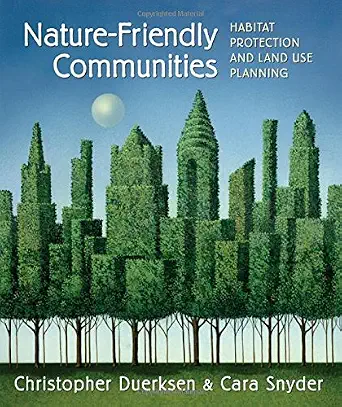
Nature-Friendly Communities: Habitat Protection And Land Use Planning
Author(s): Chris Duerksen (Author), Cara Snyder (Author)
- Publisher: Island Press
- Publication Date: May 10, 2005
- Edition: Illustrated
- Language: English
- Print length: 421 pages
- ISBN-10: 1559638656
- ISBN-13: 9781559638654
Book Description
Nature-Friendly Communities presents an authoritative and readable overview of the successful approaches to protecting biodiversity and natural areas in America’s growing communities. Addressing the crucial issues of sprawl, open space, and political realities, Chris Duerksen and Cara Snyder explain the most effective steps that communities can take to protect nature.
The book: documents the broad range of benefits, including economic impacts, resulting from comprehensive biodiversity protection efforts; identifies and disseminates information on replicable best community practices; establishes benchmarks for evaluating community biodiversity protection programs.
Nine comprehensive case studies of communities explain how nature protection programs have been implemented. From Austin and Baltimore to Tucson and Minneapolis, the authors explore how different cities and counties have taken bold steps to successfully protect natural areas. Examining program structure and administration, land acquisition strategies and sources of funding, habitat restoration programs, social impacts, education efforts, and overall results, these case studies lay out perfect examples that other communities can easily follow. Among the case study sites are Sanibel Island, Florida; Austin, Texas; Baltimore County, Maryland; Charlotte Harbor, Florida; and Teton County, Wyoming.
Nature-Friendly Communities offers a useful overview of the increasing number of communities that have established successful nature protection programs and the significant benefits those programs provide. It is an important new work for public officials, community activists, and anyone concerned with understanding or implementing local or regional biodiversity protection efforts.
Editorial Reviews
About the Author
Cara Snyder is an independent consultant and writer; she was formerly an associate with Clarion Associates.
Excerpt. © Reprinted by permission. All rights reserved.
Nature-Friendly Communities
Habitat Protection and Land Use
By Christopher Duerksen, Cara Snyder
ISLAND PRESS
Copyright © 2005 Island Press
All rights reserved.
ISBN: 978-1-55963-865-4
Contents
About Island Press,
Title Page,
Copyright Page,
ACKNOWLEDGMENTS,
INTRODUCTION,
CHAPTER 1 – The Benefits of Nature Protection,
CHAPTER 2 – Key Program Elements and Best Tools,
MAJOR CASE STUDIES,
CHAPTER 3 – Austin, Texas: Two for the Price of One—Protecting Water Quality and Habitat Through Land Acquisition,
CHAPTER 4 – Baltimore County, Maryland: Using the Entire Toolkit for Habitat Protection,
CHAPTER 5 – Dane County, Wisconsin: Stopping Sprawl and Promoting Infill,
CHAPTER 6 – Eugene, Oregon: Shining Star of Wetlands Preservation,
CHAPTER 7 – Fort Collins and Larimer County, Colorado: A Tale of Two Jurisdictions,
CHAPTER 8 – Pima County, Arizona: Planning for and Investing in Habitat Protection,
CHAPTER 9 – Placer County, California: Leaving a Legacy,
CHAPTER 10 – Sanibel, Florida: Do Enjoy, Don’t Destroy,
CHAPTER 11 – Twin Cities Region, Minnesota: Toward Regional Habitat Protection,
FOCUSED CASE STUDIES,
CHAPTER 12 – Bath Township, Ohio: Riparian Overlay District,
CHAPTER 13 – Charlotte Harbor, Florida: Ambitious Regional Critical Area Protection Program,
CHAPTER 14 – Chicago Wilderness: Biodiversity Recovery Plan,
CHAPTER 15 – DeKalb County, Georgia: Greenspace Program,
CHAPTER 16 – Farmington Valley, Connecticut: A Valley’s Biodiversity Project,
CHAPTER 17 – King County, Washington: Benchmark Program,
CHAPTER 18 – Pittsford, New York: Greenprint for a Town’s Future,
CHAPTER 19 – Powell County, Montana: Rural County Wildlife Protection,
CHAPTER 20 – Teton County, Wyoming: Natural Resource Overlay District,
CHAPTER 21 – Traverse Bay Area, Michigan: New Designs for Growth,
CHAPTER 22 – Loudoun County, Virginia: Green Infrastructure Meets Green Money,
Conclusion,
INDEX,
CHAPTER 1
The Benefits of Nature Protection
Why would a community, especially elected officials, want to protect nature and natural resources? In these economic times, local governments find it difficult to make ends meet and to avoid budget overruns, much less provide more of what might be seen as a luxury to some people. However, along with the myriad intrinsic values people often place on nature, there are a host of economically important reasons for protecting natural resources and biodiversity. This chapter focuses on these benefits. Some are readily measured and well established, while the merits of others are just beginning to be recognized. Altogether, evidence continues to mount that protecting nature and promoting biodiversity make not just good sense but good dollars and cents.
For local or regional governments to seriously consider protecting nature, the bottom line must be considered. Will the costs outweigh the benefits? Can the community afford the investment? The short answer is that each community has a different set of circumstances, and ideally each community would evaluate its own overall goals, its economic realities, and its valuable characteristics. Some specific tools are available to evaluate a community’s economic situation and to gauge the benefits of nature protection programs to the community.
Often, protecting nature is an obvious good investment. Resort communities have known this for a long time. If you protect nature, more tourists will want to visit, stay longer, and spend more. Although many resort areas draw on public land outside their community’s boundaries, it can make financial sense to protect critical areas on private lands and ensure that visitors have a positive experience with nature within the local government boundaries as well. Of course, wildlife don’t read maps—they wander in and out of public lands. But what about the majority of communities around the nation that are non-resort communities? Even then, there are many economically compelling reasons for protecting nature.
Some examples of protecting nature as a good investment—to be discussed in more detail in this chapter—include lower infrastructure service costs, benefits of green infrastructure, and increased property values. Studies of costs of facilities and infrastructure such as roads, schools, water/sewer, and emergency services have repeatedly shown that preserving open space can be more cost-effective than building a residential development on the same property. Recent experience has shown that the value of services provided by green infrastructure, such as stormwater filtration, may far outweigh the value of developing the land. Just as important, there is increasing proof that protecting natural resources is a vital factor in attracting and retaining businesses and jobs.
Americans have demonstrated that they endorse and will pay for protecting natural resources. There has been strong support for preservation of open space and habitat from voters nationwide as well as in surveys of the general public. We will delve into these topics more closely in the following pages, to remind communities why protecting nature is good for business and local economies and to give local officials the ammunition they need to make the case in persuading their colleagues and citizens to adopt effective protection strategies.
An initial decision and action to protect habitat may need to be followed by planning for future pressures on the protected area. When communities successfully preserve natural areas, that very success can increase the use of those areas, and degradation may become a pressing issue. Having mechanisms in place to prevent killing the golden goose can be just as vital as protecting the resource in the first place.
A final note: Although we focus here on the aspects of protecting nature that are most suited to quantification, as Pittsburgh mayor Tom Murphy observed at the 1999 symposium of the City Parks Forum, “Parks and many cultural events should not be forced into this kind of economic analysis mold but should have value for their own purpose.” Natural areas have many undefinable benefits, and so protection efforts may lose out to more quantifiable services like highways and schools, but that does not mean communities should not value and protect natural areas.
Positive Economic Benefits
Growing evidence illustrates that nature-friendly communities can realize substantial economic benefits. From attracting and retaining employers and employees to bringing in potentially millions of tourist dollars, an investment in nature can provide measurable payoffs in the short and long term. The beauty of investing in biodiversity protection is that it provides long-lasting benefits and returns—it is not just a one-shot deal.
Attracting Businesses/Capital Investment
Study after study documents that preservation of natural resources and provision of open space are important factors in helping a region to retain existing jobs and businesses and to attract new ones. Quality-of-life matters and natural amenities are high on the list of quality-of-life ingredients. For example, the Center for the Continuing Study of the California Economy found that conservation of open space was critical for ensuring a higher quality of life, which the center documents as one of the most important components for attracting employers and employees to California communities.
Although quality of life is valuable in both rural and urban areas, the type of employers and their priorities may be slightly different in each area. Urban areas tend to draw more of the larger or high-tech companies, while rural areas tend to see more growth in small businesses.
Urban Areas
Today, there are more fast-growing entrepreneurial companies, more telecommuters, and less economic stability than in previous eras. The marketplace is global, and technology is key. Despite the failure of many dot-com start-up companies in 2000–2002, information technology is here to stay. This is the “new economy,” and there are implications for communities wishing to attract employers and employees alike, especially when it comes to quality of life.
High-technology companies treasure natural amenities and in national and local surveys have rated environmental quality ahead of housing costs, cost of living, commuting patterns, schools, climate, government services, and public safety in making location decisions. As Bill Calder, a spokesperson for computer chip manufacturer Intel, told the New York Times in the late 1990s, “Companies that can locate anywhere will go where they can attract good people in good places.” Many of the “good people” are creative, educated high-technology workers. And, increasingly, the “good places” are those that value and protect natural resources and open space, because those are the places where high-technology workers want to live.
A survey of more than 1,200 young high-technology workers found that “community quality of life” was the second most important factor in evaluating jobs after salary considerations, and more important than benefits, stock options, or company stability. Focus groups further revealed that young high-technology workers wanted easy access to a wide range of outdoor activities and a clean, healthy environment with a commitment to preserving natural resources for enjoyment and recreation. A vibrant music and performance scene with a wide range of live music opportunities and a wide range of nightlife experiences were also part of the perceived quality of life.
Rural Areas
In rural America the situation is slightly different. Small businesses are even more crucial to rural economies. A 2003 study in the Greater Yellowstone region showed much higher growth rates in small businesses than in any other group—there were 2,781 new firms with fewer than five employees in the previous ten years. Nationally, small businesses create more jobs than large businesses. The types of small businesses vary from the low-wage service and trade sectors to high-end service providers in real estate and finance. Preferences of small companies and their employees are thus a critical economic fact of life, and they place a high value on open space.
In one study, companies with fewer than 8 employees rated “quality of life” as their number one concern, while companies with more than 88 employees chose operating costs. “Recreation/parks/open space” was the top quality-of-life element preferred by the small companies, with cost of living/housing a close second. Similarly, the results of a survey of 500 businesses in the Greater Yellowstone area—largely rural—showed that amenities like parks, trails, and rivers were relatively more important than traditional profit-maximizing reasons, both as a draw for new businesses that relocated to the area and as a magnet for retaining existing businesses. Yet another study asked participants to rate the relative importance of 15 business location variables; the results showed the highest-ranking variable to be “scenic beauty,” followed by “quality environment.”
Oakhurst is a small California tourist town near Yosemite National Park that began attracting small high-tech companies in the 1990s. Mike Jones, a Seattle native who moved to Oakhurst to work for a computer game company, pointed out in 1998: “I’ve had offers to go elsewhere and work for a lot more money, but I’d rather be in Oakhurst. The property values are good, people are nice, and this [rolling Sierra Nevada foothills] is what you see from the window!” Proximity to natural areas can play a critical role in attracting and keeping employees and contributes to a new theory of economic development that considers “migration first, then jobs” as a basis, instead of the previous “jobs first, then migration.”
Of course, rural communities should recognize that while natural amenities are a key ingredient, they will not guarantee economic growth by themselves. Although economic growth has been linked positively to the amount of protected land in an area, other factors are also critical in attracting and keeping businesses. Having a nearby airport, an educated workforce, and a local college or university were the top three other factors found by the Sonoran Institute in their studies.
Still, as discussed previously, there is no denying the growing link between economic development and natural area protection in rural America.
Direct Economic Activity
From the most remote rural towns to the most dense urban areas, nature attracts visitors. Humans cannot resist being in and near nature, delighting in it. And when Americans visit, they spend money. The burgeoning economic impacts of tourism and outdoor recreation (such as mountain biking, skiing, hiking, fishing, or birdwatching) are impressive.
Tourism Dollars Nationwide
Tourism is the largest sector of the nation’s economy. The U.S. travel industry received more than $545 billion in 2002 from domestic and international travelers, which generated about 7 million jobs. Evidence shows that nature and open space are a key to those big numbers: A 1998 survey revealed that an impressive 48 percent of mainland U.S. residents participated in nature-based activities on their last vacation.
Visitors to natural areas can be locals taking a day trip to a nearby park or tourists flying in from far away to enjoy a week’s vacation; they both bring much-needed dollars into the local economy. People living adjacent to a natural area may not even have to leave their homes to enjoy nature but may still purchase outdoor equipment such as binoculars or walking shoes. No matter what type of activity, money spent on recreation associated with wildlife and nature can have a tremendous impact. According to a U.S. Fish and Wildlife Service survey, nationwide, more than 82 million U.S. residents fished, hunted, and watched wildlife in 2001, spending over $108 billion on equipment and trips associated with those activities. The same study documented annual national expenditures amounting to $40 billion associated with wildlife watching alone. Interestingly, the study used a very strict definition of wildlife watching: participants must either take a “special interest” in wildlife around their homes or take a trip for the “primary purpose” of wildlife watching. In another arena, about 147 million people in 2002 participated in outdoor recreation such as hiking and bicycling. That number represents about 67 percent of the nation’s population! Corresponding sales for the outdoor recreation industry (specifically, human-powered recreation) were about $18 billion in 2001.
Local Examples
Looking beyond the big national numbers is instructive. Local economies can benefit in several ways from tourism and outdoor recreation associated with natural areas, open space, and wildlife. Direct expenditures can include durable goods such as outdoor equipment, as well as nondurable goods like food, beverages, and gas for the car. Indirect impacts may include the creation of jobs in nearby businesses owing to increased visitor activity and other trickledown effects of having more money in the economy, and can be calculated and quantified using economic multipliers. (Multipliers are tools commonly accepted and widely used by economists to estimate how much indirect economic activity is generated by the original expenditure. For example, a tourist may purchase a sandwich—a direct impact—but the purchases made by the restaurant to locally produce the sandwich are indirect impacts.) The economic benefits of protected natural areas can seem too numerous to count.
However, these benefits can be counted, and many studies document the local impact of nature-based tourism. For example, the cumulative total economic impact of birding along the Platte River in Nebraska in 1998 ranged between $21.8 and $48.5 million, with the average visitor contributing from $1,276 to $1,814 per year to the Nebraska economy. The East Bay Regional Park District, which operates over 91,000 acres of park lands near San Francisco, undertook an economic evaluation in 2000. The study showed that total expenditures on all goods in the East Bay were $74 million higher per year because of the presence of these lands; when multiplier effects were taken into account, the total economic impact was $148 million per year. Another study revealed that the economic impact of wildlife-related recreation on a four-county region in northeastern Florida (Clay, Duval, St. Johns, and Putnam counties) was close to 10,000 jobs and over $500 million dollars in 2000. Near Dayton, Ohio, an estimated 150,000 people per year visit the Little Miami Scenic Trail and spend an average of $13.54 each per visit just on food, beverages, and transportation to the trail. They also spend about $277 per person per year on clothing, equipment, and accessories related to trail use. Nature-based tourism in the Sierra Vista, Arizona, area (southeast of Tucson), especially visitors to Ramsey Canyon, in one year generated $1 million in value-added activity.
Having such local data can help sell a nature protection program, and an expanding number of local governments and nonprofit organizations are undertaking targeted studies. Box 1.1 briefly summarizes the steps locals can take to carry out their own economic benefits assessment.
(Continues…)Excerpted from Nature-Friendly Communities by Christopher Duerksen, Cara Snyder. Copyright © 2005 Island Press. Excerpted by permission of ISLAND PRESS.
All rights reserved. No part of this excerpt may be reproduced or reprinted without permission in writing from the publisher.
Excerpts are provided by Dial-A-Book Inc. solely for the personal use of visitors to this web site.


