 Wow! eBook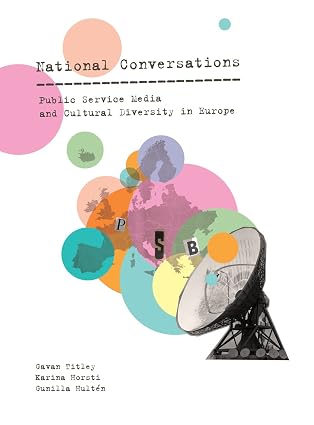
National Conversations: Public Service Media and Cultural Diversity in Europe
Author(s): Gavan Titley (Editor), Karina Horsti (Editor), Gunilla Hultén (Editor)
- Publisher: Intellect Ltd
- Publication Date: July 15, 2014
- Edition: Illustrated
- Language: English
- Print length: 200 pages
- ISBN-10: 1783201754
- ISBN-13: 9781783201754
Book Description
Editorial Reviews
About the Author
Excerpt. © Reprinted by permission. All rights reserved.
National Conversations: Public Service Media and Cultural Diversity
By Karina Horsti, Gunilla Hultèn, Gavan Titley
Intellect Ltd
Copyright © 2014 Intellect Ltd
All rights reserved.
ISBN: 978-1-78320-175-4
Contents
Acknowledgements,
Introduction: National Conversations: Public Service Media and Cultural Diversity in Europe Karina Horsti, Gunilla Hultén and Gavan Titley,
Section 1: The Rise of Diversity and Transition to Public Service Media: Complementary Perspectives,
Chapter 1: Diversity, Broadcasting and the Politics of Representation Sarita Malik (Brunel University),
Chapter 2: The Cultural Diversity Turn: Policies, Politics and Influences at the European Level Karina Horsti (University of Jyväskylä),
Chapter 3: Public Service Media and Cultural Diversity: European Regulatory and Governance Frameworks Tarlach McGonagle (University of Amsterdam),
Section 2: Policies, Practices and Future Directions: National Case Studies,
Chapter 4: Between Diversity and Pluriformity: The ‘New Style’ of Dutch Broadcasting Isabel Awad and Jiska Engelbert (Erasmus University, Rotterdam),
Chapter 5: Struggling With Multiculturalism? Cultural Diversity in Flemish Public Broadcasting Policies and Programmes Alexander Dhoest (University of Antwerp),
Chapter 6: Ireland, the ‘Migration Nation’: Public Service Media Responses Between Discourse and Desire Gavan Titley (National University of Ireland, Maynooth),
Chapter 7: A Vulnerable Diversity: Diversity Policies in Swedish Public Service Media Gunilla Hultén (Stockholm University),
Chapter 8: The Politics of a Multicultural Mission: Finland’s YLE in a Changing Society Karina Horsti (University of Jyväskylä),
Chapter 9: The Multicultural Mission in Public Service Broadcasting: The Case of Norway Gunn Bjørnsen (Volda University College),
Chapter 10: Estonian Broadcasting and the Russian Language: Trends and Media Policy Andreas Jõesaar and Salme Rannu (Tartu University),
Afterword: ‘And That’s Goodnight From Us’: Cultural Diversity and its Challenges for Public Service Media Andrew Jakubowicz (University of Technology, Sydney),
Index,
CHAPTER 1
Diversity, Broadcasting and the Politics of Representation
Sarita Malik (Brunel University)
Introduction
This chapter addresses issues of representation raised by the shifting emphases on how multiculture should be mediated in contemporary Europe. It foregrounds questions of representation, as a key concept in cultural and media studies, in order to offer a critical overview of the relationship between public service broadcasting, cultural diversity and European societies. One of the main objectives is to consider how lived multiculture is managed and mediated by the broadcasters. Whilst an important dimension of this ‘management’ is around the area of audio-visual policy frameworks (the dominant approach in current work around diversity and public service broadcasting in Europe (Rumphorst 2004; Freedman 2005), there are important issues of representation that do not relate directly to public policy.
So my interest here is with how the thread of representation runs through two, overlapping areas: first, audience representation (which considers the notion of provision, complex audience involvements with mediated communication and the rise of ‘post-national’ diasporic TV); and second, textual representation (the ways in which meanings associated with cultural diversity are made on-screen). A third dimension is involved here: the politics of cultural recognition in public communication (pertaining to the idea of how the ‘public’ of PSB might be defined). Representation is regarded here as a historical, institutional and political process. Media and cultural analysis highlights how, rather than simply reflecting or presenting ‘reality’, the work of representation constructs ‘reality’ and, more than that, serves an important role in how social relations develop and in how ideologies are constructed. The various ‘ways in’ to understanding the meaning of representation, can help us to understand public service broadcasting as a principal signifying system in contemporary society, which actively and continuously depends on the representational process.
The overview presented here considers the broader sociopolitical contexts against which such developments are occurring. Primarily this involves mapping the major European-wide paradigm shift from principles of multiculturalism to social cohesion; and asking what the possible implications are for these various orders of representation – audience developments, textual representations and the politics of cultural recognition. A set of questions begin to emerge here: how have multicultural audiences been implicated in the move away from multiculturalism? What kind of picture of cultural diversity is painted by the public service broadcasters? And what bearing does this have on both the politics of difference and the politics of recognition for Europe’s diasporic groups?
Specifically, the chapter will address issues of ethnic minority representation in relation to broader political and economic developments in public service broadcasting since the 1990s. The specific dimension of cultural diversity that will be reflected on will be ethnic minorities, because their case has been especially caught up in the difficulties currently facing public service broadcasters. The relevance of the ethnic minority case study has a wider significance for what we consider the role of public service to be in a diverse Europe. Other chapters in this book take a range of European countries including Denmark, Estonia, Finland, Ireland, the Netherlands, Sweden and Belgium as their national case studies. Although this is a general, thematic chapter which aims to explore some of the overarching themes related to representation, particular reference will be made to the United Kingdom. The rationale for this is that the United Kingdom has typically been at the vanguard of academic debates around the politics of representation and diversity in contemporary Europe (Cottle 2000; Malik, S. 2002). PSB was pioneered in the United Kingdom in the 1920s and has, since then, operated a particularly strong and globally recognized public service framework. Whilst the UK context is discussed here, many of the issues addressed are common ones that are pertinent to the dilemmas currently being faced by other public service broadcasters across Europe (see Malik 2010). This is not to divert attention from the nuanced and national characteristics of the different European public service broadcasters that are dealt with in other parts of the book.
Running parallel to the intensifying Europe-wide retreat from multiculturalism, ethnic minorities have also altered their response to PSB as a form of media governance. This is currently a scenario which indicates the ‘autonomous’ production and circulation of ‘ethnicized’ representations targeted at distinct ethnic groups led by cable and satellite systems that have what McQuail in his discussion of the principles of media structure, calls a ‘premium on diversity’ (McQuail 2010: 224). The textual representations which are offered by these transnational communication outlets appear to flaunt a more culturally intelligent and nuanced mode of representation and address (for example in terms of language, geographical setting and genre). They may also draw on a more diverse set of editorial practices, values and ideologies (see Creeber 2004). But the seeming diversity in provision also holds no guarantees, either that audiences are in turn getting deeper cultural value or an opportunity to position themselves collectively as national citizens. Indeed, diasporic audiences’ responses to transnational flows of television across national borders appear far from clear-cut (see Aksoy and Robins [2000] for analysis of Turkish audiences’ responses to transnational media in Europe). As we experience the steady erosion of public service broadcasting, this idea of the shared national experience appears to be waning (Tracey 1998).
Mediation of multiculture: A shifting emphasis
Social change and the role of the state in fostering principles of multiculturalism play a significant role in mediated communication, not least in how programme-making and editorial policy is organized in relation to society. Although multiculture is a long-established feature of modern Europe and demographically continues to develop along these lines, multicultural ism is also being actively undermined as a normative principle within political and public discourse. Multiculturalism, defined here as both an ideological principle and a practice of addressing cultural diversity through legislation and cultural and social policies, can be made distinct from cultural diversity which is a fact of all societies. If multicultural describes the nature of a society’s cultural heterogeneity, multiculturalism refers to ‘the strategies and policies adopted to govern or manage the problems of diversity and multiplicity which multi-cultural societies throw up’ (Hall 2000: 210). As Europe’s streets become more culturally diverse, we have witnessed since the late 1990s a critical shift against the idea of multiculturalism (which had publicly redirected the attention away from the evolving anti-racist politics of the 1970s and 1980s). In its place, a centre-left reconstruction of liberal integrationism and assimilationist-style rhetoric has materialized, aspiring towards an ‘absolute citizen’ subject based around integration, shared values and citizenship. Kenan Malik suggests the shift away from multiculturalism and towards ‘a collective language of citizenship’ is important because it
creates a challenge to the politics of identity and a redefinition of social justice and equality: from the right to be treated the same despite one’s cultural and ethnic differences, to the right to be treated differently because of them.
(Malik, K. 2002: 2)
The overtone here is that multiculturalism has gone ‘too far’ and now requires a redefinition in order to deliver genuine social equality. Kenan Malik’s view is reflected in a number of iterative populist European reconstructions which claim that multiculturalism and collective citizenship are incompatible, and renewed public policy concerns around social cohesion. The official turn has been exemplified in, for example, the argument made by Farrukh Dhondy, the UK broadcaster and Channel 4’s former Head of Multicultural Programming (1984–97), against what he termed ‘the multicultural fifth column’ (Dhondy 2001) and in favour of the redirection of state funding towards supporting values of freedom and democracy (see Modood 2007). David Goodhart (2004) has described Britain as ‘too diverse’ and Trevor Phillips (2005), (former Chair of the Commission for Racial Equality and Chair of the Centre for Equality and Human Rights since 2007) has urged that Britain moves on from the old order of 1980s multicultural policy-making in order to avoid ‘sleepwalking our way to segregation’ (Phillips 2005). Although the legacy of pre-existing historical trajectories of ‘racialization’ of belonging in society are apparent (see Malik, S. 2002), these recent reconstructions have tapped into the popular imagination. An alternative and lesser-heard (anti-racist) critique argues that, at worst, multiculturalism has failed to tackle the political realities of racisms (Sivanandan 2006) and, at best, that multicultural policymaking has damaged the race equality agenda.
The media, and especially the right-wing press, has played a formative role in developing and mainstreaming this post-multiculturalist mood with a circuit of headline stories based around ‘home-grown terrorists’, immigrant ‘benefit-cheats’ and ‘political correctness gone mad’. Meanwhile, popular narratives around ‘asylum seekers’, ‘black gun crime’, the ‘clash of civilizations’ and, most of all, ‘the war on terror’, have all framed today’s mainstream media agenda. One of the facets of mainstream attacks on multiculturalism is the emphasis on cultural difference. The major ideological fear stoked here is that cultural (not social, racial or economic) segregation is problematic (or as Phillips put it, that society is ‘becoming more divided by race and religion’ and that we are ‘eyeing each other over the fences of our differences’ [Phillips 2005]). Instances such as rioting in England following the racism habitually directed, not least by the police, at ethnic communities (2001), ‘race riots’ in France (2005), the UK Behzti affair (2004), the Jyllands-Posten Muhammad cartoons controversy (2005), the ongoing ‘veil debate’, the London bombings (2005), the minarets controversy in Switzerland (2009) and the far-right’s evolving integration into mainstream politics (culminating in, for example, the British National Party’s victories at the European elections in 2009), are all examples that have sustained a preoccupation with publicly evaluating the supposed challenges of living with difference. In 2010, the German Chancellor, Angela Merkel stated that ‘the approach [to build] a multicultural [society] and to live side-by-side and to enjoy each other […] has failed, utterly failed’ (Merkel 2010). Subsequently, French Prime Minster Nicolas Sarkozy, on a TF1 French television nationwide broadcast clearly stated that he also considers multiculturalism to be ‘a failure’ (CBN News 2011). In the United Kingdom the current broader political-cultural philosophies around multiculturalism first emerged as part of a broader New Labour politics of citizenship in the 1990s. The UK Prime Minister David Cameron delivered a speech in Munich (2011) where he criticized the ‘doctrine of state multiculturalism’ for encouraging different cultures to live separate lives and suggested, ‘we need a lot less of the passive tolerance of recent years and a much more active, muscular liberalism’ (Cameron 2011). The defence of ‘social cohesion’ has, in practical and rhetorical terms, therefore been mobilized as a populist and popular attack on multiculturalism because of the latter’s supposed ‘tribalism’ and, it is claimed, divisiveness. Such overt condemnations of multiculturalist principles by Merkel, Sarkozy and Cameron would arguably have been inconceivable even a decade before.
The timing of the ‘crisis of multiculturalism’ across Europe is significant. First, it has been utilized to coincide with the rise of a reinvigorated extreme right in Europe. Cameron’s speech, for example, was delivered on the same day as a high-profile English Defence League rally in Luton, England. Both were reported back-to-back in news bulletins during the course of the day. Second, this emergent politics has fed into new exclusionary forms of cultural racism preoccupied with nation, territory and identity. So Cameron’s speech was delivered at the 2011 Munich Security Conference and combined a comment on radicalization and Islamic extremism with one on multiculturalism. The retreat from multiculturalism, intensified since 9/11, has produced a new discourse of global terrorism and a highly-charged political climate wherever it touches on questions of racial and, increasingly, religious difference.
Representations of British Muslims in the media (Poole 2006) which are indicative of these new forms of cultural racism (Modood 2007) predicated on a discursive turn that mediates, in a Gramscian sense, culturally hegemonic, common-sense responses to ‘difference’. And so, it is apparent that contemporary news and documentary editorial directions are increasingly based around these iterative post-multiculturalist themes of the cultural difference of minority lifestyles. When contextualizing media representations, they can be considered as part of a shift from the struggle against racism (apparent for example in the circuit of racialized regimes of representation in the decades spanning the 1950s to the 1980s; see Malik, S. 2002) towards a struggle for religion and culture in contemporary Britain (apparent in representations since the 1990s). For example, the basic media agenda is now less preoccupied with the traditional black versus white diagrammatic seen in earlier sets of race-related reporting than with highlighting discord between those who support a secular state and those who do not. There is a strong pattern of reporting still concerned with issues of race and nation (as in the recent public evaluations of multiculturalism) but overlaid with updated populist narratives conflated with questions of religiosity (‘war on terror’, ‘the enemy within’, ‘freedom of speech’, ‘clash of civilizations’, ‘rise of Islamism’, etc.). The news agenda of the public service broadcasters frequently takes its cue from that of the mainstream press, which plays a major public role in these shifts in orientation and in the processes whereby overlapping public identities are constructed and transformed. Many of those who defend the media’s focus on Islam and Muslims argue that this is in the public interest, but frequently fail to recognize the role that these same representations can play in stoking fear, amplifying risk and perpetuating the fabled horror of certain religious lifestyles. It is against this unsettled context that we will now turn our attention to PSB.
Audience involvements with mediated communication: Diversity within universality
Issues of representation relate to the notion of provision and complex audience involvements with mediated communication. Public service broadcasting, particularly in western Europe, has traditionally been tied to the ideal of national broadcasting, raising particular issues when we complicate the idea of the national. As the founder of the British Broadcasting Corporation (BBC), John Reith, declared in 1924: ‘It is occasionally indicated to us that we are apparently setting out to give the public what we think they need – and not what they want – but few know what they want and very few know what they need (Reith, quoted in Briggs 1961: 238).
(Continues…)Excerpted from National Conversations: Public Service Media and Cultural Diversity by Karina Horsti, Gunilla Hultèn, Gavan Titley. Copyright © 2014 Intellect Ltd. Excerpted by permission of Intellect Ltd.
All rights reserved. No part of this excerpt may be reproduced or reprinted without permission in writing from the publisher.
Excerpts are provided by Dial-A-Book Inc. solely for the personal use of visitors to this web site.


