Wow! eBook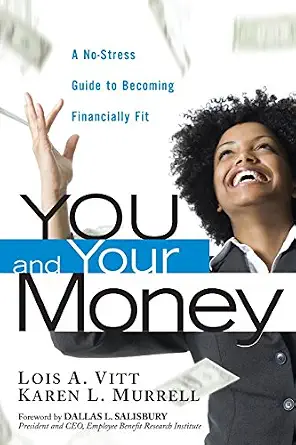
You and Your Money: A No-Stress Guide to Becoming Financially Fit
Author(s): Lois A. Vitt (Author), Karen L. Murrell
- Publisher: Ft Press
- Publication Date: April 3, 2007
- Edition: 1st
- Language: English
- Print length: 338 pages
- ISBN-10: 0131003100
- ISBN-13: 9780131003101
Book Description
Editorial Reviews
Review
Financial educators Vitt and Murrell encourage readers to become proactive and self-informed when it comes to handling their finances. Financial literacy doesn’t require an advanced degree in economics, they write: “Financial decisions are much less about how much money you have in the bank than they are about your values, needs, and wants.” To that end, they give readers a life-values profile to determine the greatest influences on money-management habits. Having identified what motivates you to spend or not spend, they say, allows you to take corrective measures to find a balance. Vitt and Murrell bring an appealingly positive voice to get readers elementally involved in home economics. But even with the help of others, they say, you are still the captain of your financial ship: “Taking responsibility for your financial well-being means setting life priorities and making choices each day in the service of those priorities.” The authors provide specific resources and advice regarding investments, housing, the use of financial professionals and–of vital importance–how to recover from adversity. A financial security blanket. --Kirkus Business and Financial Report
About the Author
LOIS A. VITT is founding director of the Institute for Socio-Financial Studies, and one of the leading U.S. authorities on financial education. Her work has been quoted by Alan Greenspan in testimony before Congress on the state of financial literacy in the United States.
Vitt has directed nationwide studies on financial education in the United States, including Personal Finance and the Rush to Competence: Financial Literacy Education in the U.S. (for the Fannie Mae Foundation); and Goodbye to Complacency: Financial Literacy Education in the U.S. 2000-2005 (for AARP). She is a member of the AARP Business and Aging Education Advisory Board.
KAREN L. MURRELL is president and founder of Higher Heights Consulting and Training and is the creator of several nationally recognized financial education programs. Her company provides financial education services to Fortune 500 companies as well as to private foundations and nonprofit organizations.
Murrell previously held leadership positions at Fannie Mae and the Fannie Mae Foundation where she helped launch initiatives that enabled millions of consumers to become homeowners. She developed financial education publications in nine languages and helped implement a public education advertising campaign in multiple languages. She currently serves as a research fellow at the New America Foundation.
Excerpt. © Reprinted by permission. All rights reserved.
PREFACE
A movement toward increased consumer financial literacy is gathering momentum across communities, schools and colleges, workplaces, faith-based organizations, financial companies, the media, and all levels of government. Its message is clear: The key to success in the twenty-first century is within everyone's grasp if we embrace the concept of personal responsibility. To get ahead, we simply need to take charge of our own financial livelihoods.
Although consumers today have unprecedented access to financial resources through work, news sources, articles and books, seminars, and Internet offerings, there's more to the equation than just information. There are other complexities. More than just receiving information, we also need to understand the general economy, the capital markets, the health care system, and the details in the contracts we sign. If you are confused, you are in good company. Even noted Harvard University law professor and consumer advocate, Elizabeth Warren, complained on national public television that she found it difficult to understand all the fine print in a typical credit card contract.1
Typically, sponsors of financial education and published information believe that when people are given access to financial advice, they will automatically choose to be more prudent in their spending decisions. Financial information alone, it is thought, is enough to motivate people to plan ahead, save for emergencies, invest for future education costs and for retirement, and engage financial service professionals to help navigate the maze of investment choices.
Unfortunately, it isn't that simple. Financial information aloneno matter how skillfully it is presentedoften does not resonate with most people mainly because the information is so voluminous and the changes in society are coming at us so fast that it seems we will never process it all.
The laws of motion as defined by Sir Isaac Newton and the great astronomer Galileo provide a framework for understanding inertia and momentum. Their wisdom indicates that a body at rest will remain at rest until moved by an outside force. The law of motion applied to understanding financial issues and putting them in practicesaving for emergencies, education, home ownership, and retirementsuggests that if people do little to plan for these life events (that is, remain at rest), they will make little headway.2 Some outside force is necessary to provide the push to prepare for future financial security.
Unlike inert objects, however, we humans require some inner spark to generate the momentum that can propel us forward. In other words, the "outside force" of available financial information and education must be met by an "inner desire" to learn and to apply financial concepts. Partially due to how complicated we may think it is and how busy we are and partially due to our "buy now and pay later" culture, that spark may have been dampened. We may have fallen behind the curve of personal financial knowledge.
It doesn't have to remain this way.
As financial education researchers, teachers, and consultants, we've seen how the principles we write about in this book can turn even rank amateurs into competent money managers who enjoy the process of building financial security. You and Your Money combines our insights about today's changing societal realities, the character traits of people who have achieved success, and the financial basics. We show you four steps everyone can take to attain the promises of the New American Dream of the twenty-first century.
The first thing to realize is that we all make money from the inside out! Once we see the possibilities and realize they are within our reach, then we can achieve them. With this in mind, you can change your behaviors and spending and savings patterns and can implement a new strategy that will transform your approach to finances. Your savvy in this critical area can improve the quality of your whole life. You can be more confident about who's in charge of your financial well-being.
You are!
Lois A. Vitt/Karen L. Murrell
Middleburg, VA/Silver Spring, MD
lvitt@isfs.org/kmurrell@higherheightsconsulting.com
© Copyright Pearson Education. All rights reserved.