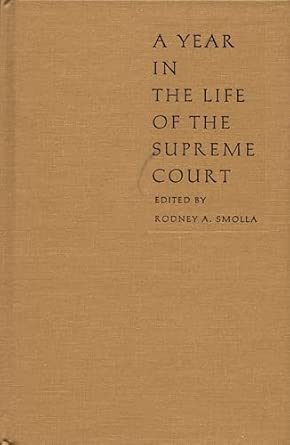
A Year in the Life of the Supreme Court

A Year in the Life of the Supreme Court book cover

A Year in the Life of the Supreme Court

Author(s): Rodney A. Smolla

  • Publisher: Duke University Press
  • Publication Date: 28 July 1995
  • Language: English
  • Print length: 312 pages
  • ISBN-10: 0822316536
  • ISBN-13: 9780822316534

Book Description

Despite its importance to the life of the nation and all its citizens, the Supreme Court remains a mystery to most Americans, its workings widely felt but rarely seen firsthand. In this book, journalists who cover the Court-acting as the eyes and ears of not just the American people, but the Constitution itself-give us a rare close look into its proceedings, the people behind them, and the complex, often fascinating ways in which justice is ultimately served. Their narratives form an intimate account of a year in the life of the Supreme Court.
The cases heard by the Surpreme Court are, first and foremost, disputes involving real people with actual stories. The accidents and twists of circumstance that have brought these people to the last resort of litigation can make for compelling drama. The contributors to this volume bring these dramatic stories to life, using them as a backdrop for the larger issues of law and social policy that constitute the Court’s business: abortion, separation of church and state, freedom of speech, the right of privacy, crime, violence, discrimination, and the death penalty. In the course of these narratives, the authors describe the personalities and jurisprudential leanings of the various Justices, explaining how the interplay of these characters and theories about the Constitution interact to influence the Court’s decisions.
Highly readable and richly informative, this book offers an unusually clear and comprehensive portrait of one of the most influential institutions in modern American life.

Editorial Reviews

Review

“An enlightening series of journalistic snapshots of the Supreme Court by those who portray it best–reporters who have made a specialty of covering the nation’s highest Court.”–Fred Graham, Chief Anchor and Managing Editor, Court TV

From the Back Cover

You don’t have to be a lawyer or a Supreme Court junkie to enjoy this book: it is as good a description–for a general audience as well as a legally trained one–of the real people and cases that come before the Supreme Court as we have ever had. This book is a joy to read.”–Floyd Abrams, Constitutional attorney

About the Author

Rodney A. Smolla is Allen Professor of Law at the School of Law, University of Richmond. His books include Suing the Press, Law of Defamation, Jerry Falwell v. Larry Flynt, Free Speech in an Open Society, Smolla and Nimmer on Freedom of Speech, and Federal Civil Rights Acts.

Excerpt. © Reprinted by permission. All rights reserved.

A Year in the Life of the Supreme Court

By Paul Barrett, Richard Carelli, Marcia Coyle Lyle Denniston, Aaron Epstein, Kay Kindred, Tony Mauro, David Savage, Stephen Wermiel, Rodney A. Smolla

Duke University Press

Copyright © 1995 Duke University Press
All rights reserved.
ISBN: 978-0-8223-1653-4

Contents

CHAPTER ONE Introduction: Personality and Process,
CHAPTER TWO A Case of Old Age,
CHAPTER THREE The Defining Moments of Jayne Bray … and Justice Blackmun,
CHAPTER FOUR A Search on the Street,
CHAPTER FIVE The Interpreter and the Establishment Clause,
CHAPTER SIX A Question of Innocence,
CHAPTER SEVEN Hate Speech, Hate Crimes, and the First Amendment,
CHAPTER EIGHT Civil Rights and Higher Education,
CHAPTER NINE A Claim of Sexual Harassment,
CHAPTER TEN The Supreme Court and the Cult of Secrecy,
APPENDIX The Justices of the Supreme Court of the United States, 1992–93,
Biographies of the Contributors,
TABLE OF CASES,


CHAPTER 1

Introduction: Personality and Process

RODNEY A. SMOLLA

The Reporters


This book, by Paul Barrett, Richard Carelli, Marcia Coyle, Lyle Denniston, Aaron Epstein, Kay Kindred, Tony Mauro, David Savage, and Stephen Wermiel, profiles a year, 1992–93, in the life of the Supreme Court of the United States. Included among these contributors are many of the most significant “Court watchers” in the nation, journalists who have made observing and reporting on the Court their lives’ avocation. Chances are, indeed, that the reports of writers who cover the Court for the nation’s major news organizations are the source of much of the information most Americans have on the decisions of the Court over the years. Outside a relatively small group of lawyers, judges, students, and academics, few Americans ever have the opportunity to observe a Supreme Court argument, or take the time actually to read the text of a Supreme Court opinion. Journalists are the eyes and ears of the American people on the actions of the Supreme Court, and in that sense, are the eyes and ears of the people on the Constitution itself.


The Stories of Real People

This book is intended to give readers a sense of the richness of Supreme Court litigation. The cases heard by the Court are, first and foremost, cases, disputes involving real people with real stories. The accidents and twists of circumstance that propelled their lives into the rarefied arena of the Supreme Court are often compelling drama.

Walter Biggins just wanted “a damn raise.” Thomas and Robert Hazen, who employed Biggins in their family-owned business in Holyoke, Massachusetts, did not think Biggins deserved as big a raise as he wanted, and as negotiations embittered, relations deteriorated. Biggins was fired. He sued. His suit reached the Supreme Court.

Jayne Bray, a homemaker from Bowie, Maryland, just wanted to register her moral outrage at abortion. She participated in an abortion clinic blockade as part of the civil disobedience efforts of Operation Rescue, one of the nation’s most vocal and aggressive anti-abortion groups. The National Organization for Women simply wanted peace for abortion clinics, for doctors who provide abortions, and for women who attend such clinics to exercise their recognized constitutional right of privacy to obtain abortions. It sponsored a lawsuit against Operation Rescue and Jayne Bray, claiming that their aggressive protest tactics violated the civil rights of women attending abortion clinics. The suit reached the Supreme Court.

Tim Dickerson was twenty-three, and had never been in trouble with the law. But one day, two seasoned police officers, Vernon Rose and Bruce Johnson, spotted Dickerson walking down the street in Minneapolis, and thought he looked suspicious. The officers stopped Dickerson and subjected him to a pat-down. Officer Rose says he felt what seemed to be “a lump of crack cocaine in cellophane” in the front pocket of Dickerson’s nylon jacket. It turned out to be one-fifth of a gram of cocaine. Dickerson claimed that the officers had no right to stop him and search him and that his conviction for cocaine possession should be overturned. He brought his case to the Supreme Court.

James Zobrest, a teenager who had been deaf since infancy, wanted to attend Salpointe Catholic High School in Tucson. He and his parents wanted the public school district to pay the costs of a sign language interpreter, just as the school district would pay if James had gone to the public high school. They sued the school district; the case found its way to the Supreme Court.

Leonel Herrera claimed he was an innocent man. Herrera was convicted by the state of Texas of killing a cop, he claimed that the state got the wrong man and that he deserved a new trial to attempt to prove that. But Herrera was sentenced to death by the state of Texas, and all his normal avenues of appeal and redress had run out. He wanted the federal courts to intervene and filed a federal writ of habeas corpus, claiming that it would violate the United States Constitution to execute an innocent man. With his life hanging in the balance, hours before the scheduled execution, his case was brought to the Supreme Court.

In St. Paul, Minnesota, Russ and Laura Jones were finding it difficult to make peace with their neighbors. Russ and Laura, African Americans, had moved with five children into a predominately white working-class neighborhood on Earl Street in St. Paul, and had been besieged with race hate: slashed tires, a smashed station wagon window, and racist slurs directed at the kids. One night a group of teenage skinheads, including Robert A. Victora, set fire to a makeshift cross in the Jones’s backyard. The City of St. Paul prosecuted the teenagers under a city “hate crimes” ordinance, a law that made it a crime to burn a cross or display a Nazi swastika to cause anger, alarm, or resentment in others on the basis of their race, color, creed, religion, or gender. Victora claimed that the law violated his rights of freedom of speech under the First Amendment, in a case that reached the Supreme Court.

Jake Ayers was a former sharecropper in Mississippi. What he and his wife, Lillie Ayers, wanted was a chance for a quality college education in Mississippi for their nine children. In 1975 Ayers filed suit against the state of Mississippi, claiming that it had systematically underfunded the historically black state colleges and universities and that decades after the Supreme Court’s historic desegregation decision in Brown v. Board of Education the state of Mississippi still ran a discriminatory higher education system. Ayers died in 1986, but his suit lived on after him and reached the Supreme Court.

Christine Franklin was a high-school student at North Gwinnett High School, a suburban high school north of Atlanta, in Gwinnett County, Georgia. Andrew Hill was the high-school football coach, athletic director, and economics teacher. Franklin claimed that Hill sexually harassed her and had sexual intercourse with her on several occasions, and when her complaints failed to draw what she believed was a meaningful and appropriate response from the high school’s officials, she sued the school district for damages arising from her claim of sexual harassment in a case that was eventually ruled on by the Supreme Court.


The Issues

These chapters tell interesting stories, but they do far more than that, for these are not just any stories, or any set of cases. These are, rather, disputes that take on a larger meaning, that are enveloped by the great social issues of the day, disputes that reach to the heart of the meaning of the Constitution and the fabric of American law: abortion, separation of church and state, freedom of speech, the right of privacy, crime, violence, police misconduct, race discrimination, sex discrimination, age discrimination, the death penalty. These are the issues that Americans think, talk, fight, vote, and sue about. These are the issues on which elections turn, on which senators grill nominees to the Supreme Court, and on which Supreme Court Justices in turn grill the lawyers who argue before them.


The Justices

The personalities and jurisprudential leanings of the nine Justices who served on the Court during its 1992–93 term are always brightly in evidence in the chapters that follow. That is partly because those who watch the Court regularly come to see it not as mystical and mythical, an oracular institution pronouncing the sacred truths of the republic from on marble high, but rather as a collection of nine quite distinct individuals, men and women who often squabble and snarl and struggle as they wrestle each other for the votes necessary to resolve many of the deepest conflicts of our national identity.

The decisions of the Court are generally announced in written opinions, in which the decision and supporting rationales are explained. As the terms are used throughout this book, a “majority opinion” is an opinion in which at least five of the nine Justices on the Court join. An individual Justice will write this majority opinion, and is referred to as writing “for the Court.” Justices who agree with the outcome of the majority opinion, but who reach that result through some other line of reasoning, or who wish to append certain individual remarks regarding the case, may file separate “concurring opinions.” Justices who disagree with the outcome reached by the majority file “dissenting opinions,” explaining why they would reach some other result. Sometimes no single rationale will command a five-Justice majority; then the result of the case is determined by piecing together enough concurring opinions to come up with at least five Justices who agree on the appropriate outcome, even if they cannot reach consensus on the reasoning. In such a case the concurring opinion commanding the most votes (at least two votes but less than five) is called a “plurality opinion.”

The decisions of the Court are often decided by one vote, and predicting the “direction” of the Court, whether more liberal or more conservative, more activist or more restrained, is a capricious science. The individual Justices are in many ways a cross-section of the political landscape of the nation.

Farthest to the right is Justice Antonin Scalia, the most colorful and intellectually interesting Justice on the contemporary Supreme Court, and one of the most colorful in the Court’s history. His strongly held conservative views on substantive issues, his fiery temperament, his distinctive approach to interpreting the Constitution, and his brilliant writing ability combine to make him one of the most formidable persons ever to sit on the Court. His views are worth detailed examination by any serious student of the Constitution and the role of the Court, for he has staked out a conservative jurisprudence of unique purity; if one understands Scalia’s thought, and the thought of those who passionately despise Scalia’s thought, one pretty much understands the full tonal range of modern constitutional debate.

Justice Scalia’s substantive views of constitutional law are “conservative,” as that term is usually used in popular discourse, and by most measures he is indeed the most conservative member of the modern Court. He believes in strict separation of powers among the various branches of the federal government; he favors increasing protection for private property under the Takings Clause; he does not believe that affirmative action should be permitted as a remedy for race discrimination; he favors overruling Roe v. Wade and holds that the Constitution does not protect abortion; he does not believe that other “unenumerated rights,” such as a right to die with dignity, should be read into the Constitution; he believes that the death penalty is constitutional; he would relax the line of separation between church and state under the Free Exercise Clause and Establishment Clause of the First Amendment; and he would permit the government to limit the free speech rights of persons who receive government benefits by placing conditions restricting the exercise of those rights on the receipt of those benefits.

Yet to say that Justice Antonin Scalia is a conservative is to say that an eagle is just a bird. For Scalia is not just a conservative, he is a magnificent conservative, often soaring alone above friends and foes with a power and style that are his alone. He is, in short, not just any conservative. There is, for example, a libertarian streak to his conservatism that at times places him in alliance with liberals. In the First Amendment area, for example, Scalia has adopted a virtually absolute rule against discrimination against speech on the basis of its viewpoint. This caused Scalia to join with liberal Justices like William Brennan and Thurgood Marshall in voting to strike down laws against flag desecration. It also lead Scalia to write a far-reaching opinion for the Court in R.A.V. v. City of St. Paul, striking down laws targeted at racist “hate speech,” a decision profiled in the chapter written by David Savage.

Scalia’s distinctive mark, however, is not so much captured by cataloguing his substantive views as it is by examining his judicial personality itself—his zest for intellectual combat, his unique views on constitutional interpretation, and his incisive writing style.

Scalia has a gregarious, exuberant personality. He is loquacious in oral argument, loving to put difficult hypotheticals and stinging questions to advocates. At times his style in oral argument appears more that of the law professor strutting his stuff before a class than the conventional image of the staid and sober jurist.

In his approach to interpreting the Constitution, and indeed in his approach to the task of judging itself, Scalia has adopted three positions that work together to set him apart from most of his colleagues on the Court. These three views of Justice Scalia can for convenience be labeled (1) a skepticism of the value of stare decisis, (2) a preference for textualism over the use of legislative history, and (3) a belief in the primacy of clear-cut rules over amorphous standards.

First, Justice Scalia does not place a high value on the notion of stare decisis (adherence to precedent from prior cases). The traditional view of stare decisis is that once an important issue has been settled by the Court, it should remain settled, unless there are strong reasons for reconsidering the issue and changing the law. The conventional wisdom is that this value of adherence to precedent is laudable because it promotes stability in the law and respect for the Court as an institution. A constitutional system in which the rules are constantly being changed by the Court, the theory goes, is disruptive, weakens the fabric of the law, and creates the appearance that constitutional law is largely a political game, in which the rules change whenever the personnel of the Court changes.

Justice Scalia has largely eschewed these traditional views about stare decisis. He believes that as a Supreme Court Justice, it is more important that issues be decided correctly than that the Court honor such abstract notions as “stability” and “respect” in order to preserve a legal rule that no longer commands a majority of the Court. While Scalia is often criticized fiercely for his views, often chastised (particularly by liberal critics) as a shrill and strident conservative, his views on stare decisis mark one sense in which it should be said that Scalia is the most open-minded of all the Justices on the Court. As a Justice who does not believe strongly in honoring precedent, nothing is ever finally decided, and lawyers have the freedom to invite Justice Scalia to take a fresh look at virtually anything. For Justice Scalia, if it has not been decided right, it hasn’t been decided.

Justice Scalia’s second striking approach to constitutional interpretation is his strong preference for using the language of the text itself in interpreting a provision of the Constitution or a statute, rather than the “legislative history” of that provision. Once again, this approach sets Scalia apart from most of his colleagues and from traditional practice.

In the American legal system it is common for lawyers and judges to invoke “legislative history” to explain the meaning of a law. The traditional justification for this is that the “law” is not the literal words written down on paper, but rather the “intent” or “meaning” of the persons who enacted those words. Because language is inherently ambiguous, and because those who write laws can never cover every conceivable detail or potential application, judges must have the flexibility to “interpret” the language in light of the actual intent of those who wrote it. For a Supreme Court Justice, interpreting the meaning of a statute is often critical, for two quite different reasons. When there is no constitutional issue at stake and the Court is merely interpreting a federal law in order to decide a case brought under that law, it is obviously important to interpret the meaning of the law, so that the case can be decided. If an employee sues an employer for discrimination under a particular federal civil rights law, for example, it is important to know whether that civil rights law “covers” that type of alleged discrimination. Traditionally, the Supreme Court has been willing to examine the legislative history of the law, including such things as reports prepared by congressional committees leading up to the passage of the bill, or remarks by members of Congress during floor debates, to shed light on what the law means.

Statutory interpretation is also critical to the task of a Supreme Court Justice in a second circumstance—when the law at issue is challenged as unconstitutional. In many areas of modern constitutional law, the constitutionality of the law may in fact turn on the legislature’s reasons for enacting it. When a legislature acts with intent to discriminate against religion, for example, it is well established under current doctrines that the law violates the Free Exercise Clause of the First Amendment. Most Justices on the Supreme Court are willing to examine the legislative history of a law to determine the legislature’s intent in passing it, so that the law may be struck down if that intent proves to be invidious or discriminatory.


(Continues…)Excerpted from A Year in the Life of the Supreme Court by Paul Barrett, Richard Carelli, Marcia Coyle Lyle Denniston, Aaron Epstein, Kay Kindred, Tony Mauro, David Savage, Stephen Wermiel, Rodney A. Smolla. Copyright © 1995 Duke University Press. Excerpted by permission of Duke University Press.
All rights reserved. No part of this excerpt may be reproduced or reprinted without permission in writing from the publisher.
Excerpts are provided by Dial-A-Book Inc. solely for the personal use of visitors to this web site.


View on Amazon

电子书代发PDF格式价格30我要求助
未经允许不得转载:Wow! eBook » A Year in the Life of the Supreme Court

A Year at the Supreme Court

A Year at the Supreme Court book cover

A Year at the Supreme Court

Author(s): Neal Devins (Editor), Davison M. Douglas

  • Publisher: Duke University Press
  • Publication Date: 13 Oct. 2004
  • Language: English
  • Print length: 256 pages
  • ISBN-10: 0822334372
  • ISBN-13: 9780822334378

Book Description

The United States Supreme Court’s 2002–03 term confounded Court watchers. The same Rehnquist Court that many had seen as solidly conservative and unduly activist-the Court that helped decide the 2000 presidential election and struck down thirty-one federal statutes since 1995-issued a set of surprising, watershed rulings. In a term filled with important and unpredictable decisions, it upheld affirmative action, invalidated a same-sex sodomy statute, and reversed a death sentence due to ineffective assistance of counsel. With essays focused on individual Justices, Court practices, and some of last year’s most important rulings, this volume explores the meaning and significance of the Court’s 2002–03 term. Seasoned Supreme Court advocates and journalists from The New Republic, The Los Angeles Times, Newsweek, National Journal, Slate, and Legal Times grapple with questions about the Rehnquist Court’s identity and the Supreme Court’s role in the political life of the country.

Some essays consider the role of “swing” Justices Sandra Day O’Connor and Anthony Kennedy within a Court that divides 5–4 more than any other group of Justices in the nation’s history. Others examine the political reaction to and legal context of the Court’s Lawrence v. Texas decision declaring a Texas law criminalizing homosexual sodomy unconstitutional. Contributors analyze the Court’s rulings on affirmative action and reassess its commitment to states’ rights. Considering the Court’s practices, one advocate explores the use and utility of amicus curiae, or “friend of the court” briefs, while another reflects on indications of an increased openness by the Court to public scrutiny. Two advocates who argued cases before the Court-one related to hate speech and the other to a “three strikes and you’re out” criminal statute-offer vivid accounts of their experiences. Intended for general readers, A Year at the Supreme Court is for all those who want to understand the Rehnquist Court and its momentous 2002–03 term.

Contributors
Erwin Chemerinsky
Neal Devins
Davison M. Douglas
David J. Garrow
Dahlia Lithwick
Tony Mauro
Carter Phillips
Ramesh Ponnuru
Jeffrey Rosen
David G. Savage
Rodney A. Smolla
Stuart Taylor Jr.

Editorial Reviews

Review

“‘The quiet of a storm center, ‘ Justice Oliver Wendell Holmes Jr. said of the Supreme Court. The storm–the drama–has never been more intense than in the 2002-03 term. Here the decisions of that term are brilliantly, provocatively described and analyzed.”–Anthony Lewis, author of Gideon’s Trumpet and Make No Law

“A close and revealing look by journalists and advocates on the operations of the Supreme Court. This book captures the powerful political pressures that constantly play against the Justices and help determine their decisions.”–Louis Fisher, author of American Constitutional Law

From the Back Cover

“A close and revealing look by journalists and advocates on the operations of the Supreme Court. This book captures the powerful political pressures that constantly play against the Justices and help determine their decisions.”–Louis Fisher, author of “American Constitutional Law”

About the Author

Neal Devins is Goodrich Professor of Law and Director of the Institute of Bill of Rights Law at the William and Mary School of Law. He is also Professor of Government at the College of William and Mary. His most recent books include The Democratic Constitution and Political Dynamics of Constitutional Law (4th edition), both coauthored with Louis Fisher.

Davison M. Douglas is the Arthur B. Hanson Professor of Law at the William and Mary School of Law, where he is former Director of the Institute of Bill of Rights Law. He is the author of Reading, Writing, and Race: The Desegregation of the Charlotte Schools.

Excerpt. © Reprinted by permission. All rights reserved.

A YEAR AT THE SUPREME COURT

DUKE UNIVERSITY PRESS

Copyright © 2004 David J. Garrow
All right reserved.

ISBN: 978-0-8223-3437-8

Contents

Acknowledgments…………………………………………………………………………………….viiThe Justices of the Supreme Court of the United States, 2002-03………………………………………….ixIntroduction NEAL DEVINS AND DAVISON M. DOUGLAS……………………………………………………….1ONE A High Court of One: The Role of the “Swing Voter” in the 2002 Term DAHLIA LITHWICK…………………11TWO Anthony M. Kennedy and the Road Not Taken DAVID G. SAVAGE………………………………………..33THREE A Revolutionary Year: Judicial Assertiveness and Gay Rights DAVID J. GARROW………………………..55FOUR The Next Culture War JEFFREY ROSEN…………………………………………………………….71FIVE The Affirmative Action Decisions STUART TAYLOR, JR………………………………………………87SIX Was Affirmative Action Saved by Its Friends? CARTER G. PHILLIPS…………………………………..113SEVEN The Court’s Faux Federalism RAMESH PONNURU……………………………………………………..131EIGHT Cross Burning: Virginia v. Black ROD SMOLLA…………………………………………………….151NINE Cruel and Unusual: Lockyer v. Andrade ERWIN CHEMERINSKY………………………………………….175TEN Glasnost at the Supreme Court TONY MAURO……………………………………………………….191Notes……………………………………………………………………………………………..209Table of Cases……………………………………………………………………………………..229Index……………………………………………………………………………………………..233Notes on the Contributors……………………………………………………………………………241

Chapter One

One of the most fascinating features of the current Supreme Court has been the large number of 5-4 decisions, particularly in some of the Court’s most important cases. In the past few years, some of the Court’s highest-visibility decisions, including cases involving the 2000 presidential election, school vouchers, affirmative action, and campaign finance reform, have been decided by 5-4 margins.

These narrowly decided decisions on cases of crucial public importance have placed intense scrutiny on those justices whose jurisprudential orientation places them at the “middle” of the Court, particularly Justices Sandra Day O’Connor and Anthony Kennedy. This scrutiny is magnified because Justices O’Connor and Kennedy have on occasion frustrated efforts to overturn important precedents involving issues that sharply divide America, such as abortion, affirmative action in universities, and school prayer. Conservatives in particular have been quick to notice that neither O’Connor nor Kennedy, unlike Justice Antonin Scalia, has become the reliable vote that President Ronald Reagan might have hoped for when he appointed the two to the Court.

Dahlia Lithwick, a senior editor at Slate, examines both O’Connor and Kennedy and their role as the “centrist” justices on the Court. She specifically responds to conservative charges that these justices are “unduly influenced by extrajudicial forces” such as the media or the legal academy. Lithwick places O’Connor and Kennedy in a larger historical context, noting that “there have been swing voters [on the Court] to twit and frustrate Presidents almost as long as there have been presidents to be annoyed.” Moreover, for Lithwick the charge of undue extrajudicial influence doesn’t stick. Speaking of O’Connor, Lithwick writes: “Her votes may not be ideologically consistent. But that need not mean that she is readily subject to influence. It may only mean that context plays a greater role in her thinking.” Lithwick emphasizes O’Connor’s admiration for Justice Lewis Powell, another non-ideological centrist justice who, in Lithwick’s words, was “just interested in making cases turn out fairly in the end.”

Lithwick also examines how Supreme Court justices over the course of the last century abandoned the need to speak with a unanimous voice, resulting in “an explosion in the number of dissents and concurrences published, as well as a rise in the number of fractured opinions.” For example, the proportion of Supreme Court cases decided unanimously was about 85 percent during the 1920s but only about 25 percent during the 1990s. In this modern era of 5-4 decisions and fractured opinions, the justice in a five-vote majority who writes most narrowly controls the precedential value of the decision. And that justice quite often turns out to be O’Connor. Hence, in many cases Justice O’Connor’s opinion, even if it is only a concurring opinion, articulates the rationale that future courts must apply.

For Lithwick, the non-ideological approach of Justices O’Connor and Kennedy is in the end a positive. As she concludes: “That both conservative and liberal scholars and commentators [complain] about the undue power at the Court’s center suggests that the current Court is likely doing more right than wrong…. To have a Court that keeps us guessing, that gets it wrong, then gets it right, that hikes one way and tacks another, … may not, in the end, be a dangerous thing at all.”-THE EDITORS

A High Court of One: The Role of the “Swing Voter” in the 2002 Term

DAHLIA LITHWICK

If there is one Supreme Court dynamic that becomes more pronounced each year, it is the consolidation of power residing with the Court’s “swing justices”: Sandra Day O’Connor and to a lesser extent Anthony Kennedy. With each term, it becomes clearer that while a sophisticated computer program could predict most of the votes in most of the cases fairly reliably, votes by the swing justices are not only unpredictable but also determinative. While scholars have been struggling for decades to identify with any empirical precision what a “swing justice” means, for our purposes we can adopt the earliest published definition, from an article in the Stanford Law Review in 1949: “a middle justice who is reasonably susceptible of being attracted” to either of “two equal and counterbalancing blocs.” Both O’Connor and Kennedy fit nicely within this definition. In a court polarized into a traditionally conservative camp (consisting of Chief Justice William H. Rehnquist, Justice Antonin Scalia, and Justice Clarence Thomas) and a more liberal camp (Justice John Paul Stevens, Justice David Souter, Justice Ruth Bader Ginsburg, and Justice Stephen Breyer), the votes of Kennedy and O’Connor are highly likely to carry the day. Moreover, since O’Connor tends to decide cases on the narrowest of grounds, her individual logic often controls not only the court’s ultimate direction but also the precise holding of the case.

During its 2002-03 term, the high court decided fourteen of its seventy-one published decisions by a 5-4 margin. That means almost one case in five was decided by a single justice. And in twelve of those fourteen cases, O’Connor was that justice. No other justice was in the majority as frequently, as is evidenced by her having dissented in only five cases in 2002. Kennedy dissented in just nine. And these close cases were not obscure tax cases, or maritime disputes. O’Connor or Kennedy, or both, “swung” the high court in the most high-profile cases of the term, the so-called blockbusters that will reshape the legal landscape for years. In the two affirmative action cases from the University of Michigan, the Texas sodomy case, the “three strikes, you’re out” cases from California, the library pornography filters case, the case involving California’s retroactive sex-offenders law, the crucial federalism challenge to the Family and Medical Leave Act, an appeal alleging ineffective assistance of counsel, and the Virginia cross-burning case, O’Connor was in the majority every time. As a result, public attention was focused on the two centrist justices as never before. Many of the above decisions were surprises. Some overturned precedent and others reversed key Rehnquist Court trends. It is now clear not only that the two swing justices determine the course of the law but that their rationales, theories, and legal tests are more and more apt to become the law of the land.

This pattern is not unique to the 2002 term. Scholars have been noting the disproportionate influence of the two centrist justices for several years now, with a wary nod to the number of cases decided 5-4, and the number of times O’Connor votes with the majority (virtually always). Yet it is worth noting from the outset that this dominance of a “swing voter” on the Court is not new. There have been moderate or centrist justices since the Supreme Court came into being. Still, the outcry about the excessive influence of the two current swing justices grows shriller each year. Why? For one thing, the composition of the court has been static for a long time-almost ten years now-and so we are witnessing in stark relief the accumulated “havoc” wrought by the same one or two swing voters over a decade. As O’Connor, Kennedy, or both stand at the epicenter of a Court that has upheld the constitutionality of abortion, found a privacy right for homosexual conduct, and allowed for racial preferences, it is easy to see why conservatives single them out for special blame-they are single-handedly stalling the progress of the so-called Rehnquist revolution. When the courts were more fluid, dynamics and influence were more fluid as well. Another factor is that structural and philosophical changes in the Court over the years have changed how decisions are made and written, in ways that may spotlight the behavior of swing justices more than that of strict ideologues. Lastly, the modern swing justices, particularly O’Connor, blend their tie-breaking powers with a uniquely personal and fact-specific way of deciding the law. The outcry about O’Connor’s disproportionate influence is sometimes conflated with a resentment of the way she decides cases. It is therefore important to separate O’Connor the jurist from O’Connor the centrist in contemplating whether swing voters have too much influence over the Court.

That O’Connor and Kennedy are the court’s pivotal justices is now a journalistic truism. The words “perennial swing vote” routinely follow their names in news accounts. It is abundantly clear that in most of the landmark cases the lawyers, parties, journalists, and even other justices hang on their every word at oral argument. But there has been surprisingly little analysis of why this is so, or how it happened, or whether it is good for the country or the Court, or whether this dynamic is as novel or dangerous as some would argue. Amid all the media references to “the O’Connor Court” it is all too easy to forget that O’Connor’s single vote does not in fact command any more statistical significance than Antonin Scalia’s.

Especially after the dramatic decisions in the affirmative action and Texas sodomy cases, however, court commentators from across the political spectrum began to suggest that the influence of the swing voter had got out of hand; that O’Connor wields too much power, that Kennedy cannot be trusted to vote predictably, and that both justices make personal, ideologically motivated decisions, then justify them by twisting the law to achieve their desired outcomes. As a result, during the summer of 2003 many voices were clamoring to blunt the power of the court’s two swingers. According to a despairing George Weigel, “the Constitution now means whatever Justice O’Connor decides it means at any given moment in her perusal of the signs of the times.” Jonathan Turley argued that the only solution to the O’Connor problem was “unpacking the court”-creating new justiceships so as to dilute the influence of any one individual swing voter. And Ramesh Ponnuru urged that O’Connor’s refusal to consistently vote with the Court’s conservative bloc, coupled with her unwillingness to disturb Warren Court precedents, makes her uniquely “authoritarian” and unreliable as a conservative jurist.

In short, many of the postmortems of the 2002 Court term attempted to explain and understand the unpredictable swing justices and to determine what, if anything, was to be done about them. Increasingly O’Connor is cast as the constitutional equivalent of a careening drunken uncle at Thanksgiving dinner, and Kennedy as a dithering Hamlet. The consensus from the right is that they are not to be trusted, and from the left that they cannot be relied upon.

If O’Connor truly is the most important member of the Court (and when one of her colleagues suggested as much at a judicial conference, she retorted, with characteristic acerbity, “You’ve been reading too many newspapers!”), there is a very real danger that the Court’s work begins to look like so much kabuki. Appeals to the high court are reduced to an elaborate piece of theater in which nine justices appear to apply sober, considered reason to a question, while in fact O’Connor is at work behind the curtain, single-handedly deciding the fate of the nation. The situation is variously described as an autocracy, a theocracy, and an empire. Of course an opposite argument may also be advanced: the existence of two swing voters on an otherwise polarized court goes a long way toward alleviating the public suspicion that everything decided is purely ideological. Public confidence in the Court might actually increase with the knowledge that decisions are not reflexively political, and that issues are decided, case by case, by justices who are as conflicted as the rest of us. After he retired Justice Lewis Powell was not derided by commentators as a weathervane but celebrated as a great “balancer”; as a “moderator and uniter.” One possibility is that the “swing justices” are only consistently disappointing to critics who are themselves ideologues.

What, precisely, is a swing voter, and why does it matter if swing voters exist? Is there a legitimate role for a judge who does not behave predictably (or at least predictably within the narrow confines of precedent and ideology), or does unpredictability threaten core notions of justice by which the courts are bound? Is there something radically novel or pernicious in the roles played by O’Connor and Kennedy on the Rehnquist Court, and if so, what can be done about it? Or is the “swing” problem just old wine in new bottles, a perennial complaint that only seems new?

First off, it is important to emphasize that these two allegedly erratic justices are by no means centrists on all issues, or even on most. A review of the voting patterns of O’Connor and Kennedy last term reveals that they consistently voted with the court’s conservative bloc far more frequently than they voted with the traditionally liberal one. This is a pattern that has held constant for many years now. There is, for the most part, a coherent and uniformly conservative jurisprudence and ideology animating both O’Connor’s and Kennedy’s decisions. We only see the deviations at the margins-which margins happen to encompass the landmark social rights cases that engender the most public scrutiny. The reason Kennedy and O’Connor are considered unpredictable (or unprincipled) has more to do with the notoriety of the cases in which they vote with the liberals than the number of times they do so.

Swing Justices in History

There have been swing justices, or better, centrists, since there has been a Supreme Court. Justice O’Connor, in casting the crucial fifth vote upholding the University of Michigan Law School’s affirmative action program, did not just solidify and reify the “diversity rationale” spelled out by Justice Lewis Powell in 1978 in his plurality opinion in Regents of University of California v. Bakke: she also stepped neatly into the role he vacated as a conciliator, tie breaker, and moderate. Powell was in many ways O’Connor’s spiritual and intellectual model on the Court. In both Bakke and Bowers v. Hardwick-the precursors of the Michigan and Lawrence decisions-his was the deciding vote. Political scientists have struggled to understand what Powell’s role as a “swing voter” meant for the Court, particularly because his vacancy (and the belief that a vacillating justice might be replaced with a consistently ideological one) ushered in the failed nomination of Robert Bork and what became known as the era of “Borking.” In most ways, Powell’s influence as a “swing voter” remains unknowable. We know only that like O’Connor, Powell put a premium on staking out a middle-of-the-road position, both politically and on the Court. Indeed he described his decision in Bakke as “an effort to map out a middle ground which will avoid the dire consequences each side predicts if it should lose.” Just as O’Connor and Kennedy are the frustrating, unpredictable swing votes today, Powell and his colleague Potter Stewart were the moderate conservative voters in their time. It is a mistake to see O’Connor and Kennedy’s power as unprecedented, or their influence as uniquely dangerous.

(Continues…)


Excerpted from A YEAR AT THE SUPREME COURT Copyright © 2004 by David J. Garrow. Excerpted by permission.
All rights reserved. No part of this excerpt may be reproduced or reprinted without permission in writing from the publisher.
Excerpts are provided by Dial-A-Book Inc. solely for the personal use of visitors to this web site.
View on Amazon

电子书代发PDF格式价格30我要求助
未经允许不得转载:Wow! eBook » A Year at the Supreme Court