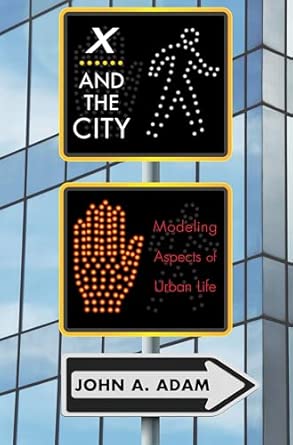
"In X and the City, John Adam proves himself to be a genial and endlessly curious companion as he takes us on a stroll through that fascinating place where reality meets the mathematical imagination. How many squirrels live in Central Park? Should you walk or run in the rain? Anyone who's ever pondered puzzles like these will find this book to be a treat."--Steven Strogatz, Cornell University
"Why did the chicken cross the road? Because the Jaywalker Equation said it had enough time between cars. How does the Ambler Gambler Graph tell if you can blast through a yellow traffic light before it turns red? And why are taxicabs slower than Euclid? These and many other mathematical conundrums are answered in John Adam's admirable new collection."--Neil A. Downie, author ofThe Ultimate Book of Saturday Science and Vacuum Bazookas, Electric Rainbow Jelly, and 27 Other Saturday Science Projects (both Princeton)
"This is a nice introduction to modeling that draws from questions arising naturally to people who are curious about how cities work. It will certainly interest readers of pop math books and will be useful to teachers of calculus and differential equations who are looking for good examples for their classes."--Anna Pierrehumbert, Community Charter School of Cambridge, Massachusetts
From the Back Cover
"In X and the City, John Adam proves himself to be a genial and endlessly curious companion as he takes us on a stroll through that fascinating place where reality meets the mathematical imagination. How many squirrels live in Central Park? Should you walk or run in the rain? Anyone who's ever pondered puzzles like these will find this book to be a treat."--Steven Strogatz, Cornell University
"Why did the chicken cross the road? Because the Jaywalker Equation said it had enough time between cars. How does the Ambler Gambler Graph tell if you can blast through a yellow traffic light before it turns red? And why are taxicabs slower than Euclid? These and many other mathematical conundrums are answered in John Adam's admirable new collection."--Neil A. Downie, author of The Ultimate Book of Saturday Science and Vacuum Bazookas, Electric Rainbow Jelly, and 27 Other Saturday Science Projects (both Princeton)
"This is a nice introduction to modeling that draws from questions arising naturally to people who are curious about how cities work. It will certainly interest readers of pop math books and will be useful to teachers of calculus and differential equations who are looking for good examples for their classes."--Anna Pierrehumbert, Community Charter School of Cambridge, Massachusetts
About the Author
John A. Adam is professor of mathematics at Old Dominion University. He is the author of A Mathematical Nature Walk and Mathematics in Nature, and coauthor of Guesstimation: Solving the World's Problems on the Back of a Cocktail Napkin (all Princeton).
 Wow! eBook