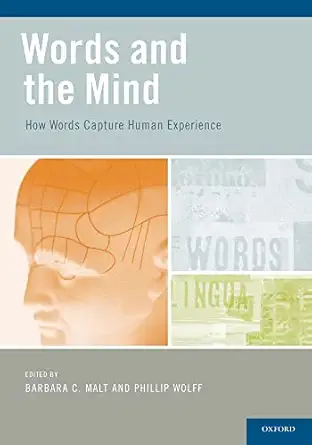
Words and the Mind: How Words Capture Human Experience
Author(s): Barbara Malt (Editor), Phillip Wolff
Publisher: Oxford University Press
Publication Date: March 1, 2010
Edition: 1st
Language: English
Print length: 360 pages
ISBN-10: 0195311124
ISBN-13: 9780195311129
Book Description
The study of word meanings promises important insights into the nature of the human mind by revealing what people find to be most cognitively significant in their experience. However, as we learn more about the semantics of various languages, we are faced with an interesting problem. Different languages seem to be telling us different stories about the mind. For example, important distinctions made in one language are not necessarily made in others. What are we to make of these cross-linguistic differences? How do they arise? Are they created by purely linguistic processes operating over the course of language evolution? Or do they reflect fundamental differences in thought? In this sea of differences, are there any semantic universals? Which categories might be given by the genes, which by culture, and which by language? And what might the cross-linguistic similarities and differences contribute to our understanding of conceptual and linguistic development? The kinds of mapping principles, structures, and processes that link language and non-linguistic knowledge must accommodate not just one language but the rich diversity that has been uncovered.
The integration of knowledge and methodologies necessary for real progress in answering these questions has happened only recently, as experimental approaches have been applied to the cross-linguistic study of word meaning. In
Words and the Mind, Barbara Malt and Phillip Wolff present evidence from the leading researchers who are carrying out this empirical work on topics as diverse as spatial relations, events, emotion terms, motion events, objects, body-part terms, causation, color categories, and relational categories. By bringing them together, Malt and Wolff highlight some of the most exciting cross-linguistic and cross-cultural work on the language-thought interface, from a broad array of fields including linguistics, anthropology, cognitive and developmental psychology, and cognitive neuropsychology. Their results provide some answers to these questions and new perspectives on the issues surrounding them.
Editorial Reviews
Review
“Malt and Wolff’s compilation of essays on the relations between language and thought offer the reader among the most thoughtful, far-reaching, and theoretically rich probes into this fascinating topic that are available today, produced by a star-studded cast of linguists, psychologists, anthropologists, and neuroscientists currently working in this area. In their synthesizing introductory remarks, the editors provide a necessary guide to the diverse topic areas-space, color, numeracy, to name a few-and points of view covered in the individual selections. Scholars and students interested in the interactions among culture, convention, and native conceptualization will find many treasures in this important collection.”–Lila Gleitman, Professor of Psychology and Linguistics, University of Pennsylvania
“Writing on the relation of language and thought has often (or should one say usually?) generated more heat than light. The present volume adds to the illumination side of the equation, in a diverse set of essays that focus on specific and often fascinating phenomena, through disciplines and perspectives such as development, cross-cultural comparisons, theoretical linguistics, and experimental psychology. The chapters reveal the intricate and puzzling interactions of language and thought, which often do not fit either side of the traditional debate between Whorfians and anti-Whorfians. This volume is an interesting and well-written contribution to the topic that will inspire many readers to regain their interest in this classic psychological problem.”–Gregory Murphy, Professor of Psychology, New York University
Book Description
As the authors’ positions on theoretical issues span the range of viewpoints, the book will provide a fair and balanced treatment of the debates associated with the language-thought interface. It will appeal to researchers and students in psychology and linguistics, with interests in word meaning, concepts, and their development.
About the Author
Barbara Malt received her Ph.D. from Stanford University with post-doctoral training at U.C. Berkeley and UMass, and she is currently Professor of Psychology at Lehigh University. Malt is interested in how people understand the world, how they talk about the world, and what the relation is between the two. She has served as associate editor for Journal of Experimental Psychology: Learning, Memory, and Cognition and as Chair of the Psychology Department at Lehigh.
Phil Wolff received his PhD degree from Northwestern University and is currently an assistant professor at Emory University. His research concerns the relationship between language and cognition, with particular interests in computational models of causal meaning and reasoning. Wolff is on the editorial board of the journal Cognitive Science.
 Wow! eBook