Wow! eBook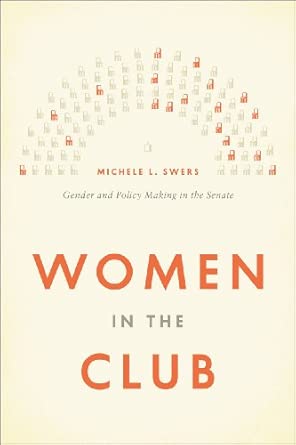
Women in the Club – Gender and Policy Making in the Senate
Author(s): Michele Swers (Author)
- Publisher: University of Chicago Press
- Publication Date: 9 Aug. 2013
- Language: English
- Print length: 304 pages
- ISBN-10: 022602279X
- ISBN-13: 9780226022796
Book Description
Editorial Reviews
Review
About the Author
Excerpt. © Reprinted by permission. All rights reserved.
Women in the Club
Gender and Policy Making in the Senate
By Michele L. Swers
THE UNIVERSITY OF CHICAGO PRESS
Copyright © 2013 The University of Chicago
All rights reserved.
ISBN: 978-0-226-02279-6
Contents
List of Figures and Tables………………………………………….ixAcknowledgments……………………………………………………xi1 Women and the New Senate Club……………………………………..12 A Stronger Voice for Women, Children, and Families? Gender Identity and
Policy Making on Women’s Issues……………………………………..333 Playing Offense and Defense on Women’s Rights……………………….994 Replacing Sandra Day O’Connor: Gender and the Politics of Supreme Court
Nominations……………………………………………………….1375 Providing for the Common Defense: Gender and National Security Politics
in the Post-9/11 World……………………………………………..1816 Gender and Policy Making in the New Senate Club……………………..231Notes…………………………………………………………….253References………………………………………………………..269Index…………………………………………………………….297
Excerpt
CHAPTER 1
Women and the New Senate Club
In the months leading up to the 2012 presidential election,the Republican and Democratic parties were lockedin a battle for women’s votes. Democrats and PresidentBarack Obama’s campaign accused Republicans of waginga “war on women.” Republicans and Republicanpresidential candidate Mitt Romney countered that Democratswere instigating a false gender war and PresidentObama’s policies undermined the interests of women.The women of the Senate played key roles in this questfor the hearts and minds of female voters. Female Democraticsenators took to the Senate floor, called press conferences,and appeared on political news shows to shine aspotlight on Republican policies that hurt women includingRepublican efforts to defund Planned Parenthoodand Republican opposition to coverage of contraceptionin Obama’s health reform bill (McCarthy 2012c; SangerKatz2012). The Democratic women also lamented Republicanobstruction of the Violence Against Women Actand the Paycheck Fairness Act, a bill to strengthen equalpay legislation (Weisman 2012b; Steinhauer 2012). PattyMurray (D-WA), the head of the Democratic Senate CampaignCommittee, launched an advertisement denouncingthe Republican war on women and urging voters to electmore women to the Senate (http://www.youtube.com/watch?v=M0hC0T_fHlU).
In response, Republicans deployed their own female surrogates topush back on the Democratic message of a war on women. Republicansenator Kelly Ayotte (R-NH) became a prominent spokesperson for theRepublican Party and the Romney campaign (Schultheis 2012). Utilizingher moral authority as a woman, Ayotte countered that Republicanopposition to forcing employers, including Catholic universities andhospitals, to cover contraception was a matter of religious freedom andnot women’s health (McCormack 2012). Republicans frequently notedthat the economy was the top concern of women voters and that morethan 92% of the jobs lost on Obama’s watch were women’s jobs (AssociatedPress 2012).
Clearly, both Republican and Democratic women utilize the powerof their position as senators to influence the public debate over therepresentation of women’s interests and to shape policy that addressesthe needs of women and their families. The emergence of women asa significant force in the Senate is a recent phenomenon. Indeed, theUnited States Senate is among the most powerful legislative institutionsin western democracies. At the same time it is in many ways the leastrepresentative (Dahl 2003; Lee and Oppenheimer 1999). In both itsdemographic makeup and its institutional rules the Senate defies idealsof equal representation. For most of its history the Senate has been awhite male bastion, and the number of women and minorities in theSenate continues to lag far behind their share of the U.S. population.The institutional structure and rules of the Senate are antimajoritarian.The filibuster gives individuals and small groups of senators the abilityto obstruct legislation and the allocation of two seats for each stategives outsized influence to senators representing small state populations(Koger 2010; Wawro and Schickler 2006; Lee and Oppenheimer 1999).In contrast to the House of Representatives, the Founders intended forthe Senate to be the less responsive body, cooling the passions of themasses in an effort to reach decisions that reflect the national characterand interest (Federalist 63 in Rossiter 1961; Dahl 2003). As a resultof this design, the Senate has often been described as both the world’sgreatest deliberative body and an insular old boys club where powerfulwhite men meet behind closed doors to shape public policy (Dahl2003).
The modern Senate club is a study in contradictions. Senators arefreewheeling policy entrepreneurs whose large staffs, ready media access,and institutional prerogatives, including the ability to offer nongermaneamendments, place holds, and threaten filibusters, allow themto become important players on any issue they choose (Evans 1991;Baker 2001; Sinclair 1989). At the same time, ideological polarizationand tight electoral competition between the parties has created a Senatedivided into partisan teams. Senators work together to create a partymessage and policy agenda. They are expected to be loyal to the team orrisk a loss of standing and influence with their colleagues (Sinclair 1989,2006, 2009; Lee 2009, 2008b; Sellers 2010).
The evolution of the Senate into an institution that is both partisanand individualistic coincided with the opening up of the Senate to newgroups, particularly women. As late as 1991, women constituted only2% of the Senate membership. By 2001, 13% of senators were womenand the number of women in the Senate was equivalent to the proportionof women serving in the House. In the 112th Congress (2011–12),women make up 17% of the Senate’s membership (Center for the AmericanWoman and Politics 2011a, 2011b). While the number of womenin the Senate remains relatively small, the power wielded by individualsand the procedural rules protecting participation rights give senatorsoutsized influence and an ability to engage any and all policy areas regardlessof committee assignment or majority/minority party status.
By focusing on the Senate, I can examine how gender influences legislativebehavior on a wider range of issues from social welfare policyto national security. Moreover, if senators feel strongly about championinggender-related causes, the organization of the Senate gives themthe resources and tools to force consideration of these interests, thusmagnifying senators’ influence beyond their numbers. In this book, Iutilize the fact that senators are policy generalists who are involved ina wide variety of issues and wield extensive individual prerogatives toanalyze the ways in which gender influences the legislative behavior ofsenators. I demonstrate that gender is a fundamental identity that affectsthe way senators look at policy questions, the issues they prioritize,and the perspective they bring to develop solutions. The importance ofgender also transcends individual identity, creating opportunities andimposing obstacles in the electoral and governing arena that senatorsmust confront when they design their political strategies and build theirlegislative reputations.
My research shows that, as they develop their legislative portfolio,female senators take into account long-standing public assumptionsand voter stereotypes about women’s policy expertise. The strong linkbetween gender and women’s interests on various social welfare andwomen’s rights issues enhances the credibility of women in these policyareas. Thus, women are able to leverage their gender to influence policydebates on a range of issues from health care and education to abortionrights and pay equity. These “women’s issues” routinely constitute atleast one-third of the Senate agenda (see chapter 2). By contrast, deeplyheld voter perceptions that men are more capable of handling defensepolicy hinder women’s efforts to become leaders on defense issues. Tocounteract voter stereotypes that portray women as soft on defense,female senators construct policy records to demonstrate toughness andseek out opportunities for position taking through cosponsorship tohighlight their support for the military.
Gendered perceptions of issue competencies are mediated by partyreputations. I show how party ownership of issues can temper or exacerbatethe importance of gender in policy debates. I highlight howthese partisan and gendered perceptions of issues alter senators’ strategiccalculations about which issues to engage and how much politicalcapital to invest in the debate. Thus, the perception of the RepublicanParty as strong on defense can moderate the negative impact of genderstereotypes for Republican women. The view of Democrats as weakon national security reinforces gender stereotypes that women are softon defense, making it more important for Democratic women to demonstratetoughness and commitment to our troops. The association ofsocial welfare and women’s rights issues with the Democratic Party reinforcesincentives for Democratic women to highlight these issues asthey develop their legislative portfolios. Indeed, the centrality of theseissues to Democratic voters, particularly female Democrats, can onlybenefit Democratic women senators as they work to achieve their policygoals and secure re-election. By contrast, Republican women do notreap the same level of benefits from pursuing women’s issues becausethese policies are not part of the core principles that make up the RepublicanParty’s message of lower taxes, strong defense, and support forbusiness. At worst, women’s rights initiatives can antagonize key elementsof the party’s base. Proposals promoting reproductive rights willantagonize social conservatives, and business-oriented Republicans willobject to employment discrimination initiatives that impose more regulationson corporations and small businesses. Thus, Republican womenmust exercise more caution as they decide whether to focus on women’sissues and which policies to champion.
Furthermore, my research shows that partisan polarization and theresulting demands for party loyalty in the contemporary Senate affectsenators’ calculations about whether to emphasize policy preferencesbased on gender. The ideological polarization and intraparty homogeneitythat characterizes the contemporary Senate increase pressure onsenators to act as members of partisan teams (Lee 2009; Sinclair 2006).Thus, my analysis indicates that in settings requiring party loyalty, suchas judicial confirmation fights over Supreme Court nominees, even themost moderate female Republicans are hesitant to publicly opposenominees based on their conservative records on women’s rights.
Finally, as members of partisan teams in an era of fierce electoralcompetition for control of the Senate, women are encouraged to utilizetheir gender in ways that will bolster the party’s standing with voters,particularly women voters. Women frequently participate in party messagingactivities that highlight their status as women as they advertisethe party message. Thus, Democratic women often join together to promoteDemocratic initiatives on social welfare and women’s rights issues.Republican women are often deployed in a defensive capacity to counterDemocratic accusations that Republican policies are anti-women.Women senators can leverage these messaging opportunities to raisetheir media profile, gain power within the party caucus, and advancetheir own policy initiatives. However, they also run the risk of being pigeonholedin specific policy areas or used as symbols of diversity withoutinfluence over the details of policy.
In sum, through careful analysis of senators’ policy activity, I demonstratethat gender is a fundamental identity that interacts with traditionalinfluences on legislative behavior like partisanship and ideologyto shape legislative priorities. Women senators are more vigorous advocatesfor inclusion of women’s interests in the development of policy,and they devote more attention to how specific policies differentiallyimpact various groups of women. A senator’s own ideological views andthe political context surrounding an issue impact whether senators pursuepolicy preferences based on gender. However, beyond personal preferences,senators also develop their legislative portfolio with an eye topublic expectations regarding gender roles and party reputations. Thus,the history of women’s integration into politics and voter assumptionsabout women’s expertise facilitate women’s efforts to stake a legislativeclaim on social welfare policy while creating additional hurdles for femalesenators working to demonstrate expertise on defense issues. Partyreputations for ownership of issues interact with gendered perceptionsof policy expertise, creating opportunities for legislative entrepreneurshipand shaping senators’ political strategies. However, demands forloyalty to one’s partisan team also complicate senators’ decisions aboutwhen to pursue gender-based policy preferences, particularly for Republicanwomen. Finally, in an era of heightened electoral competition,gender has become a tool of partisan warfare as the parties turn tofemale senators to reach out to women voters by advertising how theparty’s agenda will help women or by defending the party against criticismthat their policies will hurt women. Female senators must decidewhether employing gender to promote party messages will advance orinhibit their political and policy goals.
A Brief History: Evolution from the Old Senate Clubto the New Senate Club
Classic treatments of the Senate of the 1930s to the late 1950s includingRobert Caro’s Master of the Senate, William White’s Citadel, andDonald Matthews’ U.S. Senators and Their World provide a picture ofa U.S. Senate that was inward looking, conservative, resistant to constituentpressures, and almost exclusively made up of white men (White1956; Matthews 1960; Caro 2002). When future majority leader LyndonJohnson (D-TX) arrived in the Senate, he saw an institution populatedby whales and minnows, senior power brokers and more juniormembers with limited influence (Rae and Campbell 2001; Caro 2002).Johnson’s Senate was governed by norms of apprenticeship, specialization,reciprocity, and courtesy. New senators were expected to serve anapprenticeship where they were seen and not heard, taking the time tolearn the rules and norms of the Senate before actively participating inpolicy making. As specialists, senators focused their efforts on the policyareas within their committee jurisdictions and those initiatives that affectedtheir states. They offered few floor amendments and did most oftheir work in committee. The norm of reciprocity required senators todo favors for each other and keep their word once a bargain had beenstruck. In the spirit of reciprocity, senators rarely utilized their institutionalprerogatives such as the right to filibuster, making the historicfilibusters against civil rights legislation all the more notable. Finally,senators were expected to show each other courtesy. Senators did notengage in personal attacks against each other nor did they engage inself-promotion or any activity that would reflect poorly on the institutionof the Senate (Sinclair 1989; Baker 2001; Schickler 2011).
By the election of 1958, the restrictive norms of the old boys clubwere already falling as the Senate began its transformation into whatBarbara Sinclair calls the “individualist partisan Senate” in which partypolarization, electoral competition, and the demands of the moderncampaign led senators to abandon strict adherence to the institutionalnorms that enforced collegiality and maintained the exclusive natureof the Senate club (Sinclair 1989, 2006, 2009). The election of liberalNorthern Democrats in competitive races and the realignment of theSouth toward the Republican Party led to increasing ideological polarizationamong senators, encouraging them to organize into partisanteams that utilize the procedural prerogatives held by the majority andminority party to score political points against the other side in an effortto win majority control in the next election (Lee 2011, 2009, 2008b;Sinclair 1989, 2006; Koger 2010).
The political ferment of the 1960s and 1970s rapidly expanded thepolicy agenda of government and the size and diversity of the interestgroup community. New issues from civil rights to environmental regulationprovided senators with opportunities to become policy leaders on arange of issues. Senators responded by increasing their staffs to enhancetheir policy expertise and expanding their number of committee assignmentsand their participation on the floor to become policy generalistswho could influence any issue that caught their attention (Sinclair1989; Evans 1991; Fenno 1991). A proliferation of new interest groupsrepresenting business groups, trade associations, consumers, women’srights, and civil rights organizations reinforced senators’ efforts atpolicy entrepreneurship by working to recruit senators as championsfor the group’s causes (Sinclair 1989, 2006; Berry and Wilcox 2009).The ever-expanding news media, from state and national newspapers tonetwork and cable news, offered senators opportunities to become nationalspokespersons on various policy issues. Today the Internet blogosphereand the social media of Facebook and Twitter provide additionalavenues for senators to raise their profiles with constituents and policyactivists (Sinclair 1989, 2006, 2009; Sellers 2002, 2010).
(Continues…)
(Continues…)Excerpted from Women in the Club by Michele L. Swers. Copyright © 2013 by The University of Chicago. Excerpted by permission of The University of Chicago Press.
All rights reserved. No part of this excerpt may be reproduced or reprinted without permission in writing from the publisher.
Excerpts are provided by Dial-A-Book Inc. solely for the personal use of visitors to this web site.