 Wow! eBook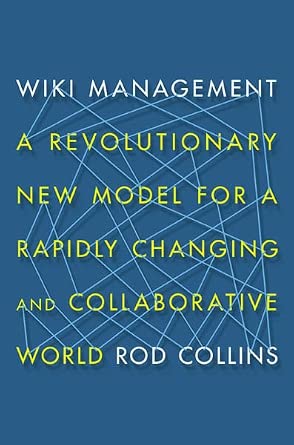
Wiki Management: A Revolutionary New Model for a Rapidly Changing and Collaborative World
Author(s): Rod Collins (Author)
- Publisher: AMACOM
- Publication Date: 16 Dec. 2013
- Language: English
- Print length: 240 pages
- ISBN-10: 0814433081
- ISBN-13: 9780814433089
Book Description
We now live in a “wiki” world where mass collaboration is not only possible—it’s often the best solution. Conventional management thought assumes that command-and-control is the most effective way to organize the efforts of large numbers of people, but rapid change and increasing complexity have rendered that model obsolete. As a result, most managers today lack the skills and knowledge needed to succeed in an age when networks are proving smarter and faster than hierarchies. Designing organizations for mass collaboration demands a new and very different model—wiki management.
Featuring enlightening examples from forward-thinking companies including Google, Whole Foods, Linux, and Wikipedia, Wiki Management outlines the revolutionary but necessary steps companies must take to:
• Leverage their collective intelligence
• Effectively integrate diverse points of view
• Transition leaders from the role of “boss” to that of facilitator
• Make “delighting customers” more important than pleasing superiors
• Achieve a shared and actionable understanding of the key drivers of business success
The power of networks is dramatically reshaping both the work we do—and the way we work. This groundbreaking book reveals what it takes to succeed in this fast-paced and exciting business environment.
Editorial Reviews
From the Back Cover
Management, as most of us know it, is a highly structured hierarchy designed to coordinate the tasks and activities of large numbers of workers. But with the advent of the Digital Revolution, the business landscape has been radically transformed by the unprecedented combination of three developments: accelerating change, escalating complexity, and ubiquitous connectivity. In a world where mass collaboration has created entirely new ways of working together, our nineteenth-century management model, built around centralized decision-making and a sharp divide between workers and managers, has revealed itself to be inadequate to the job.
A new breed of companies and managers is leading a paradigm shift, favoring the values of serendipity, self-organization, emergence, simple rules, and transparency. Containing real world examples and case studies of how the best, most limber organizations are mastering the unprecedented challenges of our fast-changing world, Wiki Management presents you with a set of fifty specific practices you can use to:
• Leverage your organization’s collective intelligence
• Effectively integrate diverse points of view within your company
• Transition leaders from the role of “bosses” to that of facilitators
• Prioritize “delighting customers” over pleasing superiors
• Achieve a shared and actionable understanding of the key drivers of business success
How did Google revolutionize the practice of management with a 60-to-1 ratio of employees to supervisors, open conversations, and a strategic horizon limited to 90 days? What has Zappo’s done to transform its customer call center into a model of memorable and remarkable service? How has Whole Foods made its system of hiring smarter through a system of peer review? Through accounts of well known organizations as well as author Rod Collins’s experience leading a highly effective collaborative network within the deeply entrenched hierarchy of a larger, more traditional organization, this book introduces you to a new management vocabulary describing the innovative tools of 21st century business: serendipity, emergence, collective intelligence, shared understanding, simple rules, and self-organization.
A fast-changing world isn’t necessarily unmanageable—it just needs to be managed differently. Inspiring and filled with practical methodologies for today’s business environment, Wiki Management gives you the tools you and your organization need to thrive in our fast-moving, thrillingly collaborative world.
About the Author
Excerpt. © Reprinted by permission. All rights reserved.
Preface
Today’s managers face a difficult and unprecedented challenge: The world
is changing much faster than their organizations. Every industry, without
exception, has been overtaken by an accelerating pace of change that
shows no signs of letting up anytime soon. In a business world of increasing
uncertainty, the one clear certainty is that the pace of change is only
going to get faster.
As managers struggle to keep pace with a fast-forward world, they are
increasingly becoming aware of a very troubling problem. They are discovering
that methods and practices that have always delivered predictable
results aren’t working anymore. Forecasts are suddenly unreliable as new
disruptive technologies radically reshape markets. Cutting costs does not
necessarily result in improved efficiencies and productivity. Proven analytical
methods are now too slow and cumbersome to keep up with a fastchanging
world. And exerting more control seems to drive companies out
of control—and sometimes out of business. In a world where change is
constant and longstanding rules don’t seem to work anymore, it’s not
surprising that many managers feel overwhelmed by what appears to be a
completely unmanageable state of affairs.
At the same time, there is a small but growing group of vanguard
companies that is thriving in this time of great change. While most companies
have had to trim their sails to weather the storm of the Great Recession,
this small group has experienced relatively smooth sailing with
steady growth, increasing profits, and the creation of new jobs. The vanguard
group, composed of companies that we love engaging with as consumers,
includes Amazon, Google, Threadless, Valve, Whole Foods, and
Zappos, among others. What separates these vanguard companies from
their traditional counterparts is that their managers understand a fastchanging
world is not necessarily unmanageable—it just needs to be
managed differently. That’s because, with the rapid emergence of the
Digital Age, we suddenly find ourselves in a new world with a completely
different set of rules. The managers of the vanguard companies are thriving
because they have mastered these new rules, and in so doing, they have
completely overhauled the fundamental disciplines of business management.
While most of us are aware of the much-publicized successes of these
vanguard companies, few of us are familiar with how they achieve their
extraordinary performance. We have a vague notion that they do things a
little differently, but chances are most of us would be surprised at just how
differently the leaders of these companies manage their businesses. In fact,
if we spent a week inside one of these innovative enterprises, most of us
probably would walk away puzzled at how they could be so successful
when we didn’t see anything that remotely resembled management.
For most of us, management is about business plans, organization
charts, bosses, formal meetings, policies, procedures, tasks, and reports.
These are the common practices of the top-down hierarchical structures
that have defined the context of management for well over a century.
These practices are the embodiment of a fundamental set of disciplines
that have served as the framework for leading and managing large orga-
nizations. This framework dates back to the late nineteenth century, when
mass production was radically transforming the ways people worked and
the major challenge for managers was how to effectively coordinate the
tasks and activities of the large numbers of workers in their new factories.
Management, as most of us know it, was invented to guide business
leaders in building and preserving sustainable business models and maintaining
highly efficient operations. Its disciplines were designed to support
the core values of top-down hierarchical structures: planning, control, and
efficiency. Accordingly, in the command-and-control management model,
the fundamental work of the manager is to plan and control, and productivity
is synonymous with efficiency.
The managers of the vanguard companies, however, loathe commandand-
control management. In fact, they are quite proactive in making sure
that as their organizations grow, they do not inadvertently slip into traditional
management practices. Instead, they have created a different management
model that is based on a completely different set of fundamental
disciplines. This alternative model is designed for adapting and innovating
rather than preserving and maintaining. Its disciplines support the
prime values of learning, collaboration, and innovation. Thus, the fundamental
work of the manager is not to plan and control but rather to be the
catalyst for collective learning and collaboration. And productivity is seen
more as a function of innovation than efficiency.
The managers of the vanguard companies see little value in making
traditional business models faster or less expensive. The real value is in
creating the new business model that will render the old model obsolete.
That’s why, when the vanguard managers think about productivity, they
focus on value rather than cost. When it comes to improving the bottom
line, creating value is far more efficient than cutting costs.
This book is about the emerging management model used by the vanguard
companies to make sure that their organizations are changing as
quickly as the world around them. We call this new model “Wiki Management.”
Wiki is the Hawaiian word for “quick” or “fast,” and it is an
appropriate appellation for a set of management disciplines designed to
help managers keep pace with accelerating change. In the chapters ahead,
we will describe the five specific disciplines that the vanguard companies
share in common, and we will outline fifty concrete practices that they use
to drive their extraordinary performance. As you read through the book
and become familiar with the new management model, please keep an
open mind because many of these practices will feel counterintuitive,
some will seem heretical, and most will probably challenge your basic assumptions
about what managers do and what management is.
Although there is some discussion of the theory that serves as the foundation
for the new management model, the bulk of the book is devoted to
stories and practices. When managers are ready to think and act differently,
real stories of success and actual practices that work are more valuable
than abstract theory. Some of the stories and practices come from the
vanguard companies referenced above, while others reflect my own experiences
as a manager building a Wiki Management business unit inside a
larger, traditional enterprise, and how we used many of the practices to
quickly and successfully turn around a business that had endured two
decades of low growth and low performance.
In our case, we learned the disciplines of Wiki Management out of
necessity when we realized that the prime enabler of our poor performance
was our adherence to a traditional management model that no longer
worked. Learning new ways of managing wasn’t easy because we
needed to readjust the deeply held beliefs we had about what managers do
and what management is. However, if we were going to improve our performance,
we knew we had to change, regardless of how unfamiliar or
counterintuitive managing differently might feel. Our venture into Wiki
Management transformed us into a highly effective management team
and enabled us to realize the single largest five-year growth period in the
fifty-three-year history of our business unit. In embracing the new management
model, we didn’t just turn the business around; like so many of
the vanguard companies, we made a leap to extraordinary performance.
The primary message of this book is simple and, hopefully, obvious: A
nineteenth-century management model is unsustainable in a twenty-firstcentury
world. As the pace of change continues to accelerate, it is unrealistic
to believe that a century-old management model will somehow
endure while the rest of the world is reshaped by the technologies of the
Digital Age. We live in a new world with new rules, and the old rules are
quickly becoming obsolete. That’s why they’re not working anymore.
As you approach this book, be prepared to be surprised because everything
you have believed about the way we work and the work we do is
about to dramatically change. In the chapters ahead, you will discover a
very different business world where leaders are facilitators, workers are
highly involved in shaping strategic thinking, and business processes are
designed around what’s most important to customers. You will become
familiar with a new management vocabulary that describes the innovative
tools of twenty-first-century business: serendipity, emergence, collective
intelligence, shared understanding, simple rules, and self-organization.
But most importantly, you will have at your disposal a set of fifty specific
practices that you can use to master the unprecedented challenges of our
fast-changing world. While fifty practices may sound like a lot, you’ll find
that you will be able to pick out those that are best suited to your particular
business or situation. I hope that you will find much value in these
pages and will commit to discovering and applying the incredible power
of the disciplines and the practices of Wiki Management so you too can
make a leap to extraordinary performance.
Rod Collins



![[(The Story of Managing Projects: An Interdisciplinary Approach )] [Author: Young-Hoon Kwak] [Jan-2005]-Wow! eBook](https://m.media-amazon.com/images/I/31rW8gEWMyL._SX342_SY445_ML2_.jpg)