 Wow! eBook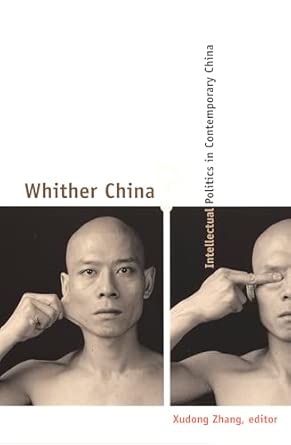
Whither China?: Intellectual Politics in Contemporary China
Author(s): Xudong Zhang
- Publisher: Duke University Press
- Publication Date: 28 Mar. 2002
- Language: English
- Print length: 408 pages
- ISBN-10: 0822326590
- ISBN-13: 9780822326595
Book Description
The contributors to Whither China? describe how, instead of spearheading the popular-mandated and state-sanctioned project of modernization, intellectuals now find themselves caught amid rapidly changing structures of economic, social, political, and cultural relations that are both global in nature and local in an irreducibly political sense. Individual essays interrogate the space of Chinese intellectual production today, lay out the issues at stake, and cover major debates and discursive interventions from the 1990s. Those who write within the Chinese context are joined by Western observers of contemporary Chinese cultural and intellectual life. Together, these two groups undertake a truly international intellectual struggle not only to interpret but to change the world.
Contributors. Rey Chow, Zhiyuan Cui, Michael Dutton, Gan Yang, Harry Harootunian, Peter Hitchcock, Rebecca Karl, Louisa Schein, Wang Hui, Wang Shaoguang, Xudong Zhang
Editorial Reviews
Review
–John A. Crespi, “The Journal of Asian Studies”
“By bringing together a group of leading China specialists to comment critically on the intellectual politics of the last decade, this book is academically very useful.”
“
”
–Shiping Hua, “The China Journal”
“I love the title of this book. . . . The editor is not only an intellectual, he is also very intelligent. His introductory chapter, “The Making of the Post-Tiananmen Intellectual Field: A Critical Overview” amounts to a small book of its own. Laced with poignant data and penetrating insights, it is a fitting overture to the ten essays that follow.”
–Sino-Platonic Papers
“The introduction is a real “tour de force,” It shows excellent understanding both of the intellectual climate of the West, which still tends to be the source of ‘global ideas’ and of China. . . . [T]his book . . . has been beautifully edited and written. . . . The production is . . . excellent . . . . [T]his is an important book. The introduction is especially important . . . [I]t should be very useful for specialists and students and I recommend it strongly.”
–Colin Mackerras, “The China Review”
“This is a fascinating read because it goes past the politics and the masses to focus on the confusion of the intellectuals and academics. A highlight of this book is a 15-page collection of post-Tiananmen art that aptly illustrates many of the theories in the book about a country torn between state-sanctioned modernization and global cultural upheaval.”
–Asian Week
“This is a stimulating and informative volume, which deserves a wide readership among students of contemporary China. It is at times rather abstract, but always intellectually challenging.”
–Richard Kraus,” The China Quarterly”
About the Author
Xudong Zhang is Associate Professor of Comparative Literature and East Asian Studies at New York University.
Excerpt. © Reprinted by permission. All rights reserved.
Whither China?
Intellectual Politics in Contemporary China
Duke University Press
Copyright © 2001 Duke University Press
All right reserved.
ISBN: 978-0-8223-2659-5
Contents
Preface…………………………………………………………………………………………………………………….vii1. The Making of the Post-Tiananmen Intellectual Field: A Critical Overview, Xudong Zhang……………………………………………12. Debating Liberalism and Democracy in China in the 1990s, Gan Yang………………………………………………………………793. Whither China? The Discourse on Property Rights Reform in China, Zhiyuan Cui…………………………………………………….1034. The Changing Role of Government in China, Shaoguang Wang………………………………………………………………………1235. Contemporary Chinese Thought and the Question of Modernity, Wang Hui……………………………………………………………161Post-Tiananmen Art…………………………………………………………………………………………………………..1996. King Kong in Hong Kong: Watching the “Handover” from the U.S.A., Rey Chow……………………………………………………….2117. The Burdens of History: Lin Zexu (1959) and The Opium War (1997), Rebecca E. Karl………………………………………………..2298. Mao to the Market, Peter Hitchcock………………………………………………………………………………………….2639. Chinese Consumerism and the Politics of Envy: Cargo in the 1990s?, Louisa Schein…………………………………………………28510. Nationalism, Mass Culture, and Intellectual Strategies in Post-Tiananmen China, Xudong Zhang……………………………………..31511. Street Scenes of Subalternity: China, Globalization, and Rights, Michael Dutton…………………………………………………349Appendix In the Tiger’s Lair: Socialist Everydayness Enters the Market Economy in Post-Mao China, Harry D. Harootunian,…………………371Contributors………………………………………………………………………………………………………………..383Index………………………………………………………………………………………………………………………385
Chapter One
The Making of the Post-Tiananmen Intellectual Field: A Critical Overview
Xudong Zhang
Today, in media and academic discourses across the world, the image of China overwhelms our appetite for contradictory descriptions and frustrates our established analytical and conceptual framework. Amid dizzying change and radical uncertainty, however, an unruly and shapeless presence is confirmed, and it looms beyond doubt. The transformation of post-Mao China is widely credited as a result of its irreversible integration with the world market and its tantalizing merger with the social-cultural conventions of global capitalism. Everyone agrees that this period is transitional for China. Nobody is certain about where it is leading and what it really means, either for China or for the rest of the world. The lack of a cognitive road map for reading China results from the rapidity of change. It also stems from old assumptions and frameworks that no longer are adequate to address these problems. More productive ways to examine the Chinese situation are still hampered by ideologies and methodologies nourished in the heyday of the Cold War and by an entrenched Eurocentric worldview prevalent in both China and the West.
Mechanical and superficial views still boast empirical and ideological clarity, yet they invariably depend on obsolete binary opposites-state versus society, “official” versus “nonofficial,” dictatorship versus democracy, communism versus capitalism, hard-liners versus reformers, government intervention versus a free market, etc.-opposites that still obstruct our critical knowledge of the country in seemingly countless contexts. We are experiencing an increasing and intensifying discrepancy between the perceived object called China and the lingering epistemological models rooted in the Cold War, backed by the even more time-honored machinery of “knowing the Other” that is integral to the long history of the global expansion of capitalism (colonialism, imperialism, etc.). As long as the old regime of knowledge and its reproduction holds sway, the emerging complexity and dynamism of the Chinese economy, society, politics, culture, and everyday life will remain concealed, distorted, and oppressed in the symbolic global terrain. This situation, however, indicates not so much an intrinsic crisis among Western scholars in the production of knowledge about China as it indicates the corruption of that knowledge-gathering by power. At its core, this process reveals the extent to which China as a subject of study is still effectively “contained” inside a theater of a permanent ideological warfare about global capitalism and its “subjectivities.”
Such institutional restraints may explain why the most dynamic and productive development in Chinese studies in the United States during the past decade can be found in the integration of those studies with “disciplines” such as social history, and especially in works grounded in approaches and methodologies of Cultural Studies and Critical Theory (from film studies to women’s studies, from the Frankfurt School to postcolonialism). The last phenomenon is especially noteworthy, as it is genuinely cross-Pacific and shared by younger scholars in the United States, the PRC, Taiwan, and Hong Kong. In terms of the generational politics and paradigmatic break that this tendency implies, its development seems radical. But in terms of the “normalization” of scholarly research, it suggests nothing more radical than an institutional rationalization, namely, the need to engage Chinese studies in the same manner, and hopefully with the same intellectual and theoretical sophistication, as a scholar would engage in, say, French studies or subaltern studies. Similarly, disengagement from the various state or state-sanctioned discourses in both the People’s Republic and the United States should be regarded as part of the same movement to carry the field beyond its overdetermination by the Cold War era and that period’s ideological limitations.
No suggestion is being made that the historical conditions of contemporary China should be considered in the homogeneous space of capitalist or bourgeois universality, either as one more proof of sameness or as an exception that proves the rule. Rather, a move beyond the intellectual and ideological straitjacket of Cold War and Orientalist scholarship refutes the ideological homogeneity reinforced by rigidly fixing compartmentalized and instrumentalized knowledge imposed on the margins of the capitalist world system. Instead, such a movement beyond fixed positions is an attempt to reassert the internal differences of reality, which in the self-affirmation-even celebration-of its own contradictions prefigures a new social, political, and cultural horizon integral to a more plural, more democratic world. Ironically, the uneven development within this general tendency is more pronounced in a reluctance by the U.S. field of Chinese studies to face its own formation in and overdetermination by the Cold War enterprise and to realize the intellectual or merely scholarly need to go beyond Cold War limits. To be sure, this difficulty in moving beyond limits has more to do with the intense mythology of freedom and autonomy in so-called open society-a mythology of Enlightenment that proves to be deeply resistant to its own demystification. In so-called totalitarian societies, state repression is transparent, while possibilities are opaque. And nobody can even pretend to ignore that condition for knowledge production.
In this initial chapter, I seek to provide a historical and theoretical overview of Chinese intellectual development in the 1990s, especially as that development affected socioeconomic change, politico-ideological conflict, and cultural transformations in China after Tiananmen. My intention is to keep a chronological and thematic narrative clear, but also to show how that narrative mixes with and sometimes is suspended by a closer examination of particular phenomena, issues, topics, attitudes, and discourses that mark intellectual production and ideological position-taking in China today. If sometimes I appear more concerned with the contentious discursive “framework” than with a pedestrian chronology, my reasons are straightforward: I think that articulating the Chinese problematic is possible only by way of working through-and on the way disrupting and reconstructing-some intellectual premises and ideological assumptions that still govern our understanding of the contemporary world.
Reading the Chinese State
The habit goes unchallenged-both inside and outside China-to view everything in the PRC through the imagined totality of the government and its official policies and rhetoric. It is also customary, even a knee-jerk reaction, to see anything extragovernmental as instantaneously and naturally subversive, progressive, and good. As a result, new configurations of social space often are unaccounted for, and new cultural-intellectual manifestations willfully interpreted and misread. New forms of material life, social power, and ideological legitimacy often remain invisible to the eyes searching behind the veil of systematic dogma and bigotry. Take the emerging self-assertiveness of Chinese public opinion, which often is thought by Western students to be nationalistic, anti-Western, and government-orchestrated. A closer look, however, will show that a wide range of popular and intellectual debates spawn from both the marketplace and state-controlled media; it is virtually impossible and meaningless to determine the intellectual and ideological content of these debates by where they originate. Compared to the free-spirited discussions in those “independent” journals (all of them published by state publishing houses since no private publishing exists in China today) such as Dushu (Reading), Tianya (Frontier), Zhanlue yu guanli (Strategy and management), Gonggong luncong (Res publica), and numerous BBSS, or internet forums, the mouth-pieces of state propaganda per se are the most consistently and single-mindedly pro-American voices in China today, despite their occasional protest against U.S. “hegemony.” Not that the Chinese state as a realpolitik animal has any more faith in the “Sino-U.S. strategic partnership” than its U.S. counterpart. Rather, the raison d’etat of the Deng and post-Deng regimes-namely, developmentalism-sees the United States as the realization of that officially sanctioned “truth beyond dispute” (yingdaoli).
The only thing that the Chinese government does not readily take from the American model is procedural or formal democracy. Nor does it show any sign of embarrassment when it turns to authoritarian capitalist societies in East Asia-Singapore, South Korea, and, until recently, Taiwan-for political inspiration. Indeed, the anticlimatically smooth takeover of Hong Kong in 1997 testifies not so much to the working of a “one country, two system” principle envisioned by Deng Xiaoping as it does to the virtual continuity of authoritarian and colonial capitalism in the former British colony. The Chinese government, despite garnering credit for presiding over rapid economic growth, seems an anomaly in the post-Cold War “new world order,” and, ideologically, it is put on the defensive both at home and in the international arena. Its undemocratic qualities require closer and more discriminate analysis.
One may wonder to what extent these undemocratic positions derive from the residual system of Mao’s proletarian dictatorship and to what extent they are redefined by the new technocratic-managerial regime. Both of those causes are interrelated in the post-Mao Chinese social environment, to be sure; but they also have different socioeconomic origins and political-ideological dispositions, which produce different effects in concrete social-political terms. Where public opinions refracted through intellectual debates are conflicting and schizophrenic, what may pass as a national ideology upheld by the state media is little more than a developmentalist and culturalist apology for political underdevelopment.
So politically deprived is its cultural-nationalist self-glorification that this national ideology invariably fails to inspire, as even the most unreflected cultural affirmation of one’s “way of life” would have at its core a moral passion for the political ideals of a nation. By denying the people the possibility of a passionate political debate over what kind of a social system they want to build, the Chinese state, still nominally communist, becomes increasingly dependent on cynical pragmatism and opportunism as the sole sources of its legitimacy. By effectively muffling public articulation of an actually existing but internally differentiating socialism’s political vision, the new technocratic regime puts itself permanently on the ideological defensive both vis–vis the capitalist new world order and before its own people. This internal fracture between daily reality and its theoretical formulations is by no means accidental or something to be explained away by the incompetence of the Chinese intelligentsia. On the contrary, it is an indication of the Chinese national elite’s general disorientation and demoralization amid increasing economic disparity and class stratification. To this extent, the Chinese state-along with the conceptual space it still occupies as an empty shell-ceases to be an effective framework to critically analyze contemporary Chinese society and culture, and the state must be considered a remaining or reinvented ideological sham necessary for real power operations on both subnational and supranational levels. In other words, the uniformity of the Chinese state must now be regarded as a function or agency of the economic, social, and ideological reconfigurations driven by global and local forces and interests.
The political and philosophical poverty of the Chinese state has not fully undermined its legitimacy. Such forms of poverty merely allow the state to replace its moral authority with a legalistic, administrative, and technocratic function or indispensability, a tendency in accord with the secularization and rationalization processes unfolding since the end of the Cultural Revolution (1966-76). The social acceptance of such new authority is ensured by the government’s willingness to silence public debate and exercise raw, brutal power. But this is only half the story. The oppressiveness of the Chinese state in some areas is paralleled by unprecedented freedom and anarchism in others. Even political repression in China today bears a self-righteous air, as though its acceptance by the general populace testifies to the state’s mandate to achieve wealth and order through whatever means necessary, while economic growth vindicates the government’s policies and ideologies. As long as the government’s legitimacy comes exclusively from maintaining economic growth and social stability, its official ideology will remain a meaningless signifier awaiting appropriation by the newborn economic and class interests and positions in the differentiated social sphere. In fact, state ideology is already intertwined with the forces of the capitalist global market and with the new social and class formations in the new economic situation.
Often painted in dissident and international opinions as a political dinosaur and public enemy, the current Chinese government proves far more sophisticated, flexible, and dynamic than many of its opponents want to admit. That pliancy can be attributed in part to its unabashed pragmatism and its instinctual identification with the new urban middle class at home and the ideological mainstream abroad. The Chinese state, however, needs a new ideological coherence to better identify, claim, or fuse with the emerging social-ideological center. In this area, the state’s usual clumsiness reveals itself not so much in the rigidity of Communist ideology as in the complexity, unevenness, and diversity of Chinese socioeconomic development. This clumsiness, ironically, stems from the state’s loyalty to a more classical or modernist model of capitalist development now being replaced in advanced capitalist societies by information technologies and a new bourgeois subjectivity. While paying lip service to the socialist legacies of the People’s Republic, the government is busy disengaging from society and the everyday life it inherited from Mao’s China. After two decades of trying to relink the Chinese economy to the world system, the ruling technocratic elite seems to agree that the socialist (let alone Maoist) moral-ideological framework of the past will have to be dismantled to make room for the neoliberal theology of the free market, efficiency, competitiveness, etc., and to rationalize the state form in the new global economy.
(Continues…)
Excerpted from Whither China? Copyright © 2001 by Duke University Press. Excerpted by permission.
All rights reserved. No part of this excerpt may be reproduced or reprinted without permission in writing from the publisher.
Excerpts are provided by Dial-A-Book Inc. solely for the personal use of visitors to this web site.


