 Wow! eBook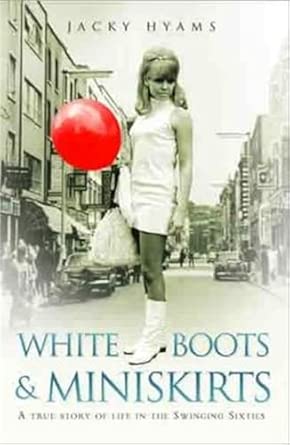
White Boots & Miniskirts – A True Story of Life in the Swinging Sixties: The follow up to Bombsites and Lollipops
Author(s): Jacky Hyams (Author)
- Publisher: John Blake
- Publication Date: 4 Feb. 2013
- Language: English
- Print length: 268 pages
- ISBN-10: 1782190147
- ISBN-13: 9781782190141
Book Description
Editorial Reviews
Review
About the Author
Excerpt. © Reprinted by permission. All rights reserved.
White Boots and Miniskirts
A True Story of Life in the Swinging Sixties from the Author of Bestselling Bombsites & Lollipops
By Jacky Hyams
John Blake Publishing Ltd
Copyright © 2013 Jacky Hyams
All rights reserved.
ISBN: 978-1-78219-014-1
Contents
Title Page,
Dedication,
FOREWORD,
INTRODUCTION,
CHAPTER 1 THE COMPLAINTS MANAGER,
CHAPTER 2 A SECRET TRIP ON THE CENTRAL LINE,
CHAPTER 3 RANDY SANDY AND THE CHICKENS,
CHAPTER 4 THE GO-GO GIRL FROM GUILDFORD,
CHAPTER 5 BANDAGE MAN,
CHAPTER 6 AN UNRAVELLING,
CHAPTER 7 THE ’60S ARE OVER,
CHAPTER 8 BOLO DI CREMA,
CHAPTER 9 MR VERY, VERY DANGEROUS,
CHAPTER 10 THE CLOSED SHOP,
CHAPTER 11 THE SPY WHO LOVED ME,
CHAPTER 12 MANY RIVERS TO CROSS,
Copyright,
CHAPTER 1
THE COMPLAINTS MANAGER
A light aircraft, a Piper Aztec, is taking off from a small airfield just outside London.
It’s a clear, bright summer weekend afternoon, a light breeze, little cloud, remarkably good flying conditions. As the plane climbs to 2,000 feet, anyone looking up from below might envy the passengers the delight of their winged freedom on this, a perfect day. If they continued to look up, they might have been somewhat impressed by the daring but perfectly executed aerobatic roll executed by the pilot a few minutes later.
Brilliant stuff. If you’re on the ground. But I’m up in the tiny plane, strapped in behind the pilot, Des, and his friend, Jeff. A gregarious, charismatic, speedy chatter-upper in his early thirties, Jeff is hell bent on making a real impression on me, a 21-year-old secretary working in his office. Well, it’s one way to pull the birds, eh? Persuade your best mate, a former RAF fighter pilot, to take you and your latest object of desire up in the clouds for a few aerobatic show-off manoeuvres.
‘Show Jacky some tricks, Jeffrey,’ laughs Des, as he manoeuvres the controls to send us into that head spinning, stomach-churning, 360-degree spin. Luckily, I’m not expecting this. No time to anticipate the sheer terror of being flipped upside down in a flimsy airborne tin can: it’s all over in a matter of seconds. I manage to remain impassive, stay outwardly remote, in my gingham mini-dress with the white organdie collar, cutaway shoulders and short white Courrèges boots, though it’s the fake cool of ignorant youth, rather than any kind of real courage or bravado, that gets me through this terrifying moment. This is the sort of thing that’s exciting once you’ve done it, I tell myself. He could’ve asked me first …
‘All right Miss Hyams?’ grins Jeff, turning back to give my exposed bare knee a quick caress. Jeff’s a Hackney lad, common ground with me that he’s exploiting to the hilt in his quest, so far thwarted, to get me into bed.
‘Yeah,’ I smile, remembering to show my girly gratitude to my host. ‘Er … nice one, Des.’
‘Next time we’ll show her some more tricks, eh Jeff?’ winks Des as he expertly handles the controls and guides the plane down towards the landing strip. Jeff looks chuffed: ‘tricks’ are his thing all right. I’m well used to the double entendre: it goes on all day, every day in the office. But I’m not the giggly, wriggly, ‘Oo, you are awful’ type. It’s usually a sarcastic retort, a sharp put down. Yet today, for some reason, I don’t bite back.
Still, for 1966, this is a pretty resourceful ploy for seduction. Getting young women up in small planes isn’t exactly commonplace. Nor is flying itself, still mostly for the comfortably off, though I’ve already had my first flight to Italy and, by the end of the decade, five million Brits will be off holidaying abroad, mainly on package-deal charter flights.
Mostly, men deploy their cars as girl bait, especially those who can afford to show off in flash Rovers, souped-up Minis, Triumph TR4s or MG MGBs. Young office girls are still some way off from buying their own cars after they pass the test, propelling themselves around town independently. And because it is still quite common for sons and daughters to live in the family home until marriage, car ownership means a guy has, at least, a love trap on wheels. Otherwise it’s outdoor sex (never a brilliant idea in Blighty’s climate, but nonetheless popular because it’s comparatively easy to find a secluded spot to carefully place the blanket) or the deserted office or shop floor – more popular then than you’d ever imagine. Or, as a final resort, there’s always the family home when unoccupied: not always achievable with other siblings hanging around.
Jeff hasn’t yet quite convinced me of his charms on this day of the aerobatic somersault. He’s an outrageous flirt around the electronics company where we both work and there’s an element of mystery around his existence that makes me initially wary (it will take several years before I learn to trust those first, crucial instincts).
He claims to live with a brother, somewhere in deepest Hertfordshire. The truth is he lives in sin in Pinner with a much older woman he’s been with for years. There’s also an illegitimate son and the boy’s mother, tucked away in Scotland, seen about once a year – a brief affair from Jeff’s national service days. Yet I don’t know about any of this when, a few months later, I willingly succumb to his persistent advances in the back of his Rover.
This relationship with Jeff, which continues until I learn the whole truth a couple of years later, brings my tally of boyfriends up to three. There’s Bryan, the on–off boyfriend, a racy, chubby advertising man I knew before leaving home in Dalston. I go to pubs, Indian or Chinese restaurants with Bryan and sleep with him, usually in his flat, albeit intermittently. And recently, I’ve regularly started to see Martin, a less dashing figure than the other two – a wiry, ambitious shop manager from Islington, a sharp dresser, almost a Mod, whom I mostly see on weekends for drives and trips to the cinema.
It sounds odd now, but our favourite drive is to get into Martin’s much-prized Mini and drive to Heathrow airport (people actually drove to airports then just to look at the planes, a popular family day out). Today’s traffic-clogged, hellish and unloved route from central London to Heathrow, the A4, was very different then, virtually empty and car-free. Sometimes we whizz down from central London to the airport in 20 minutes or so. No unending stream of planes taking off every 60 seconds at Heathrow then. Park outside, go into the quiet terminal, blissfully free of innumerable shopping opportunities and sit there, watching the BEA Comets and the Spantax Coronados. Without the crowds and bustle we know today, it is all quite … romantic. ‘I’m gonna be on one of those BOAC planes one day, when I go to live in the States,’ Martin says confidently. And he does just that a few years later.
I never do get too involved with Martin for some reason, though I admire his sparky determination to move his life along and not just accept what he’s been dished out. Our dates never go beyond the odd snogging session in the Mini. Who knows? Maybe he had another girl, maybe he hid his shyness or lack of sexual experience under his sharp-suited exterior.
Yet had anyone asked me back then, I’d have told them it was perfectly acceptable for a young single woman to go out with – and sleep with – as many men as she pleased, get drunk if she felt like it and treat life like an adventure, a quest for experience, rather than a single-minded march towards marriage and motherhood. After all, it was 1966, wasn’t it? Sex was now freely available. Thanks to the arrival of the contraceptive pill, women of all ages, single or married, no longer had to worry about the threat of unwanted pregnancy or men who couldn’t abide johnnies. (‘Like picking your nose with a boxing glove,’ as one wag described it.)
The ’60s, of course, are historically defined by the sexual revolution because once the pill was introduced (1961) and the laws on abortion changed (1967), sex became quite a different proposition, as women had real choice in such matters for the first time ever. All this sex revolution stuff was sweet music to my ears. Yet it was still a matter of time before those changes actually took effect in everyday lives: the reality across the land was not quite the way I was choosing to see it. Women’s take up of the pill in the ’60s was tiny: only one in ten were actually taking it by the end of the decade. If my conversations with girlfriends were anything to go by at that point, I was a little bit different to those I knew in being quite so generous with my favours. Some of us were bravely, blindly, diving into the freedom of choice or ‘love is free if you want it’ idea. But not half as many were going for it as one might imagine from the burble and hype around the sexual revolution and swinging London in the mid-1960s.
Today no one bats an eyelid at single women juggling lovers of either sex, having one night stands at whim or even opting for what are known, somewhat bleakly, as ‘fuck buddies’. This kind of thing was not really happening for the majority in the mid-1960s. Essentially, the sexual freedom hype, as purveyed by the newspapers of the time (let’s face it, it’s an eye-catching story, particularly when there are pictures of beautiful young women in tiny skirts to go with it), created a somewhat confusing picture of a wild, free-love society which, to a greater extent, was still the very opposite: it remained solidly class-bound and reticent in all matters sexual. Youth was going mad, but for now the older generation was having none of it.
Nonetheless, the genie is well and truly out of the bottle. The influence of the maverick young leading the way, the Pied Pipers of the ’60s, is enormous: the Beatles, Stones, snappers David Bailey and Terence Donovan, models Jean Shrimpton, Celia Hammond and Twiggy, actors such as Michael Caine and Terry Stamp, and girls like Cathy McGowan, the Ready Steady Go presenter with her glossy long hair and dead straight fringe. Mostly (but not quite all) they are working class, yet they are positioned right at the heart of all the hype by dint of what they represent – youth, glamour, talent and beautiful role models for millions of youngsters.
Beyond the buzzy, happening centre of London – just a few square miles of tiny clubs, shops, an area running from posh, louche Chelsea, the King’s Road, the fabled, tiny Abingdon Road shop called Biba (which moves to Kensington High Street in 1965) and across to the West End and Soho – the swinging city runs out of steam. Out in the groovy live music venues in south-west London’s suburbs – the Bull’s Head at Barnes (jazz) or the Crawdaddy in the Station Hotel, Richmond (the bluesy launch pad for the Rolling Stones) – there had been a buzz going since the early ’60s. Yet way beyond, in the outer suburbs, the provincial cities or small towns, free love, long hair for men and dolly birds in micro minis are on their way – but have not yet arrived. Only by the time of the summer of love, 1967, the pivotal moment when the Beatles launched the groundbreaking Sgt Pepper’s Lonely Hearts Club Band and young people started piling in to cool, small, trendy venues in cities and towns like Canterbury, Bristol, Norwich, York and, of course, Liverpool, was the effect of it all to move right across the country, fuelled by the massive influence of the music and those making it – and of the powerful American hippie culture.
Yet at this point, real economic freedom, as we know it now, is still a long way away for ordinary, working class girls like me. Career options for professional women remain limited, even for the university-educated middle classes. Beyond shop, factory or office and secretarial work there is – what? Nursing, teaching and the civil service, of course. And for the educated women, academia. A few middle-class women venture into creative fields like advertising or journalism, yet the limitations don’t lift in the ’60s. Girls’ jobs remain more or less what you do before finding a man to marry, rather than the sometimes overblown career expectations of millions of young girls now, spurred on by fantastic dreams of instant stardom and lifelong riches.
I may be more rebellious in my thinking than the other girls I know of my age, some of whom are already married. In my case, however, I am a child of my times in that I am heavily influenced by the imagery and the printed word. Like so many others, I soak it all up. Because I have avoided further education and dived into the working world at 16, most of my ideas about life and sex come through devouring magazines like three-month-old US Cosmopolitans, eagerly purchased from Soho newsagents each month. (Britain’s Cosmo does not arrive until 1972.)
US Cosmo, with its bold editor, Helen Gurley Brown (best quote: ‘Bad girls go everywhere’), pushes forward the daring new belief that women can enjoy sex, pick and choose their partners – they don’t have to focus solely on marriage and motherhood to lead a fulfilled life. They can make themselves gorgeous – and follow their own career path. This, to me, makes perfect sense. All of it. I already understand, by pure instinct, that the traditional path up the aisle isn’t going to suit me. Too restrictive, too mundane. Men? Yes, please. Sex? Ooh, yes. Marriage? Er … no thanks. Babies? Pass. Though it will be many years before the notion of career ambition starts to emerge for me.
Yet for all my defiance and media-led ideas about sexual freedom, I am still stuck with one thing: the men around me continue to retain all the power. Even at this mid-1960s point when the social change really begins to accelerate, the men are still setting the agenda of the chase. You can reject an offer, an advance, a date. But if you like someone, fancy them, you still have to sit around waiting for the phone to ring, summoning you. It’s a convention I profoundly resent, partly because I am terminally impatient but also because I see all this waiting as grossly unfair. My argument is: if you can phone me when you want, why can’t I phone you? Yet because such equality doesn’t yet exist and communication itself is so limited by today’s standards – phone, letter or a knock on the door – I’m still stuck with that wait, staring at the black Bakelite instrument, willing it to send out its shrill, exciting sound.
This limited communication also gives men the edge in terms of keeping you in the dark about what they are actually up to. It’s so much easier for them to be vague or non-committal. Or simply untruthful, which some ’60s men are if they’re juggling two ‘birds’ at a time. Unless they live or work near you, know your friends and family, how can you, living in the heart of the big city, know anything about what they’re really doing? No Facebook, Google or website to check someone out. No blog, no exchange of text messages or tweets, mobile phone lists. No email to whizz off a swift one-line retort or naughty come-on. Telegrams, delivered to your front door, usually by bike, are the only other means of fast communication. You can hardly send a telegram to a man: ‘hurry up and ring me, you bastard’. Or even: ‘What’s going on, it’s been two weeks since you called’.
Voicing these things out loud when the call does come never seems to get you anywhere. Just more waffle, excuses and vague references to ‘work’. If a man you’re entangled with says they’re going ‘up north on business’ (a popular favourite in London, the frozen north being a remote place to be approached with considerable caution) for an unspecified period, you accept it. People simply could not go round checking up on each other’s behaviour the way they do now. So ’60s men, for all the historical hype about the era, got away with a lot that would be very difficult for them to get away with now. Unless you’re going steady or engaged, the unspoken rule is: they call, you can’t ring them.
Financially, too, they call the shots. Going Dutch or sharing the bill does not exist in traditional dating. The man pays for the drinks, the cinema seat, the meal, you drive there in his car – whatever needs to be paid for in cold cash is down to him. He’s doing the courting (unless he’s seriously mean, when it’s just a drive and maybe one or two drinks, if you’re lucky, in a local pub). The tradition of the man paying is reinforced by the fact that women earn much less than men and will continue to do so for a long time. Even in the rarer instances where there is some kind of equality of pay at work, you’re unlikely to find anything other than misogyny from the men in charge. ‘Equal pay, equal work, carry your own fucking typewriter’ was the mantra of one friend’s boss, an editor of a local newspaper when she joined the team as a youthful reporter.
(Continues…)Excerpted from White Boots and Miniskirts by Jacky Hyams. Copyright © 2013 Jacky Hyams. Excerpted by permission of John Blake Publishing Ltd.
All rights reserved. No part of this excerpt may be reproduced or reprinted without permission in writing from the publisher.
Excerpts are provided by Dial-A-Book Inc. solely for the personal use of visitors to this web site.


