 Wow! eBook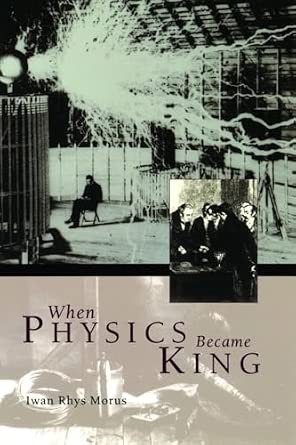
When Physics Became King
Author(s): Iwan Rhys Morus (Author)
- Publisher: University of Chicago Press
- Publication Date: 15 Feb. 2005
- Edition: Illustrated
- Language: English
- Print length: 316 pages
- ISBN-10: 0226542025
- ISBN-13: 9780226542027
Book Description
As recently as two hundred years ago, physics as we know it today did not exist. Born in the early nineteenth century during the second scientific revolution, physics struggled at first to achieve legitimacy in the scientific community and culture at large. In fact, the term “physicist” did not appear in English until the 1830s.
When Physics Became King traces the emergence of this revolutionary science, demonstrating how a discipline that barely existed in 1800 came to be regarded a century later as the ultimate key to unlocking nature’s secrets. A cultural history designed to provide a big-picture view, the book ably ties advances in the field to the efforts of physicists who worked to win social acceptance for their research.
Beginning his tale with the rise of physics from natural philosophy, Iwan Morus chronicles the emergence of mathematical physics in France and its later export to England and Germany. He then elucidates the links between physics and industrialism, the technology of statistical mechanics, and the establishment of astronomical laboratories and precision measurement tools. His tale ends on the eve of the First World War, when physics had firmly established itself in both science and society.
Scholars of both history and physics will enjoy this fascinating and studied look at the emergence of a major scientific discipline.
Editorial Reviews
About the Author
Excerpt. © Reprinted by permission. All rights reserved.
WHEN PHYSICS BECAME KING
By Iwan Rhys Morus
The University of Chicago Press
Copyright © 2005 The University of Chicago
All right reserved.
ISBN: 978-0-226-54202-7
Contents
List of Illustrations…………………………ixAcknowledgments………………………………xi1 Queen of the Sciences……………………….12 A Revolutionary Science……………………..223 The Romance of Nature……………………….544 The Science of Showmanship…………………..875 The Science of Work…………………………1236 Mysterious Fluids and Forces…………………1567 Mapping the Heavens…………………………1928 Places of Precision…………………………2269 Imperial Physics……………………………261Bibliographic Essay…………………………..287Index……………………………………….297
Chapter One
Queen of the Sciences
At the entrance to Belfast’s Botanic Gardens, across Queen’s University’s main campus from my office, stands a statue of the physicist William Thomson, Lord Kelvin (figure 1.1). Born in Belfast—where his father taught mathematics at the Academical Institution—in 1824, Thomson’s career as a man of science spanned the nineteenth century that forms the focus for this book. The statue is worth a closer look. As he gazes out towards University Road, Thomson holds an open book in his hands. The pages are inscribed with illustrations of his vortex model of the atom—the foundation to one of Thomson’s many claims to a place in the physicists’ hall of fame. He is leaning backwards slightly against a short pillar that turns out to be a magnetic compass on its stand—a key patented invention of his that played a vital role in the late nineteenth-century shipping industry that powered the economies of both his native Belfast and his adopted city of Glasgow. The combination of civic pride, philosophical insight, and industrial prowess represented by this statue says a great deal about nineteenth-century physics and what it came to stand for. It shows what mattered about physics in late nineteenth-century culture. This book follows the story of physics throughout that century, showing how a science that barely existed in 1800 came to be regarded a hundred years later as the ultimate key to unlocking nature’s secrets.
So why does the history of physics matter? One way of answering the question is simply to point to the central role physics and physicists have played and continue to play in our culture throughout the twentieth century and into the twenty-first. One area at least where we still seem to be largely in agreement with our late Victorian predecessors is on the issue of physics’ preeminence. We take it for granted that physicists are the best people to find out about the nature of the universe, and we look to their laboratories to keep producing the innovations that power our economies and satisfy our ever-increasing appetites for more. We look to them as well for solutions to the looming environmental catastrophe that two centuries of industrial expansion seems set to deliver. On the whole, but with increasing uncertainty, we still trust physics and physicists. In many ways, the iconography of Kelvin’s statue still rings true today. Great physicists are a source of national pride—living embodiments of a country’s genius. The number of Nobel laureates in physics is still cited as an index of a country’s international reputation. We admire physicists for their insights into the workings of nature. We gasp at the seemingly endless parade of wonders emanating from their laboratories as we look forward to Star Trek–style warp drives and transportation pads. In other ways, however, the status of physics is less clear than it was only a few decades ago. Arguably at least, molecular biology in the form of the Human Genome Project and its offshoots has replaced it in the public eye as the most visible scientific generator of excitement and progress.
As a historian, I am convinced that the first step towards understanding the central role that physics continues to play in twenty-first-century culture—and the ways in which that role is increasingly under threat—is to understand how that role came about in the first place. Peculiar as it might seem from the modern perspective of people accustomed to turning to physics (and to science and technology more generally) as a source of authority and of answers, it was not always like this. Two hundred years ago there was no discipline called physics, nor was there anybody who called themselves a physicist. For most of the century described in this book even, very few practitioners would have described what they did as physics and even fewer would have described themselves as physicists. Ironically enough, Lord Kelvin is one who would have rejected the labels out of hand. The practice of natural philosophy and the natural philosophers who practiced it had very different cultural roles from the ones their descendants play today. There was nothing inevitable about physics’ rise to prominence either. Making physics into the dominant discipline it is today took a great deal of work and effort. It was not just a matter of producing theories that appeared more and more successful at accounting for nature. It was a matter of persuading others that these theories really were true, that physics really was the best way of finding out about how the laws of nature operated. In other words, making physics into the preeminent scientific discipline needed real cultural engagement on the part of its practitioners.
This is why the history of physics that I offer here is an unashamedly cultural history. Again, this might at first appear a little strange. It is central to the view of science—and of physics as the preeminent science—that we hold in our culture that science and culture do not mix. In many ways one of the reasons we think we trust physics so much is because it appears to be free of that cultural taint. Physics simply tells it the way it is. Its results have nothing to do with its practitioners or the kinds of institutions they work in or their cultural status. Even the most superficial history of science tells us that this view is wrong, however. Physicists have always engaged with their culture, as did natural philosophers before them. Indeed, as this history of physics will show, without this kind of engagement there simply would not be any such thing as physics today. Making physics work needed more than great experiments and new insights into the workings of nature. At the very least those great experiments needed laboratories where they could be carried out. That meant persuading others to provide the resources needed to build those laboratories. Similarly, great insights into the workings of nature are of very little use unless others can be persuaded that they are worth listening to. This means that physicists in the past had to establish their own authority and their own claims to people’s trust at just the same time as they went about establishing their science.
The long standing perception of an unbridgeable chasm between science and ‘culture’ is another good reason for insisting that a properly cultural history of physics is essential. Physics is often portrayed—even by some of its greatest promoters—as some kind of alien force. The wild-eyed, disheveled physicist (think Albert Einstein on a bad hair day) is a familiar icon. The image is useful to physicists, serving as it does to underline their otherworldliness, the arcane nature of their practices, and their disconnectedness from mundane affairs. The image is just as useful to physics’ detractors and for much the same reasons. That physics is difficult, abstruse, and obsessed by detail seems a good enough reason for relegating it and its practitioners to the margins of modern culture. Ignoring physics like this, however, means ignoring one of the most influential aspects of our culture. Regardless of cozy assumptions by some physicists and their detractors alike that physics has nothing to do with culture, there are in fact very few aspects of our daily lives that are untouched by what physicists do. Understanding this means appreciating that physics is a part of, not apart from, our culture.
A cultural history of physics can also help us to move away from the prevailing view of science as the product of individual great men. When we think of physics’ past we typically view it in terms of a succession of individual scientific heroes, each building on the achievements of their predecessor. Most people, including most physicists, probably think of the history of physics (when they think about it at all) in this way. We think of Newton, or Faraday, or Einstein as individuals possessed of some ineffable insight into nature’s workings that belongs to them alone. This is what we mean when we describe people like them as geniuses. The picture of physics that emerges from cultural history, however, is very different. Physics from this perspective is a collective enterprise. To understand the way nature works requires collaborative action as much as individual thought. Physics as we know it today is a product of the mass mobilization of material and social resources on an unprecedented scale. To make physics what it is, physicists in the past had to do more than sit in their studies and think. They had to find ways of mobilizing those resources and carving out a cultural niche for themselves and their new discipline. To understand how they did this, we need a cultural history.
The history of science has changed dramatically over the last quarter century. Historians of science up until the 1960s saw their discipline as a handmaiden to philosophy. Philosophers analyzed the scientific method, and historians looked to the past to find examples of the method in action. The history of science was the history of progress. It recorded the gradual accumulation of scientific facts and theoretical insights that led inevitably to our modern understanding of the universe. A new generation of historians borrowed a term from political history to castigate this tradition as “Whig history”—it was the equivalent for science of liberal historians regarding the past in terms of the inevitable rise of liberal democracy and suffered from the same problems in that it judged the actions, achievements, and failings of the past through modern eyes rather than trying to understand them on their own terms. Historians of science in general and of physics in particular now tend to focus their attention on what might be called the microhistory of science instead. They look at particular controversies, the work of particular laboratories or institutions, the consolidation of particular theories. The result is a far richer and more nuanced understanding of physics and how it works than we had before.
Old-style history of science did, however, have one virtue. It had a “big picture.” The history of physics as the history of progress could be painted with a broad brush on a large canvas. Historians of physics now are quite rightly suspicious of such big pictures. We know very well that science is far too messy and human an affair for overeasy generalization. The problem with this is that it leaves us as historians without a broader perspective. The history of physics written as the history of progress from ignorance to enlightenment did at least provide its authors and their readers with a convenient narrative framework from which to hang their portraits. This is something that a cultural history of physics should be able to provide as well, however. It has the potential to develop new overarching themes that can play a role in reversing the current fragmentation of the historical picture. Looking, for example, at the different ways in which physicists have in the past tried to establish their authority as the ultimate arbiters on questions about the natural world and the ways in which this might be related to the kind of knowledge they produced does not commit us to any particular view concerning progress or the scientific method. It does, however, give us a new common thread running through our histories.
This particular history of physics starts around 1800. In many ways the choice of starting point is arbitrary. The period covered by the book is a reflection of the period about which I think I have something sensible and interesting to say. It is not, however, entirely arbitrary, and the reasons why it is not so provide another indication of the advantages of looking at physics through the lens of culture. Historians are largely agreed that events taking place in the last quarter or so of the eighteenth and around the beginning of the nineteenth century were truly revolutionary in their impact. The American and French Revolutions shattered the old social order. The Revolutionary and Napoleonic Wars in Europe convulsed society. The gathering pace of the Industrial Revolution had major implications for national and international economies and the organization of labor and trade. As the nineteenth century moved on, democracy gradually became less of a dirty word as newly powerful social groups sought to match their rising economic power with equivalent political clout. Some historians of science have labeled this period as the Second Scientific Revolution, with consequences as momentous as those of the first, seventeenth-century one. With appropriate qualifications I agree with them.
Physics in anything resembling the modern sense was born out of the cultural cauldron of late eighteenth- and early nineteenth-century Europe and America. It is no accident that the word physicist—in English at least—was first coined in the 1830s. The word was not invented earlier for the simple reason that the kind of person it was intended to describe did not exist more than a few years previously. The equivalent French and German words (physicien and Physiker respectively), while having a longer pedigree, underwent a similar redefinition during this period too. The kinds of institutions that typify modern physics—the laboratories, university training regimes, and research institutions—have their origins in the nineteenth century. It was during the nineteenth century that physicists forged for themselves the authoritative position as the ultimate legitimate spokespersons for nature that they still to a large degree enjoy today. It was during the nineteenth century that the intimate link between physics and industrial and technological progress that we now recognize was first forged as well. None of this is to suggest that there are not clear continuities between nineteenth-century physics and what went before. As we shall see over the next few pages, nineteenth-century physicists had concerns about the laws of nature, about the best ways of investigating them, and about the position of men of science in society that they certainly shared with their natural philosophical predecessors of the eighteenth, seventeenth, and earlier centuries. All I want to argue here is that the discontinuities were in the end rather more important.
The Worlds of Natural Philosophy
What can we say then about these continuities and discontinuities? Natural philosophers during the first Scientific Revolution certainly regarded themselves as having brought about a profound and important rupture from the past. They were placing the search for knowledge on a new footing, looking at nature instead of consulting the ancient authorities. Natural philosophers such as Galileo wrote in the vernacular rather than in dusty Latin and poked fun at the staid and unimaginative Schoolmen. He found new audiences for his writings in the urbane courts of Italian city-states like Florence and Venice. New societies devoted to the pursuit of natural knowledge, such as the Accademia del Cimento in Florence, the Académie Royale des Sciences in Paris, and the Royal Society of London for the Promotion of Natural Knowledge, likewise looked to the courts for patronage. Their members saw themselves as far removed from the traditional image of the reclusive Scholar. On the contrary, they were civic-minded gentlemen, committed to making their knowledge both useful and accessible. Universities were largely deemed irrelevant to the making of the New Science. Increasingly, it was outside the cloisters in royal or princely courts and aristocratic households that gentlemanly natural philosophers hoped to make their mark and cultivate patronage.
(Continues…)
Excerpted from WHEN PHYSICS BECAME KINGby Iwan Rhys Morus Copyright © 2005 by The University of Chicago. Excerpted by permission of The University of Chicago Press. All rights reserved. No part of this excerpt may be reproduced or reprinted without permission in writing from the publisher.
Excerpts are provided by Dial-A-Book Inc. solely for the personal use of visitors to this web site.


