Wow! eBook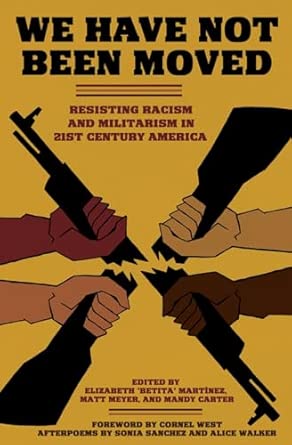
We Have Not Been Moved : Resisting Racism and Militarism in 21st Century America
Author(s): Elizabeth Betita Martinez (Author)
- Publisher: PM PRESS
- Publication Date: 17 Aug. 2012
- Edition: Illustrated
- Language: English
- Print length: 590 pages
- ISBN-10: 160486480X
- ISBN-13: 9781604864809
Book Description
Editorial Reviews
Review
“When we sang out ‘We Shall Not Be Moved’ in Montgomery and Selma, we were committed to our unshakeable unity against segregation and violence. This important book continues in that struggle–suggesting ways in which we need to do better, and actions we must take against war and continued racism today. If the human race is still here in 2111, the War Resisters League will be one of the reasons why!”
–Pete Seeger, folk singer and activist
“The rich and still evolving tradition of revolutionary pacifism, effectively sampled in these thoughtful and penetrating essays, offers the best hope we have for overcoming threats that are imminent and grim, and for moving on to create a society that is more just and free. These outstanding contributions should be carefully pondered, and taken to heart as a call for action.”
–Noam Chomsky, professor emeritus of linguistics at the Massachusetts Institute of Technology; philosopher, cognitive scientist, and activist
“One of the biggest stumbling blocks to building a successful movement against war has been our inability to cross racial and cultural lines, bridging the divides created and maintained by the powers that be. Since the 1960s, there have been some hopeful signs–in grassroots groups and in educational efforts–but the road forward is still long and difficult. The contributors to We Have Not Been Moved, with extraordinary scope and vision, have given us an indispensable tool to fight oppression, resist war and injustice, and create powerful new coalitions for lasting social change. This volume should be required reading–alongside of Howard Zinn’s A People’s History of the United States–in every sociology and political science class.”
–Connie Hogarth, life-long peace and justice activist and inspiration for Manhattanville College’s Connie Hogarth Center for Social Action; cofounder and former executive director of the Westchester People’s Action Coalition
“While it is nearly impossible to agree, or to disagree, with the totality of this or any other book, I applaud the ways in which We Have Not Been Moved helps us sharpen our understanding of these moral and social imperatives. This book is in the best tradition of civil and human rights movements and a welcome addition to the literature on these crucial issues.”
–Congressman Luis V. Gutiérrez, (D-IL)
“In an era of rampant militarism, growing anti-Islamic sentiment and racist violence, the essays in We Have Not Been Moved provide us with urgently needed analytical frameworks and on-the-ground strategies for challenging structural injustice. The wide range of voices in this collection, spanning generations and social movements, remind us of the interconnectedness of our struggles against racism, militarism, violence, and injustice, and collectively urge us to build a unified, principled movement to resist intensified empire.”
–Angela Y. Davis, author, activist, and professor emerita, History of Consciousness, UC Santa Cruz
About the Author
Elizabeth Betita Martínez is a Chicana feminist and a long-time community organizer, activist, author, and educator. She has written numerous books and articles on different topics relating to social movements in the Americas. Her best-known work is the bilingual 500 Years of Chicano History in Pictures, which later formed the basis for the educational video ¡Viva la Causa! 500 Years of Chicano History. Her work has been hailed by Angela Y. Davis as comprising “one of the most important living histories of progressive activism in the contemporary era… [Martínez is] inimitable… irrepressible… indefatigable.”
Mandy Carter began her long career as a human rights and nonviolent activist working with the War Resister’s League (WRL) in San Francisco, beginning in 1969. A veteran of Rev. Dr. Martin Luther King Jr.’s Poor People Campaign, Carter has been called “one of the nation’s leading African American lesbian activists” by the National Organization of Women. She has served on countless planning committees for national and regional lesbian and gay pride marches–including the steering committee for the historic 1987 March on Washington for Lesbians and Gays. As a staff member of the WRL’s Southeast regional office throughout the late 1970s and 1980s, Carter worked on the Boards of the National Stonewall Democratic Federation, the Triangle Foundation, Equal Partners in Faith, and Ladyslipper Music.
Matt Meyer is an educator-activist, based in New York City. Founding co-chair of the Peace and Justice Studies Association, and former Chair of the Consortium on Peace Research, Education and Development (COPRED), Meyer has long worked to bring together academics and activists for lasting social change. A former public draft registration resister and chair of the War Resisters League, he continues to serve as convener of the War Resisters International Africa Working Group. With Bill Sutherland, Meyer authored Guns and Gandhi in Africa: Pan-African Insights on Nonviolence, Armed Struggle and Liberation (2000), of which Archbishop Desmond Tutu wrote, “Sutherland and Meyer have looked beyond the short-term strategies and tactics which too often divide progressive people… They have begun to develop a language which looks at the roots of our humanness.”
Cornel West is a prominent and provocative democratic intellectual. He is the Class of 1943 University Professor at Princeton University. He graduated Magna Cum Laude from Harvard in three years and obtained his M.A. and Ph.D. in Philosophy at Princeton. He has taught at Union Theological Seminary, Yale, Harvard, and the University of Paris. He has written 19 books and edited 13 books. He is best known for his classic Race Matters, Democracy Matters, and his new memoir, Brother West: Living and Loving Out Loud. He appears frequently on the Bill Maher Show, Colbert Report, CNN and C-Span as well as on his dear Brother, Tavis Smiley’s PBS TV Show.
Alice Walker’s writings have been translated into more than two dozen languages, and her books have sold more than fifteen million copies. Along with the Pulitzer Prize and the National Book Award, Walker’s awards and fellowships include a Guggenheim Fellowship and a residency at Yaddo. In 2006, Walker was honored as one of the inaugural inductees into the California Hall of Fame. In 2007, Walker appointed Emory University as the custodian of her archive, which opened to researchers and the public on April 24, 2009.
Excerpt. © Reprinted by permission. All rights reserved.
We Have Not Been Moved
Resisting Racism and Militarism in 21st Century America
By Elizabeth Martínez, Matt Meyer, Mandy Carter
PM Press
Copyright © 2012 Elizabeth Martínez, Matt Meyer, and Mandy Carter
All rights reserved.
ISBN: 978-1-60486-480-9
Contents
Foreword: King’s Truth: Revolution and America’s Crossroads Cornel West,
Resisting Racism and War: An Introduction; or, What Will It Take to Move Forward? Matt Meyer, Elizabeth “Betita” Martínez, and Mandy Carter,
How the Moon Became a Stranger Chrystos,
By Any Means Necessary: Two Images Carrie Mae Weems,
I. Connections, Contexts, and Challenges,
II. (Re)Defining Racism and Militarism: What Qualifies? Who Decides?,
III. Chickens and Eggs: War, Race, and Class,
IV. The Roots and Routes of War: Patriarchy and Heterosexism,
V. The Roots and Routes of War: Nationalism, Religion, Ageism,
VI. Where Do We Go from Here? Organizing Against War and Racism,
VII. AfterPoems,
Acknowledgments:,
Contributors:,
Index:,
CHAPTER 1
Wild Poppies
Marilyn Buck
I remember red poppies, wild behind the school house
I didn’t want to be there, but I loved to watch the poppies
I used to sit in the window of my room, sketching charcoal trees
what happened to those magnolia trees, to that girl?
I went off to college, escaped my father’s thunderstorms
Berkeley. Rebellion. Exhilaration!
the Vietnam War, Black Power, Che took me to Chicago
midnight lights under Wacker Dr. Uptown. South Side. Slapped
by self-determination for taking Freedom Wall photos
without asking
on to California, driving at 3:00 in the morning in the mountains,
I got it: what self-determination means
A daunting task for a young white woman, I was humbled
practice is concrete … harder than crystal-dream concepts
San Francisco, on the front steps at Fulton St.
smoking reefer, drinking “bitterdog” with Black Panthers and white
hippie radicals, talking about when the revolution comes
the revolution did not come. Fred Bennett was missing
we learned he’d been found: ashes, bones, a wedding ring
but later there was Assata’s freedom smile
then I was captured, locked into a cell of sewer water
spirit deflated. I survived, carried on, glad to be
like a weed, a wild red poppy,
rooted in life.
Are Pacifists Willing to Be Negroes?
A 1950s Dialogue on Fighting Racism and Militarism, Using Nonviolence and Armed Struggle
Dave Dellinger, Robert Franklin Williams, Rev. Dr. Martin Luther King Jr., and Dorothy Day
Founded in 1956 as a forum for debates on strategies and tactics, coalition and movement-building, Liberation magazine came to be an important foundation of the growing civil rights, human rights, peace and anti-war movements of the 1960s and ’70s. Edited by leading pacifists A.J. Muste, Dave Dellinger, and Bayard Rustin, the magazine — in part funded by the War Resisters League — was seen by many as part of the New Left, but had roots in the calls for revolutionary nonviolence coming from the radical conscientious objectors and resisters of World War II. The following 1959 excerpted exchange (between King, Williams, and Dellinger) is a case in point of how seemingly divergent peoples were respectfully discussing their points of ideological and practical differences, with an eye toward the greater unity which may be achieved. Williams’s classic book Negroes with Guns had not yet been published, but he was already an iconic leader — as the NAACP local chapter president who was advocating armed self-defense against the KKK. Three years later, Catholic Worker founder Dorothy Day traveled to Cuba — where Williams was living in exile — and gave an update to the conversation.
Because North Americans tend to look at famous figures and frozen moments of massive events, we have a harder time remembering or understanding the ways in which movements are built by small steps, overcoming obstacles all the way. Beyond the canonization of King, the ways in which we remember Williams (as an early militant and, later, the first president of the Republic of New Afrika), Dellinger (as a member of the Chicago Eight and the center of the coalitions against the war in Vietnam), and Day (as the architect of the modern Catholic left), do not help us in holding onto the fact that each of the four of them were affected by and helped affect the tides of history which came their way. This dialogue, held in the pages of Liberation, helps remind us of both their humanity as well as the force of those times. Looking at the tactical issues faced after the now-historic Montgomery bus boycott, and the increased lynching of Black activists in the South, Dellinger especially turns the question of whether the Black movement should embrace absolute nonviolence on its head, centering his argument on the responsibilities of anti-racist white peaceniks. Over fifty years later, with some of the same points creating challenges and divisions within our organizations and campaigns, we may do well to create greater spaces for respectful discussion in our quest for building more successful movements.
Dave Dellinger: Robert F. Williams makes a strong case for a negative answer to the question many Negroes are asking these days: can Negroes afford to be nonviolent? The Montgomery bus protest, which was once hailed as a portent of greater victories to come, is fast becoming an icon for pacifist devotions. In Alabama and Mississippi, in North Carolina and Virginia, in Little Rock and Tallahassee, the organized movement for liberation is almost at a standstill. In almost any southern town, the individual Negro who dares to assert his dignity as a human being in concrete relationships of everyday life rather than in the sanctuary of the pulpit is in danger of meeting the fate of Mack Parker or Emmett Till.
In such a situation, it would be arrogant for us to criticize Robert Williams for arming in defense of himself and his neighbors. Gandhi once said that although nonviolence is the best method of resistance to evil, it is better for persons who have not yet attained the capacity for nonviolence to resist violently than not resist at all. Since we have failed to reach the level of effective resistance, we can hardly condemn those who have not embraced nonviolence. Nonviolence without resistance to evil is like a soul without a body. Perhaps it has some meaning in heaven but not in the world we live in. At this point, we should be more concerned with our own failure as pacifists to help spread the kind of action undertaken in Montgomery than with the failures of persons like Williams who, in many cases, are the only ones who stand between an individual Negro and a marauding Klan.
When nonviolence works, as it sometimes does against seemingly hopeless odds, it succeeds by disarming its opponents. It does this through intensive application of the insight that our worst enemy is actually a friend in disguise. The nonviolent resister identifies so closely with his opponent that he feels his problems as if they were his own, and is therefore unable to hate or hurt him, even in self-defense. This inability to injure an aggressor, even at the risk of one’s own life, is based not on a denial of the self in obedience to some external ethical command, but on an extension of the self to include one’s adversary. “Any man’s death diminishes me.”
But it is a perversion of nonviolence to identify only with the aggressor and not with his victims. The failure of pacifists with respect to the South has been our failure to identify with a “screaming Mack Parker” or with any of the oppressed and intimidated Negroes. Like the liberals, we have made a “token” identification to the point of feeling indignant at lynching and racist oppression, but we have not identified ourselves with the victims to the point where we feel the hurts as if they were our own. It is difficult to say what we would be doing now if Emmett Till had been our own son, or if other members of our family were presently living in the south under the daily humiliation suffered by Negroes. But it is a good bet that we would not be in our present state of lethargy. We would not find it so easy to ask them to be patient and long-suffering and nonviolent in the face of our own failure to launch a positive nonviolent campaign for protection and liberation. The real question today is not can Negroes afford to be pacifists, but are pacifists willing to be Negroes?
This question is particularly pointed in the South, and those of us who live in the North should not feel overconfident as to how we would act if we lived there. But the tragic fact is that in the South, the bulk of the members of the Society of Friends and of other pacifist groups live down to the rules of segregation much as other people do … So long as this pattern is maintained, a temporary absence of overt violence only means the appearance of peace when there is no peace. Human beings must love one another, or they will learn to hate one another. Segregation is incompatible with love. Sooner or later, segregation must erupt into violence, and those white persons who conform to the practice of segregation are as surely responsible as those of either color who bring out the guns.
Robert Williams makes a bad mistake when he implies that the only alternative to violence is the approach of the “cringing, begging Negro ministers,” who appealed to the city for protection and then retired in defeat. The power of the police, as the power of the F.B.I., the courts, and the federal government is rooted in violence. The fact that the violence does not always come into bloody play does not alter the fact that the power of the government is not the integrating power of love but the disintegrating power of guns and prisons. Unfortunately, too many of those who hailed the precedent of the Montgomery bus protest have turned away from its example and have been carrying on the fight in the courts or by appeals to legislators and judges.
In Montgomery, it was Rosa Parks, Martin King and their comrades who went to jail, not the segregationists. The power of the action lay partly in the refusal of the participants to accept defeat when the power of the local government was stacked against them, partly in their refusal to cooperate with the evil practice (riding the segregated buses) and partly in the spirit of dignity and love expressed in the words and actions of King.
(Continues…)Excerpted from We Have Not Been Moved by Elizabeth Martínez, Matt Meyer, Mandy Carter. Copyright © 2012 Elizabeth Martínez, Matt Meyer, and Mandy Carter. Excerpted by permission of PM Press.
All rights reserved. No part of this excerpt may be reproduced or reprinted without permission in writing from the publisher.
Excerpts are provided by Dial-A-Book Inc. solely for the personal use of visitors to this web site.