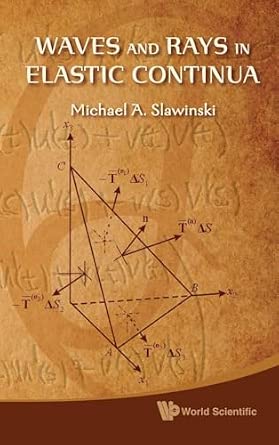
This is the second edition of the textbook that was first published by Elsevier Science. Professor Slawinski has the copyright to the textbook and the second edition is significantly extended. The present book emphasizes the interdependence of mathematical formulation and physical meaning in the description of seismic phenomena. Herein, we use aspects of continuum mechanics, wave theory and ray theory to explain phenomena resulting from the propagation of seismic waves. The book is divided into three main sections: elastic continua, waves and rays and variational formulation of rays. There is also a fourth part, which consists of appendices. In Part 1, we use continuum mechanics to describe the material through which seismic waves propagate, and to formulate a system of equations to study the behaviour of such a material. In Part 2, we use these equations to identify the types of body waves propagating in elastic continua as well as to express their velocities and displacements in terms of the properties of these continua. To solve the equations of motion in anisotropic inhomogeneous continua, we use the high-frequency approximation and, hence, establish the concept of a ray. In Part 3, we show that, in elastic continua, a ray is tantamount to a trajectory along which a seismic signal propagates in accordance with the variational principle of stationary traveltime. Consequently, many seismic problems in elastic continua can be conveniently formulated and solved using the calculus of variations. In Part 4, we describe two mathematical concepts that are used in the book; namely, homogeneity of a function and Legendre’s transformation. This section also contains a list of symbols.
Editorial Reviews
Review
“This textbook serves as a useful reference for both final-year undergraduates and beginning graduate students interested in the application of the mathematical theories of waves to seismic studies. Seismic data analysis has been an important tool in the study of the earth’s interior and in the exploration for mineral resources. Techniques for such analysis are often based on semi-empirical models and signal processing algorithms. This book provides a comprehensive theoretical framework for the understanding of the propagation of seismic wave energy based on wave and ray theories. It fills in a gap between the more practical, empirical approaches and the mathematical theories of waves in elastic media. Overall, it is an excellent book which deserves a second look.” — Lim Hock, Director, Temasek Laboratories
“The treatment is modern, but the mathematics is presented in a classical style, readable by geophysicists. Slawinski’s inclusion of issues related to anisotropy is a must for any modern book on the subject. The text provides a modern mathematical physics context for seismic wave and ray theory, acting as a bridge between the disciplines of mathematical physics and geophysics that will benefit anyone interested in these topics.” — The Leading Edge
“Particularly useful are the sets of exercises with complete solutions at the end of each chapter which illustrate important calculations, methods and proofs of theorems. This book touches on several important classical areas of physics and applied mathematics and provides an excellent introduction both to them and to the theory of waves in a geophysical context and is strongly recommended.” —Contemporary Physics
From the Back Cover
This is the second edition of the textbook that was first published by Elsevier Science. Professor Slawinski has the copyright to the textbook and the second edition is significantly extended. The present book emphasizes the interdependence of mathematical formulation and physical meaning in the description of seismic phenomena. Herein, we use aspects of continuum mechanics, wave theory and ray theory to explain phenomena resulting from the propagation of seismic waves.
The book is divided into three main sections: elastic continua, waves and rays and variational formulation of rays. There is also a fourth part, which consists of appendices. In Part 1, we use continuum mechanics to describe the material through which seismic waves propagate, and to formulate a system of equations to study the behaviour of such a material. In Part 2, we use these equations to identify the types of body waves propagating in elastic continua as well as to express their velocities and displacements in terms of the properties of these continua. To solve the equations of motion in anisotropic inhomogeneous continua, we use the high-frequency approximation and, hence, establish the concept of a ray. In Part 3, we show that, in elastic continua, a ray is tantamount to a trajectory along which a seismic signal propagates in accordance with the variational principle of stationary traveltime. Consequently, many seismic problems in elastic continua can be conveniently formulated and solved using the calculus of variations. In Part 4, we describe two mathematical concepts that are used in the book; namely, homogeneity of a function and Legendre’s transformation. This section also contains a list of symbols.
 Wow! eBook