 Wow! eBook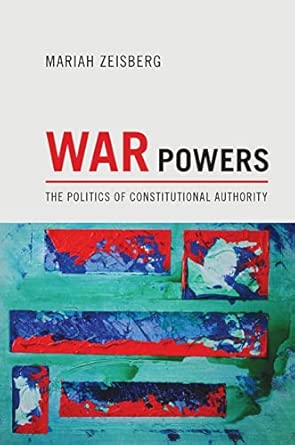
War Powers: The Politics of Constitutional Authority
Author(s): Mariah Zeisberg (Author)
- Publisher: Princeton University Press
- Publication Date: 26 May 2013
- Language: English
- Print length: 288 pages
- ISBN-10: 0691157227
- ISBN-13: 9780691157221
Book Description
Editorial Reviews
Review
“An ambitious new book.”
—Joseph Margulies, Political Science Quarterly“Winner of the 2014 Richard E. Neustadt Award, Presidents and Executive Politics Section of the American Political Science Association”
“Zeisberg has written a sophisticated, painstakingly researched analysis focusing on the age-old question of the proper allocation of war powers between Congress and the president.”– “Choice”
From the Inside Flap
“We should judge constitutional conflicts, Mariah Zeisberg argues, by asking how they engage the distinctive strengths and capacities of the different branches of government. This is a thoughtful and stimulating book–it breaks new ground in war powers theory and constitutional theory.”–Jack M. Balkin, Yale Law School
“With clear and accessible prose, and a plethora of historical examples, this truly splendid book will repay repeated readings. Zeisberg presents highly nuanced arguments in favor of adopting an alternative to currently standard conceptions of war powers that seek unequivocal answers to whether Congress or the president has the authority to go to war under the Constitution. No future discussion of the topic can ignore this book.”–Sanford Levinson, author ofFramed: America’s 51 Constitutions and the Crisis of Governance
“Zeisberg’s book on war powers brings you in, stops you short, and forces you to reassess your own assumptions. Taking war powers scholarship in a new direction, this book encourages engagement with the right set of issues, asks the right questions, and is a breath of fresh air.”–Stephen Griffin, Tulane University Law School
“This first-rate work looks at how the US Constitution allocates war powers between the executive and legislative branches of the national government. The focus away from constitutional law toward a well-functioning constitutional politics is a breakthrough and Zeisberg develops a highly original method of thinking for vital constitutional problems.”–Mark Graber, University of Maryland Francis King Carey School of Law
From the Back Cover
“We should judge constitutional conflicts, Mariah Zeisberg argues, by asking how they engage the distinctive strengths and capacities of the different branches of government. This is a thoughtful and stimulating book–it breaks new ground in war powers theory and constitutional theory.”–Jack M. Balkin, Yale Law School
“With clear and accessible prose, and a plethora of historical examples, this truly splendid book will repay repeated readings. Zeisberg presents highly nuanced arguments in favor of adopting an alternative to currently standard conceptions of war powers that seek unequivocal answers to whether Congress or the president has the authority to go to war under the Constitution. No future discussion of the topic can ignore this book.”–Sanford Levinson, author of Framed: America’s 51 Constitutions and the Crisis of Governance
“Zeisberg’s book on war powers brings you in, stops you short, and forces you to reassess your own assumptions. Taking war powers scholarship in a new direction, this book encourages engagement with the right set of issues, asks the right questions, and is a breath of fresh air.”–Stephen Griffin, Tulane University Law School
“This first-rate work looks at how the US Constitution allocates war powers between the executive and legislative branches of the national government. The focus away from constitutional law toward a well-functioning constitutional politics is a breakthrough and Zeisberg develops a highly original method of thinking for vital constitutional problems.”–Mark Graber, University of Maryland Francis King Carey School of Law
About the Author
Excerpt. © Reprinted by permission. All rights reserved.
WAR POWERS
The Politics of Constitutional Authority
By Mariah Zeisberg
PRINCETON UNIVERSITY PRESS
Copyright © 2013 Princeton University Press
All rights reserved.
ISBN: 978-0-691-15722-1
Contents
Chapter 1 Who Has Authority to Take the Country to War?……………….1Chapter 2 Presidential Discretion and the Path to War: The Mexican War
and World War II…………………………………………………..54Chapter 3 “Uniting Our Voice at the Water’s Edge”: Legislative Authority
in the Cold War and Roosevelt Corollary………………………………92Chapter 4 Defensive War: The Cuban Missile Crisis and Cambodian
Incursion…………………………………………………………146Chapter 5 Legislative Investigations as War Power: The Senate Munitions
Investigation and Iran-Contra……………………………………….184Chapter 6 The Politics of Constitutional Authority……………………222Acknowledgments……………………………………………………263Index…………………………………………………………….265
Excerpt
CHAPTER 1
WHO HAS AUTHORITY TO TAKE THECOUNTRY TO WAR?
In early 2012 President Quaddafi’s suppression of popular uprisings inLibya began to arouse concern domestically and abroad. Attention beganto focus on what, if any, the US response would be. By late February theUN Security Council adopted a resolution expressing “grave concern”about Libya, and the US Senate unanimously approved a resolution callingfor the Security Council to impose a Libyan no-fly zone. By March,the Security Council had authorized member states to use force to protectLibyan civilians, and the House simmered with dispute about thepresident’s constitutional war authority. On March 18 President Obamadeployed troops to Libya.
The president’s domestic authority to intervene in Libya was conditionedby two authoritative texts: the US Constitution, which grants himthe power to command the military, and Congress the power to declarewar; and the War Powers Resolution of 1973 (WPR), which creates proceduraland reporting requirements for deployments. The WPR declaresthat presidents may introduce US armed forces into “hostilities” “onlypursuant to (1) a declaration of war, (2) specific statutory authorization,or (3) a national emergency created by attack upon the United States.”With none of these conditions in place, the president’s legal authorityto intervene in Libya under the WPR was suspect from the beginning.Nonetheless, the WPR’s procedural requirements created a set of structuredexpectations about how the branches would respond to one anotherover the Libyan incursion. On March 21 Obama reported to Congress”consistent with the War Powers Resolution.” When US militaryoperations continued past the time horizons of the WPR, still withoutlegislative authorization, members of Congress challenged the president’sconstitutional and statutory faithfulness.
Instead of either challenging the constitutionality of the WPR, or discontinuingoperations, the executive branch argued that the deploymentsdid not amount either to “hostilities” or to “war in the constitutionalsense.” By early June, a restive House resolved that the Libyan missionhad not been legislatively authorized and stated the legislature’s prerogativeto withdraw funding. Hundreds of senators and representatives expressedconstitutional concerns, but this did not translate into a willingnessto either authorize or shut down operations.
The legislature’s challenge and the president’s response constitute a revealingwindow into characteristic features of a constitutional war powersdebate. Consider first that the debate was nowhere judicialized. Membersof the House sued the president, but the US District Court threw thecase out, noting its “frustration” at being asked to hear the case givenlong-standing precedent. This controversy would be decided throughnonjudicial politics. Indeed, the politics of the moment were on vividdisplay in the reasoning of three prominent executive branch officials—PresidentObama, Vice President Biden, and Secretary of State Clinton—allof whom argued that this use of the military was constitutional, but allof whom, when they were Democratic senators challenging a Republicanpresident, had emphasized the importance of legislative authorizationfor war.
The debate pivoted around the meaning of “war”—in the language ofthe Office of Legal Counsel (OLC), “war for constitutional purposes.”Despite air strikes and remote drones, the administration claimed thatthe Libyan intervention was neither “war” nor “hostilities.” PresidentObama interpreted the meaning of “war” and “hostilities” not throughinternational law, or judicial precedent, or close readings of the Constitution’stext. Rather, the administration invoked policy concerns, structuraland governance reasons, and historic precedent. State Department legaladvisor Harold Koh told Congress that it should interpret the WPR’slanguage in light of the security consequences of their chosen readings,emphasizing that a “mechanical reading of the statute could lead to unintendedautomatic cutoffs … where more flexibility is required.” Theadministration described the importance of US intervention for regionalsecurity, for UN and NATO credibility, for humanitarian needs, and forinternational alliances, especially given the foreign policy imperatives ofthe Arab Spring. The OLC made these policy reasons one element of aconstitutional test, arguing that the president’s war authority dependedupon whether the intervention served “sufficiently important nationalinterests.”
The administration also gave reasons that spoke to the governing capacitiesof the branches. For example, it cited the president’s capacity torespond to “rapidly evolving military and diplomatic circumstances.”It emphasized that costs and casualties would be low and that the administrationwould not ask Congress for appropriations. Apparentlyconcerned about policy intersections between Libya and other legislativesecurity priorities, the administration argued that the intervention wouldhave few policy consequences elsewhere. For example, the interventionwould not impact operations in Iraq and Afghanistan, nor was it likely toescalate. The OLC argued that only operations sufficiently extensive in”nature, scope, and duration” required legislative approval. Finally, itscitation of OLC reasoning during the Clinton administration amountedto a precedent-based claim.
To argue for the constitutionality of a president’s deployment becauseof its importance for domestic security interests would seem toviolate one central effort of constitutional law: to seek answers aboutprocedural authority precisely so as to avoid controversy over topics likeLibya’s security significance. Legal objections either condemned Obamafor playing fast and loose with constitutional and statutory language, orchallenged the integrity of the OLC’s legal process. No constitutionalscholarship found Obama’s substantive claims worth investigating: forexample, whether the Libyan intervention actually was as significant toregional peace, NATO and UN credibility, and US domestic interests asObama claimed. Nor did constitutional scholars engage the structuralarguments that Obama offered for presidential war governance. Perceivingthat the administration was being strategic in its interpretation of constitutionallanguage, some argued that the War Powers Resolution—andperhaps the Constitution itself—were shoddy in their legal draftsmanship,especially in allocating interbranch war authority with referenceto a set of slippery terms (“war,” “hostilities”) that have little definitivecontent.
It is true that the US Constitution’s allocation of the power to initiatehostilities is ambiguous. That the Constitution empowers a federalgovernment to wage war is beyond dispute. But which branch hasthe power to initiate hostilities? Congress is vested with the power to”declare war,” a power whose scope could range from the simple legalpower of naming, to an exclusive power to authorize any and all militaryconfrontation. Congress can also pass laws and appropriate funds,regulate the military, and create the structure of the executive bureaucracy,including security-related bureaus. Finally, Congress is vested withthe power to “issue letters of marque and reprisal,” a common form oflimited and undeclared war of the eighteenth century. Yet the presidentis granted a vague “executive power,” and the Constitution designateshim “Commander in Chief … when called into the actual Service of theUnited States.” Unlike the legislature and judiciary, the presidency neveradjourns, and the structure of the branch is comparatively efficient andunitary. Article II Section 1 also requires the president to swear to “preserve,protect, and defend” the Constitution. These features imply someindependent war powers, and the oath implies that those powers are fordefensive purposes. The contours of those powers, and the conditionsunder which they may be used, are never specified. Nor do originalistsources reveal any bright lines. Justice Jackson said that the answer tothis question “must be divined from materials almost as enigmatic as thedreams Joseph was called upon to interpret for Pharaoh.”
The Constitution also fails to provide for one authoritative institutionto settle this controversy. Whereas the South African Constitutiondesignates its Constitutional Court as the “highest court on all constitutionalmatters,” and specifies that the Court “makes the final decisionwhether a matter is a constitutional matter,” the US Constitution neverconcretely establishes judicial review. The power of the US Supreme Courtto interpret the Constitution is implied, not explicit, and its origins rest injudicial constitutional reasoning that has been sustained and reinforcedby other political actors, rather than being mandated, or even explicitlycontemplated, by the text. In its constructions of constitutional meaning,the judiciary has chosen to limit its scrutiny of “political questions” likethe nature of constitutionally authoritative procedures for going to war.
In the domain of war powers, the agents who have advanced andjudged claims of war authority are not courts but the elected branchesthemselves as they formulate and defend their policies to one another andto the electorate. They have often done so in ways that are transparentlylinked to institutional or partisan policy advantage. Presidents in thetwentieth century have made vast claims for independent war-making authority.Truman, Ford, Kennedy, Johnson, Nixon, Reagan, George H. W.Bush, Clinton, and Obama all claimed the power to initiate hostilitieswithout congressional authorization—a claim premised on the executive’sauthority to decide on his own what constitutes a threat and anappropriate response to threat. Although it was unusual for nineteenth-centurypresidents to state it explicitly, presidents from Jefferson to Polkto Lincoln to Wilson behaved as if congressional authorization for militaryhostilities was optional. In fact, while George W. Bush is rememberedfor bellicosity, his effort to achieve congressional authorization to fightwars in Iraq and Afghanistan was notably sensitive to legislative prerogativesin war. Many presidents have behaved as though whether to engagein military hostilities is not a relevant question for Congress.
Congress, too, has been actively engaged on its own behalf. Early Congressesmade assertions of constitutional authority that are breathtakingto modern ears. The debate between Pacificus and Helvidius, oneof the first showdowns between the branches, concerned whether ornot it is constitutionally appropriate for the president to offer a pointof view about how a treaty should be interpreted. Partisans of Congressworried that a president’s speech about the meaning of a defensetreaty would unduly contort the legislature’s deliberative space. Many ofCongress’s esteemed members—Senators Vandenberg, Nye, Taft, Mansfield,Fulbright—were known for their sustained challenges to executivewar authority. In 1973 congressional solicitude for its own institutionalhonor reached a new level of mobilization in the War Powers Resolution.The Iran-Contra hearings and contemporary agitation about executiveauthority for interventions in Libya show us that even in the age of the”imperial presidency,” the legislative branch has its defenders.
Both the Constitution’s text—which apparently commits the elaborationof the meaning of “war” to a potentially rivalrous interbranchrelationship—and the history of war powers debates, where the branches’interpretive claims are transparently driven by partisan, institutional, andpolicy rivalries, generate one common conclusion: core features of thisarea of constitutional policy do not intersect well with standard presumptionsabout the conditions of faithful constitutional interpretation.Conventional beliefs about constitutional reasoning emphasize neutrality,impartial review, and the value of making policy in conformity withthe Constitution’s procedural requirements as specified either explicitlyin the text or through judicial construction. With underdeterminate constitutionallanguage, an interpretive process driven by the politics of motivatedand strategic officeholders, and the absence of a final arbiter, thestructural conditions of the war powers debate are repugnant to coreconditions thought necessary for achieving good practices of constitutionalinterpretation.
The idea that constitutional fidelity means adhering to the meaningof determinate text, or adhering to the decisions of one authoritative,impartial adjudicator is sustained by reference to an idea about constitutionalauthority called the settlement thesis. The settlement thesis claimsthat the very point of constitutions is to resolve conflict over basic politicalquestions like the allocation of power between institutions. Forthe Constitution to be authoritative in disciplining war powers is for theConstitution to resolve the basic question of where war authority residesand for all agents to conform their behavior to that settled understanding.Policies may be more or less legitimate, more or less in accord withthe “spirit” of the Constitution. But the Constitution as authoritativetext is the Constitution whose translation into politics is determinate.
The hope is that constitutions can contain policy controversy withina set of uncontroversial decision procedures. If a constitution offers a setof clear boundaries, then actors can uncontroversially assess the constitutionalityof their behavior, and a core function of the constitutionalorder—t o create a stable, procedural, lawful framework—i s achieved.The link between settlement theory and judicial supremacy should betransparent: if the primary function of a constitution is to resolve interpretiveconflict, then it is important to identify a single institution whoseimpartial reasoning about vague language can be accepted as authoritativeby all others.
Yet establishing stable, legal, procedural frameworks is only one taskof a constitutional order. Constitutions also create resources—textual,ideological, and institutional—through which actors occupy variousroles, or offices, and in turn use those offices to advance their aims inpolitics. The Constitution creates a politics every bit as much as it createsa legal order. The aims that politicians pursue in this constitutional universeare premised on, and have implications for, the policies and institutionsthat surround them. The Cold War ferocity of the Republican Partyin the 1970s and 1980s was linked to an interpretive claim about presidentialwar powers; so too, apparently, is the Obama administration’sconception of liberal international order. The availability of these textual,ideological, and institutional resources for ordinary politics makesit appropriate to assess constitutional fidelity not only in terms of respectfor a legal framework, but also in terms of officials’ relationships to astructured politics that is created and sustained through constitutionallanguage and institutions.
Can this politics be assessed in any meaningfully constitutionalist way?Evaluating the behavior and rhetoric of strategic, partisan, and motivatedpublic officials in terms of their adherence to neutral, procedural, nonpartisanstandards seems to promise only disappointment. For this reason,some say that we should not assess constitutional fidelity in the areaof war powers at all. John McGinnis and Mark Tushnet both argue thatthe Constitution’s failure to advance determinate rules over war powersmeans that the constitutional text is consistent with, in Tushnet’s words,”whatever the political process produces.”
But it is precisely this constitutional politics that determines the allocationof war authority in practice. And war has been endemic to Americanstatecraft. Since the constitutional founding, the United States has beenin an almost continuous state of war, and war has arguably been thesingle most important engine behind the development of the US state.To refrain from evaluating the interpretive politics behind this tremendousexertion of resources is to remove highly consequential domains ofgovernance from constitutional scrutiny. At the same time, we should beskeptical of accounts of constitutional fidelity that begin with the premisethat the ordinary behavior of elected officials is constitutionally deficient.
Assessing the branches’ war powers politics requires an altogether differentway of theorizing constitutional fidelity. This book demonstratesthat the constitutional politics of war powers can be meaningfully assessedin terms that are congruent, rather than repugnant, to their animatingconditions. Constitutional theory need not be disabled in its confrontationwith an interpretive politics that is shot through with vagueness, under-determinacy,structured interbranch conflict, and partisan and policyrivalries. We can generate standards for assessing interpretive fidelity thatcapture, track, and engage this constitutional politics rather than resist,ignore, and condemn it. Doing so requires new and different theoriesabout constitutional authority. This book is simultaneously about thewar power, about the best way to interpret the Constitution’s interbranchallocation of war authority; but it also offers a broader way of conceivingconstitutional authority, one that is relevant for other dimensions of constitutionalpolicy whose structuring premises, like those of war powers,fit poorly with the terms of settlement theory.
(Continues…)Excerpted from WAR POWERS by Mariah Zeisberg. Copyright © 2013 by Princeton University Press. Excerpted by permission of PRINCETON UNIVERSITY PRESS.
All rights reserved. No part of this excerpt may be reproduced or reprinted without permission in writing from the publisher.
Excerpts are provided by Dial-A-Book Inc. solely for the personal use of visitors to this web site.


