Wow! eBook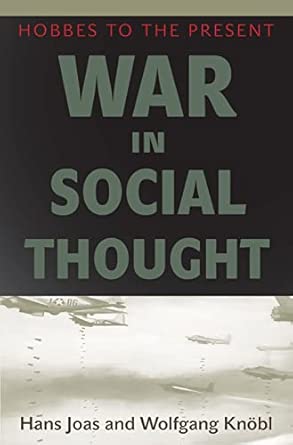
War in Social Thought: Hobbes to the Present
Author(s): Hans Joas (Author), Wolfgang Knobl (Author), Wolfgang Knöbl (Author)
- Publisher: Princeton University Press
- Publication Date: 4 Nov. 2012
- Language: English
- Print length: 336 pages
- ISBN-10: 0691150842
- ISBN-13: 9780691150840
Book Description
Editorial Reviews
Review
From the Inside Flap
"Joas and Knöbl place modern sociological theory in the distinctive perspective of war and peace, actual conflicts and struggles to end armed strife. This encourages readers to see familiar themes in new light as well as to pay attention to often-neglected dimensions of classical sociological theory. Not least, they help to situate theories that are often considered ahistorically in the abstract as part of the effort to understand war and peace in particular historical contexts."--Craig Calhoun, director of the London School of Economics and Political Science
"Viewed in its social context, war embraces every dimension of human life, yet the subject of war is almost wholly missing from social thought. This book is a very valuable corrective to this situation and well worth reading."--Edward Luttwak, Center for Strategic and International Studies
"There has been a tendency in social thought to stay clear of the issues of war despite its importance in shaping the modern age. But, as this important and erudite study shows, war keeps on intruding. By demonstrating how much theorists have struggled with the problems of war, Joas and Knöbl illuminate vital aspects of social theory--and of war itself."--Lawrence Freedman, King's College London
"This book, written by two eminent social theorists, has no parallel. Hans Joas and Wolfgang Knöbl tackle a fundamental problem in historical and contemporary social theory: the conceptualization of war as a fundamental phenomenon in social life. At the same time, they provide a comprehensive review of thinking about war in modern social theory since Hobbes. This book presents an impressive panorama of its subject."--Dieter Senghaas, University of Bremen
From the Back Cover
"Joas and Knöbl place modern sociological theory in the distinctive perspective of war and peace, actual conflicts and struggles to end armed strife. This encourages readers to see familiar themes in new light as well as to pay attention to often-neglected dimensions of classical sociological theory. Not least, they help to situate theories that are often considered ahistorically in the abstract as part of the effort to understand war and peace in particular historical contexts."--Craig Calhoun, director of the London School of Economics and Political Science
"Viewed in its social context, war embraces every dimension of human life, yet the subject of war is almost wholly missing from social thought. This book is a very valuable corrective to this situation and well worth reading."--Edward Luttwak, Center for Strategic and International Studies
"There has been a tendency in social thought to stay clear of the issues of war despite its importance in shaping the modern age. But, as this important and erudite study shows, war keeps on intruding. By demonstrating how much theorists have struggled with the problems of war, Joas and Knöbl illuminate vital aspects of social theory--and of war itself."--Lawrence Freedman, King's College London
"This book, written by two eminent social theorists, has no parallel. Hans Joas and Wolfgang Knöbl tackle a fundamental problem in historical and contemporary social theory: the conceptualization of war as a fundamental phenomenon in social life. At the same time, they provide a comprehensive review of thinking about war in modern social theory since Hobbes. This book presents an impressive panorama of its subject."--Dieter Senghaas, University of Bremen
About the Author
Excerpt. © Reprinted by permission. All rights reserved.
War in Social Thought
HOBBES TO THE PRESENTBy Hans Joas Wolfgang Knöbl
Princeton University Press
Copyright © 2008Suhrkamp Verlag, Frankfurt am Main
All right reserved.
ISBN: 978-0-691-15084-0
Contents
Preface........................................................................................................................vii1. Introduction................................................................................................................12. War and Peace before Sociology: Social Theorizing on Violence from Thomas Hobbes to the napoleonic Wars.....................163. The Long Peace of the nineteenth Century and the birth of Sociology.........................................................654. The Classical Figures of Sociology and the Great Seminal Catastrophe of the Twentieth Century...............................1165. Sociology and Social Theory from the end of the First World War to the 1970s................................................1566. After Modernization Theory: Historical Sociology and the bellicose Constitution of Western Modernity........................1947. After the east-West Conflict: Democratization, State Collapse, and empire building..........................................2178. Conclusion..................................................................................................................252Notes..........................................................................................................................257Bibliography...................................................................................................................277Name Index.....................................................................................................................315Subject Index..................................................................................................................323
Chapter One
Introduction
If we survey post-1945 sociology, which has claimed for itself chief if not sole responsibility for the field of social theory, it is striking how little it has been influenced by violence and war. This pattern applies both to the recent violent past, in other words the era of world wars and state-organized mass murder that ended in 1945, and to the dangers of the contemporary era, by which we mean both the tensions between the two superpowers during the Cold War and the unstable international situation of the early twenty-first century. Neighboring subjects or analytical approaches, such as the theory of international relations or interdisciplinary conflict and peace studies, have produced important studies on states' capacity for peace and the stability of the global power system (Galtung 1996; Senghaas 2001). But these studies had very little impact on the overall development of social theory. A truly in-depth engagement with the problems of war or the threat of war that might have driven theoretical developments is absent both from the oeuvre of Talcott Parsons, the most influential sociologist during the first few decades after the Second World War, and from the grand theories of the 1970s, 1980s, and 1990s. Authors such as Jürgen Habermas and Niklas Luhmann in Germany and Pierre Bourdieu and Alain Touraine in France all produced a more or less systematic theory of society without seriously examining the problem of war and associated phenomena. This absence is all the more remarkable given that war undoubtedly played a formative role in their biographies. There are exceptions. In early postwar sociology, the key figure here is Raymond Aron and later, above all, Anthony Giddens (1985), who produced a comprehensive social theory at around the same time as the previously mentioned French and German authors, in which historical analyses of war and collective violence played a major role. But Giddens quite abruptly lost sight of this topic in the early 1990s. Surprisingly, then, the vast majority of past and present theorists—even if they attempted to produce a systematic interpretation of "modernity"—have almost always sidestepped the phenomenon of war, either completely or to a great extent. All too often, if they show any interest at all in historical analyses rather than restricting themselves to snapshots of society or cursory diagnoses of the contemporary world, they approach the history of the past few centuries as a more or less linear process of differentiation and rationalization, as if social change had always been a matter of peaceful if not harmonious progress, as if modernity hadn't been characterized by repeated phases of large-scale violence between states (see Knöbl/Schmidt 2000).
In brief, most contemporary social theory has failed to adequately express the internal contradictions, the Janus face, of the modern era. A substantial number of social scientists are still caught up in the peaceful-utopian mood of the European enlightenment and continue to dream the "dream of a non-violent modernity" (Joas 2003). From this perspective, it is easy to dismiss wars as extreme exceptions, as temporary disturbances in the civilizational equilibrium. What are the reasons for this blindness of contemporary sociology and, above all, social theory with regard to war or—more generally—to violence?
It is no doubt significant in this context that violence, whether within societies or between states, has never been a central topic within the discipline. Certainly, the founders and classical figures of sociology referred to the causes, course, and impact of wars, class struggles, or other violent conflicts in their commentaries on current affairs and historical surveys—but the relationship between these commentaries and the systematic core of their theories is mostly quite unclear. They always paid far more attention to economic, social, and political inequality than to the phenomena of violence in general and war in particular. Even the legitimate institutions of the state monopoly on violence (police and armed forces) received fairly scant attention, which is remarkable in view of their size and significance in the age of the greatest rivalry between nation-states and massive social conflicts on the cusp of the twentieth century. It is this past lack of interest that has resulted in the theoretical problems of the present. While criminology and the sociology of deviant behavior have become established research fields, with notable findings on individual violence, far too little attention continues to be paid to the genesis and forms of collective and state violence (of whatever kind), and thus we find the greatest theoretical shortcomings here as well. Analyses of collective violence are often plagued by the misleading application of models presenting the genesis of individual violence and tend to fluctuate between rationalistic and irrationalistic overstatement. Whereas some authors attempt to understand violence as an instrument coolly selected and deployed to further the interests of a nation or class, a phenomenon about which we can say little beyond noting its instrumentality, others view violence solely as the collapse of all social order, the consequence of a loss of normative orientation and individual rationality (for an excellent survey, see Pettenkofer 2010). Dramatic public events such as the racial unrest in the United States during the 1960s did lead to a temporary increase in scholarly interest and to solid reports by expert commissions; and it is true that recently some authors (mostly from the field of historical sociology) have produced theoretically ambitious studies of the genocidal violence that has proliferated since the 1990s (see, e.g., Mann 2005). Yet just as the public, and social scientists, quickly lost interest in the commissions' findings in the past, even a broad social theoretical interest in genocidal violence or the so-called new Wars is likely to tail off again rapidly as soon as other phenomena become the flavor of the month. The deeply anchored relevance structures of sociology have tended to obstruct engagement with the topic of collective violence and will likely continue to do so in future.
There are good reasons to believe that this peculiar apportioning of attention is due to the Western social sciences' attachment to the worldview of liberalism. There is of course no such thing as liberalism in the singular; we would probably be best advised to refer to a family of "liberalisms." nonetheless it is fair to say that in this worldview violent internal conflicts and especially wars inevitably appeared as relics of an era nearing its end, an era not yet illuminated by the enlightenment (Williams 2006). Early liberalism regarded contemporary wars as a consequence of the aristocrats' martial spirit or despots' mood swings, and even the First World War was perceived by American liberal intellectuals of the day as a sign of European backwardness in comparison with American modernity. The martial spirit of the aristocracy, and despotism, were themselves considered remnants of primitive developmental stages of humanity; civilized life should also be a civil life in which martial characteristics and needs are not merely prohibited by religion and morality, but genuinely toned down and alleviated, or redirected into sporting and economic competition ("le doux commerce"). Although this might not quite amount to an age of nonviolence, enlightened liberals at least seemed to discern the path ahead and the steps that must be taken in order to achieve a perfectly rational order. Just as torture, including its publicly celebrated forms, must be eliminated from the field of criminal justice, so must war and all forms of violence against individuals and things vanish from modern—in other words, bourgeois—society. In the modernization theory of the period after 1945, nonviolent conflict resolution even became part of the definition of modernity. Thus, in this worldview, the sharp rejection of violence goes hand in hand with a certain downplaying of its presence. As liberals kept their eyes fixed firmly on the bright future to come, they looked on the bad old ways, now on their way out, with impatience, and without much real interest. The theories of globalization so fashionable at present, incidentally, have often simply adopted certain premises of the old modernization theory (see Knöbl 2007, 54ff.); they too see the occurrence of conflicts and wars merely as a sign of a lack of cosmopolitanism, and there is therefore no need to subject them to further scrutiny.
Even classical Marxism is a descendant of the liberal worldview when it comes to this faith in the future. Its exponents, it is true, emphasized the violent enforcement of the capitalist mode of production, the unrelenting material constraints concealed behind freely made contracts, and the class rule underlying the equality of individuals. So it didn't weigh heavily on their conscience that class rule could probably be overcome only by violent means or that, even well after the victory of the revolution, the "dictatorship of the proletariat" would have to suppress its opponents by force. But, in a sense, classical Marxism merely pushed the liberal worldview one era further: after the violence-necessitating global upheavals, Marxists envisaged the rise of a social order with no place for violence— in the shape of the universal and free association of producers. Thus, for Marxism, the end of violent social conflicts would ultimately result from the disappearance of all divergent interests in a totally just, spontaneously self-regulating system. As all wars or ethnic conflicts were understood as the expression of class contradictions, they would vanish when class conflicts came to an end.
Since the nineteenth century, then, (Western) social theory has largely been characterized by fundamental and deep-seated liberal assumptions, as a result of which violence has been ignored. Examination of the topic of war in the modern era—and thus the unavoidable questioning of those fundamental assumptions—is bound, therefore, to result in theoretical revisions and reorientations. It is also clear that getting to grips with forms of international violence is not something we might safely leave to the subdiscipline of "military sociology" and thus "exoticize" with respect to its significance to social theory. Rather, we can expect detailed consideration of the topic of war to advance the discipline's theoretical development, or at least to provide pointers to the construction of a more empirically convincing sociological theory and theory of modernity. For if we fail to take account of war, we can understand neither the constitution of modernity through the nation-state—rather than transnational processes—nor many of the social and cultural changes that have occurred in the modern age. Revolutions, shifts in class structures, and the extension and universalization of rights or upheavals in artistic and aesthetic fields are phenomena that have often been very closely bound up with the consequences of wars. Ignoring the question of the role played by military conflicts in the genesis and form of modernity inevitably results in sociological blind spots. Wars, which will not, presumably, be disappearing any time soon, can then be understood—as liberal theorists have suggested time and again—merely as a barbaric relic, as the "relapse" of civilized societies into cultural stages believed long since overcome rather than a constitutive element of the modern age, as momentous events that change the course of history. If sociology continues to argue in this way, if it fails to grasp the significance of wars and continues to suppress them, it will be squandering major opportunities to analyze the contemporary era—with far-reaching consequences for the future of the discipline.
So war is a field well worth researching, especially from a theoretical standpoint. But why should examination of the history of social theory be such a promising source of insight if (as indicated above) since its foundation sociology has never seemed to get very far with the topic of war? The answer begins to emerge from the following facts. The discipline, it is true, has never featured a stable and long-standing focus on "war" comparable to that on "social inequality," for example. Yet it has produced individual analyses here and there that are worth looking at if we want to understand why the social sciences in general and sociology in particular, with all their blind spots, have become what they are—but especially if we are in search of ideas that might still be a source of inspiration today. Such analyses are not simply sitting there ripe for the picking; there is no canon of classical texts on war and peace by social theorists, let alone genuine sociologists, that would provide a rapid and representative overview of the field. If we want to uncover this aspect of the sociological inheritance, we really have to look for it, setting off along seemingly remote paths as well as those that lead deep into the prehistory of social theory; only then will we understand why modern-day social scientists answer questions about war and peace just as they do. Four conceptual or methodological remarks are necessary at this point in order to avoid misunderstandings from the outset.
1. We quite consciously do not refer to "sociology" or "social sciences" in the title of this book. Instead, we use the terms "social thought" and "social theory. "This choice of terminology has at least two consequences. "Social theory" (see Joas/Knöbl 2009, ix ff.) refers to systematic reflection on social realities and putative regularities of social life; but there is also an element of (critical) theoretical strategy to the term, which was after all coined and deployed toward the end of the nineteenth century (in the Anglo-American world) as a means of questioning overt and covert utilitarian premises in the social sciences. Social theory and—with an even broader meaning—social thought are thus essentially the analysis of social action, social order, and social change (1ff.); at the same time, such analysis inevitably comes up against normative questions, and those engaged in it are compelled to take some kind of position on these questions. This is plainly apparent, for example, in the "genre" of sociological analyses of the contemporary world (such as theories of modernity). All of this means (to turn to those consequences we mentioned) that, first, examination of the relationship between social theory and war must be both wide-ranging and focused. It must be wide-ranging because ideas about social action, social order, and social change on the one hand and war on the other were never limited to just one discipline. Analyses of these things have been produced (and are produced still) within economics and political science, history and philosophy—though we should bear in mind that before the nineteenth century disciplinary boundaries were blurred anyway. In what follows, therefore, we are not concerned to keep strictly within the confines of the discipline of sociology, though we are both sociologists. We feel that debates on who is or is not a genuine sociological pioneer are quite unhelpful: sociology is certainly active in the domain of social theory but is not alone there. So we discuss a number of authors not usually counted among the subject's ancestral lineage. Our approach is inter- or transdisciplinary and thus "wide-ranging" in the sense of a "post-disciplinary history of disciplines" (Joas 1999a). Second, however, the notion of "social theory" compels us to focus our attention. because we are concerned with the abstract problems of action, order, and change, we are not interested in every social scientific analysis ever published on the topic of war: detail-rich findings by military sociologists on the ethnic or class composition of ground forces are of as little interest to us here as analyses of key players' decision-making behavior in crisis situations by international relations scholars. Only those research findings, observations, and reflections that touch on the field of social theory, defined in abstract terms above, are of relevance to us here, which is why we feel free to ignore large swathes of the social scientific literature on war. We do discuss a fair number of thinkers of the seventeenth and eighteenth centuries in particular who are also key figures in social philosophy and/or political philosophy. But we believe that our social theory focus on the problems of action, order, and change provides new insights into the often quite peculiar highways and byways of thinking on war and peace. If we therefore opt not to consider certain issues or adopt a different perspective, this is not a matter—to use Max Weber's terms—of a value judgment (Werturteil) but merely a value relation (Wertbeziehung); the problems with which we are concerned are simply different from those dealt with in parts of the literature or the various disciplines mentioned above.
(Continues...)
Excerpted from War in Social Thoughtby Hans Joas Wolfgang Knöbl Copyright © 2008 by Suhrkamp Verlag, Frankfurt am Main . Excerpted by permission of Princeton University Press. All rights reserved. No part of this excerpt may be reproduced or reprinted without permission in writing from the publisher.
Excerpts are provided by Dial-A-Book Inc. solely for the personal use of visitors to this web site.