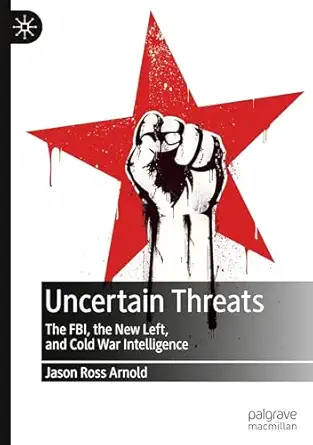
Uncertain Threats: The FBI, the New Left, and Cold War Intelligence
Author(s): Jason Ross Arnold (Author)
Publisher: Palgrave Macmillan
Publication Date: October 2, 2025
Language: English
Print length: 247 pages
ISBN-10: 3031980867
ISBN-13: 9783031980862
Book Description
What if the FBI’s surveillance of the New Left wasn’t only about repression and cynical self-interest?
This book revisits one of the most controversial episodes of the Cold War: the FBI’s counterintelligence investigations into the activist leaders of SDS and other radical groups. While scholars have rightly emphasized political overreach, constitutional violations, and the Bureau’s institutional self-interest, newly declassified documents reveal that it also possessed a stream of intelligence — often fragmentary, sometimes credible — that pointed to international ties many scholars have overlooked or discounted.
Through close historical analysis of this evolving intelligence picture, the book complicates the dominant narrative of Hoover-era surveillance. It shows how the FBI and other agencies perceived the New Left’s developing connections to Cuba, North Vietnam, and other Communist powers, and why they came to see those ties as potential counterintelligence threats.
Rather than defending the Bureau’s conduct, the book seeks to understand it on its own terms, emphasizing how counterintelligence agencies operate amid deep uncertainty and limited oversight. In doing so, it offers a new perspective on the internationalization of the New Left, the nature of foreign influence, and the machinery of Cold War security. A work of historical and analytical recovery, it challenges prevailing narratives in U.S. political history, intelligence studies, and the historiography of the 1960s.
Editorial Reviews
Review
“Uncertain Threats is organized as a chronological review of New Left behaviour and of FBI and other evidence bearing on that behaviour, with a focus on the years 1965 to 1970. … Uncertain Threats is a studiously balanced account … It is an exceptionally well thought-through book. … it does deserve to be read.” (Rhodri Jeffreys-Jones, Intelligence and National Security, February 10, 2026)
“Arnold’s research appears meticulous and rigorous, as evidenced by the extensive citations provided in each chapter. … Uncertain Threats does offer balance and nuance to the historical record by situating these earlier practices within the broader context of Cold War anxieties and pervasive fears of subversion. … As Arnold concedes, however, this conclusion demands further research. While longstanding tensions between national security imperatives and the protection of civil liberties persist, Uncertain Threats adds a meaningful contribution to this ongoing debate.” (Gregory Moore, International Journal of Intelligence and CounterIntelligence, March 3, 2026)
From the Back Cover
What if the FBI’s surveillance of the New Left wasn’t only about repression and cynical self-interest?
This book revisits one of the most controversial episodes of the Cold War: the FBI’s counterintelligence investigations into the activist leaders of SDS and other radical groups. While scholars have rightly emphasized political overreach, constitutional violations, and the Bureau’s institutional self-interest, newly declassified documents reveal that it also possessed a stream of intelligence — often fragmentary, sometimes credible — that pointed to international ties many scholars have overlooked or discounted.
Through close historical analysis of this evolving intelligence picture, the book complicates the dominant narrative of Hoover-era surveillance. It shows how the FBI and other agencies perceived the New Left’s developing connections to Cuba, North Vietnam, and other Communist powers, and why they came to see those ties as potential counterintelligence threats.
Rather than defending the Bureau’s conduct, the book seeks to understand it on its own terms, emphasizing how counterintelligence agencies operate amid deep uncertainty and limited oversight. In doing so, it offers a new perspective on the internationalization of the New Left, the nature of foreign influence, and the machinery of Cold War security. A work of historical and analytical recovery, it challenges prevailing narratives in U.S. political history, intelligence studies, and the historiography of the 1960s.
Jason Ross Arnold is Professor and Chair of Political Science at Virginia Commonwealth University (VCU). He is author of Secrecy in the Sunshine Era: The Promise and Failures of U.S. Open Government Laws (2014) and Whistleblowers, Leakers, and Their Networks, from Snowden to Samizdat (2019).
About the Author
Jason Ross Arnold is Professor and Chair of Political Science at Virginia Commonwealth University (VCU). He is author of Secrecy in the Sunshine Era: The Promise and Failures of U.S. Open Government Laws (2014) and Whistleblowers, Leakers, and Their Networks, from Snowden to Samizdat (2019).
 Wow! eBook