 Wow! eBook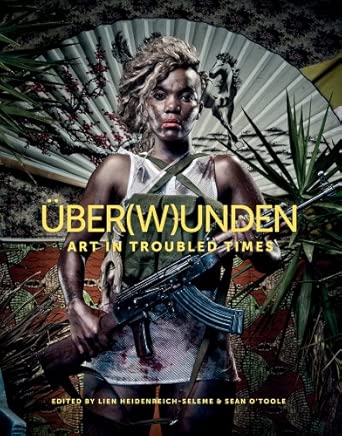
Uber(w)unden: Art in troubled times
Author(s): Sean Otoole (Author), Lien Heidenreich-Seleme (Author)
- Publisher: Jacana Media (Pty) Ltd
- Publication Date: 12 Aug. 2012
- Language: English
- Print length: 272 pages
- ISBN-10: 1431404977
- ISBN-13: 9781431404971
Book Description
Editorial Reviews
About the Author
Excerpt. © Reprinted by permission. All rights reserved.
Über(w)unden
Art in Troubled Times
By Lien Heidenreich-Seleme, Sean O’Toole
Jacana Media (Pty) Ltd
Copyright © 2012 Text: Individual contributors
All rights reserved.
ISBN: 978-1-4314-0497-1
Contents
Introduction — LIEN HEIDENREICH-SELEME & SEAN O’TOOLE,
Writing in troubled times — VÉRONIQUE TADJO,
Re-dreaming a future — ANTJIE KROG,
Ngibonile (I have seen …) — ZANELE MUHOLI,
Islands of beauty — STACY HARDY,
Bringing colour into life again — THÉOGÈNE NIWENSHUTI,
Repetition ahead — JENS DIETRICH,
State of the nation — KUDZANAI CHIURAI,
The beautiful mess — MPUMELELO PAUL GROOTBOOM,
But was I traumatised? — MARCEL VAN HEERDEN,
Na Ku Randza — CENTER FOR HISTORICAL REENACTMENTS,
Murder ballads — DIANE AWERBUCK,
You have a good CV! — DJO TUNDA WA MUNGA,
Making art is an occupational hazard — RUMBI KATEDZA,
What’s in a name? — WARREN NEBE,
My mistake, your mistake — SELLO PESA,
Seeing through the bandage — MARCEL ODENBACH,
Silence as an act of recovery — KATHLEEN MACQUEEN & JO RACTLIFFE,
Ghosts that provoke violence — SAM HOPKINS & VINCENZO CAVALLO,
Coming through slaughter — SEAN O’TOOLE,
Pictures of life during wartime — ABOUDIA,
A space to search for answers — SAMMY BALOJI,
Between the lens & the eyepiece — WILLIAM KENTRIDGE,
Notes on the division of the earth — DIERK SCHMIDT & MALTE JAGUTTIS,
United African Utopias — JOÃO ORECCHIA & HANS NARVA,
BIOGRAPHIES,
NOTES & REFERENCES,
CHAPTER 1
Writing in troubled times
VÉRONIQUE TADJO
About: Rwanda; The Shadow of Imana; a lesson in humility; Ivory Coast; on mixed parentage; being African; exile and alienation; authentic storytelling; living in Johannesburg; xenophobia; representing trauma; exploring new frontiers through literature; taking risks.
Back in the 1980s, when I first started writing, it was very much in a vacuum. Not in the sense that I had no literary tradition, on the contrary, I had always read a lot of poetry, mainly from France and Africa. Charles Baudelaire, Arthur Rimbaud and Jacques Prévert were my favourites, and I also read the poets of the Négritude movement with passion, in particular Léopold Sédar Senghor, Aimé Césaire and Léon-Gontran Damas, whose blend of political commitment and lyricism won me over. I was also aware from an early age that I was living in the Third World, in a place where poverty and inequality were serious issues. So when I say that I was writing in a vacuum, I mean that my own writing had no past. I was not weighed down by anything. After Latérite (1984), my first collection of poems, I ventured into prose writing, without ever really becoming a “novelist”, as it is usually defined. I see my writings more as texts (récits in French), pieces of writing whose genre is not defined. But with each work came an increasing awareness of social responsibility in my role as a writer.
The turning point came more than a decade later when I was invited, together with nine other African writers, to participate in ‘Rwanda, Writing as a Duty to Memory’ (Rwanda, Écrire Par Devoir de Mémoire), a writing residency in Kigali. Initiated by the Fest’ Africa festival, the objective of this collective project was to produce an imaginative response to the Rwandan genocide and its aftermath. When I reflect on the book I wrote following my time in Rwanda, L’Ombre d’Imana (2000) – it was published in translation two years later as The Shadow of Imana – I’ll always remember how daunted I felt by the sheer magnitude of the subject. I made a key decision: to write as an outsider, not as a witness. Indeed, I couldn’t do otherwise since I had no particular link with the country prior to the project. All I had was a good Rwandese friend who helped in the logistics of our stay, but apart from that, my life had not been linked with the genocide. It quickly became obvious that if I wanted to be truthful to myself – and to readers – I needed to state where I came from at the outset. At the same time, I was convinced that, as a writer and artist, I needed to interact with the world in a way that would allow me to better understand how our lives were increasingly intertwined.
I wrote The Shadow of Imana after two trips to Kigali. On my first trip, in 1998, I made initial contact with people and visited the sites of genocide; my second trip a year later was more introspective, addressing issues about our human nature. I am still haunted by one question: if I had been caught in the frenzy of the killings, would I have acted in a heroic manner, or would I have been a coward, possibly even a killer? Would I have resisted the atrocity, in effect risking my own life, or would I have simply turned my head and looked elsewhere, pretending it had nothing to do with me?
The Shadow of Imana presents readers with short texts in which they hear people tell their stories. The book is a kind of mosaic of voices. Each voice is simultaneously autonomous and linked to the others, because of the tragedy that binds them. I wanted to present as many voices as possible, to show that the genocide in Rwanda had affected many people, all sorts of people, directly and indirectly. My two biggest challenges were finding a balance between fiction and historical fact, and finding an appropriate style. In a chapter titled “The Wrath of the Dead”, those who had departed violently vent their anger and outrage at the cruelty of the living. Thanks to the power of fiction, I was able to make the dead speak. Added to this, in the culture I grew up with in West Africa, the dead are not dead, they are still around us, and continue to influence our existence.
I learnt a lot in the process of writing The Shadow of Imana; it was a great lesson in humility. On my two trips to Rwanda I met people like you and me, everyday people, people you might meet anywhere in Africa, or indeed in the world. This really shook me. I realised that the rules of society we follow in our ordinary lives can easily be destroyed by ideological manipulation and brainwashing. It is now a well-known fact that the local media in Rwanda, in particular Radio Télévision Libre des Mille Collines (RTLM), played an important role in spreading hatred and actively encouraged the mass killings by using vocabulary that dehumanised Tutsi people. Hutu extremists systematically fanned antagonisms between the two major ethnic groups in order to serve their political agenda.
I am particularly sensitive to these dangerous abuses because of what subsequently happened in Ivory Coast, in 2011, when the country became engulfed in political instability following the disputed November 2010 presidential elections. The country was ideologically divided. Who had the right to be an Ivorian became a national obsession. It shocked me profoundly, and suddenly brought to the surface feelings I had pushed to the back of my mind. And yet, I have always known that at any time in my life someone could turn round and proclaim that I did not belong in my own country, or the continent, for that matter. It is written in my face, on my skin. Being of mixed parentage, of mixed origins, I am vulnerable to rejection for the mere fact of being myself, for being me. I had to deal with this realisation very early on, while growing up in Abidjan. “You are not a complete African!” I was sometimes told.
Living abroad has reinforced this feeling of being forever an outsider, even though I am aware that it is a common phenomenon experienced by people who are away from home. Edward Saïd, the great essayist and intellectual, writes about this in his book, Reflections on Exile (2002): “Exiles look at non-exiles with resentment. They belong in their surroundings, you feel, whereas an exile is always out of place. What is it like to be born in a place, to stay and live there, to know that you are of it, more or less forever?”
But who can be so sure of their place? Belonging to a well-defined racial or ethnic group has never been a guarantee against marginalisation. I understood that very clearly when I got involved in the Rwanda literary project. Tutsi and Hutu people share the same language, Kinyarwanda, the same traditional customs and a common faith, Roman Catholicism, but none of this prevented the genocide. Yes, you can be rooted in one country and everyone may know your ancestors, but some day someone can still throw your world on its head. That is because alienation comes from the construction of the other. You can become alienated in your own country if a “murderous identity” takes shape, to quote an expression used by the novelist and historian Amin Maalouf. In his book In the Name of Identity (2003) Maalouf explains how ethnicity can evolve into a major threat to social stability when it is manipulated by elite groups driven by political ambitions: this is “how murderers are made – it’s a recipe for massacres,” warns Maalouf.
“Globalization divides as much as it unites; it divides as it unites – the causes of division being as identical with those which promote the uniformity of the globe,” writes Zygmunt Bauman, a Polish sociologist living in Britain, in Globalization: The Human Consequences (1998). “An integral part of the globalizing processes is progressive spatial segregation, separation and exclusion. Neo-tribal and fundamentalist tendencies, which reflect and articulate the experience of people on the receiving end of globalization, are as much legitimate offspring of globalization as the widely acclaimed ‘hybridization’ of top culture – the culture at the globalized top.” A particular cause for worry, adds Bauman, is “the progressive breakdown in the communication between the increasingly global and extraterritorial elites and the ever more ‘localized’ rest.” We need to be aware of this and work against its destructive impact.
For the writer, this realisation necessarily poses some important challenges. Jack Zipes, an American literary scholar and specialist in fairy tales, elaborates on this in his book Relentless Progress: The Reconfiguration of Children’s Literature, Fairy Tales and Storytelling (2009). “Can one really gain personal and social satisfaction as a professional storyteller in a world that dissolves identity as soon as it creates it and disconnects us from each other as soon as it connects us?” asks Zipes. “Is it possible to be authentic as a storyteller? Is authentic storytelling possible?” The word “authenticity” is key for Zipes. “Since authenticity depends on community, I want to explore whether it is still possible to be authentic when the forms of community have changed and been changed rapidly by globalization in the last 25 years so that the very nature and structure of communities have become artificial and amorphous.” According to Zipes, a story can become authentic again if the storyteller believes in it, if he or she believes that it can open up new possibilities for others, or if he or she is convinced that the story might find resonance in a particular community while providing meaning for his or her life.
I live and work in Johannesburg. It is an inspiring location for a writer, because of the city’s vibrant dynamics. In Johannesburg, all the major issues of the African continent seem to materialise with an intensity that is on a par with the enormous scale of the country. It is a place that belongs to our African collective consciousness through its historical struggle against apartheid, and through its potential as a meeting point for our future. But it is also a place where resentments fester, where poverty, violence and xenophobia can wipe out ordinary life. Of concern for me is the negative portrayal of the rest of the continent by local media and in popular culture.
In her final book, Regarding the Pain of Others (2004), New York intellectual Susan Sontag discusses how images of Africa have reinforced stereotypes all over the world. Postcolonial Africa, she writes, “exists in the consciousness of the general public in the rich world – besides through its sexy music – mainly as a succession of unforgettable photographs of large-eyed victims, starting with figures in the famine lands of Biafra in the late 1960s to the survivors of the genocide of nearly a million Rwandan Tutsis in 1994 and, a few years later, the children and adults whose limbs were hacked off during the programme of mass terror conducted by the RUF, the rebel forces in Sierra Leone.” More recently, she argues, photographs of whole families of indigent villagers dying of AIDS have added to this image stock. “These sights carry a double message,” offers Sontag. “They show a suffering that is outrageous, unjust, and should be repaired. They confirm that this is the sort of thing which happens in that place.”
African artists and writers living in troubled times have to tread a difficult path. They are torn between the desire to render reality as fictionally truthful as possible, and the gnawing feeling that this could reinforce distorted perceptions. This is a dilemma we have to live with and resolve as best we can in our art. One thing is certain: silence is the worst option; it would mark the end of our humanity. Timing is also critical. When is it ethically possible to depict a war, a humanitarian catastrophe or a horrific event in a creative way? Is there a reasonable time to wait? Is distance a necessary condition, or can art be immediately reactive and receptive?
The aim of literature, it seems to me, is to create a space where it is possible to explore new frontiers, and take risks. Literature allows us to understand what hurts us. It blends general history with personal history. It nourishes itself on the past while processing the present and projecting our minds into the future. The writer tries to attain universality by using the individual story. He or she puts back the human dimension into the central preoccupation so that the reader can identify with the characters and escape dogmas and prejudices. Writing therefore implies a refusal to accept the world as it is while at the same time asking people to listen and enter a new realm. It is sustained by this contradiction between despair, which normally breeds total silence, and hope, which prompts renewed action.
CHAPTER 2
Re-dreaming a future
ANTJIE KROG
About: South Africa; state violence; Truth and Reconciliation Commission; Phila Portia Ndwandwe; police torture; a blue plastic shopping bag; Judith Mason; the killing fields of Flanders; Käthe Kollwitz; grieving parents; 2011 North African revolutions; violence; the things that frustrate Africa’s blooming.
The violence that marked the twentieth century, and persists into the present, provides the backdrop for a meditation on three distinctive artworks: Judith Mason’s untitled mixed-media work made in response to a traumatic revelation at the South African Truth and Reconciliation Commission (TRC); a piece of sculpture by Käthe Kollwitz dealing with her own personal trauma; and an imaginary installation expressing the trauma of being caught up in a visionless space filled with poverty and the betrayal of the dreams that informed the struggle for liberation and determined the pact South Africans made in 1994.
The Truth Commissioner spreads the photos out on the table. He is reporting on the digging up of the grave of ANC commander Phila Ndwandwe. When she disappeared during the height of apartheid, her family was told that she had eloped to Tanzania. It was only when a member of the security forces asked for amnesty for her killing that her death and grave became known.
The photographs of the Truth Commissioner show a slope of tamboekie grass, a windblue sky, some fresh soil. He says: “The amnesty applicant showed us the place … we dug … we found red topsoil mixed with black subsoil … then we knew there had been interference with the layers of the soil … and soon the spade hit something … ‘She was brave this one, hell she was brave,’ the amnesty applicant said, showing us where the hidden grave was. He whistled softly through his teeth as if admiring her for the first time. ‘She simply refused to talk.'”
The next photo is of earth holding a bundle of bones. Delicately they were chiselled loose. In the image you can see cigarette butts, an empty beer bottle.
“‘It’s hard work, digging,’ the amnesty applicant said, as if to explain the presence of rubbish in the grave,” says the Truth Commissioner.
In the next photo a man in short sleeves puts the bones on a small piece of canvas next to the grave – like building blocks. A vertebra … the thin, flattened collarbone … the skull with a bullet hole right on top. The Truth Commissioner continues: “‘She was kneeling,’ said the amnesty applicant, ‘so we shot from above.'”
The following photo is of ribs, a breastbone that once held a heart. Her heart. The next is of a pelvis and around it blue plastic. An ordinary blue plastic shopping bag. “When he saw this,” says the Truth Commissioner, “the amnesty applicant suddenly remembered. ‘Oh yes, we kept her naked and after ten days she made herself these panties.’ He sniggered. ‘Oh yes, she was brave.'”
Judith Mason, The Man who Sang and the Woman who kept Silent (triptych), 1998 top oil on canvas, 190 x 160cm bottom left sculpture (dress), 200 x 70 x 45cm bottom right oil on canvas, 166 x 122cm. Collection: The Constitutional Court of South Africa Copyright Judith Mason
On television that night were the grieving parents of Phila Ndwandwe. The mother, who never knew whether her daughter was alive or not, broke down as she said: “I cannot bear the fact that all these years she was in a grave a mere ten kilometres away from me and I didn’t know that. I didn’t feel that. My previous grief suddenly seems like such a luxury.”
It’s a peaceful weekday morning. As I ring the bell to the art gallery, the suburb comes to me in friendly domestic sounds of radio chatter and the hum of appliances. Someone suggested I go and see the exhibition of artist Judith Mason.
Suddenly I find myself in a room – completely empty at first glance except for an ordinary wire coat hanger suspended in the middle. From it hangs a dress made of blue plastic – blue shopping-bag plastic. The pretty shoulder straps holding up a blue embroidered bodice – from the soft pleated empire line the skirt flows out light and carefree as if swaying in the soft morning breeze. As if in it a woman is moving, lithe and lovely. It is so exquisite, this soft, twirling, blue, delicately rustling dress, that I simply have to bend over. Kneel. Sit. Choke.
It is for her!
(Continues…)Excerpted from Über(w)unden by Lien Heidenreich-Seleme, Sean O’Toole. Copyright © 2012 Text: Individual contributors. Excerpted by permission of Jacana Media (Pty) Ltd.
All rights reserved. No part of this excerpt may be reproduced or reprinted without permission in writing from the publisher.
Excerpts are provided by Dial-A-Book Inc. solely for the personal use of visitors to this web site.


