 Wow! eBook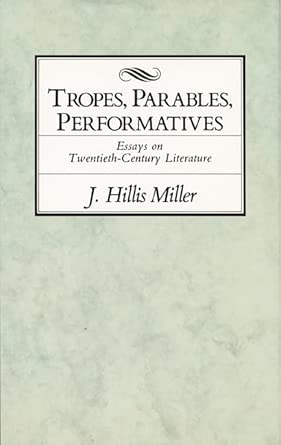
Tropes, Parables, and Performatives: Essays on Twentieth-Century Literature
Author(s): J. Hillis Miller (Author)
- Publisher: Duke University Press
- Publication Date: 6 Dec. 1991
- Language: English
- Print length: 288 pages
- ISBN-10: 0822311119
- ISBN-13: 9780822311119
Book Description
Throughout these essays Miller is fascinated with the tropological dimension of literary language, with the way figures of speech turn aside the telling of a story or the presentation of a literary theme. The exploration of this turning leads to the recognition that all works of literature are parabolic, “thrown beside” their real meaning. They tell one story but call forth something else.
Miller further agrees that all parables are fundamentally performative. They do not merely name something or give knowledge, but rather use words to make something happen, to get the reader from here to there. Each essay here attempts to formulate what, in a given case, the reader perfomatively enters by way of parabolic trope.
Editorial Reviews
Excerpt. © Reprinted by permission. All rights reserved.
Tropes, Parables, Performatives
Essays on Twentieth-Century Literature
By J. Hillis Miller
Duke University Press
Copyright © 1991 J. Hillis Miller
All rights reserved.
ISBN: 978-0-8223-1111-9
Contents
Preface,
Notes,
Acknowledgements,
1: D. H. Lawrence: The Fox and the Perspective Glass,
2: Franz Kafka and the Metaphysics of Alienation,
3: Wallace Stevens’ Poetry of Being,
4: Williams’ Poetry of Resignation,
5: Thomas Hardy: A Sketch for a Portrait,
6: Williams’ Spring and All and the Progress of Poetry,
7: History as Repetition in Thomas Hardy’s Poetry: The Example of “Wessex Heights”,
8: Parable and Performative in the Gospels and in Modern Literature,
9: Mr Carmichael and Lily Briscoe: The Rhythm of Creativity in to the Lighthouse,
10: Thomas Hardy, Jacques Derrida, and the “Dislocation of Souls”,
11: Heart of Darkness Revisited,
12: Topography and Tropography in Thomas Hardy’s “In Front of the Landscape”,
13: Impossible Metaphor Stevens’ “The Red Fern” as Example,
14: When is a Primitive Like an Orb?,
15: Prosopopoeia in Hardy and Stevens,
CHAPTER 1
D. H. Lawrence The Fox and the perspective glass
I
D. H. Lawrence has been dead now for over twenty years, but various impediments, his reputation for pornography and the unevenness of his work among them, have kept him from the serious reading he deserves. Even when his excellence has been praised he has often been misunderstood, and he has never been accorded his place as one of the masters of the short story and the novella. In addition, it has never been widely enough recognized that his work is one of the best keys to the central preoccupations of Western literature in our century so far. Motifs which lie more or less hidden behind much modern literature are overtly Lawrence’s subject.
I shall begin with a somewhat detailed look at a single work and then go on to more macroscopic remarks about Lawrence’s work. The essay will be like one of those road maps with an insert in one corner giving a much closer view of one part of the area.
Diana Trilling describes The Fox as “the most perfectly conceived and sustained of any of the novelettes.” But it is more than that. Here the themes that most preoccupied Lawrence throughout his work received one of their most perfect expressions. The story was written in Lawrence’s middle period (which came during and just after the first world war, and was the time of his best novels, The Rainbow and Women in Love). It is without the didacticism and mythologizing that mar later works like The Plumed Serpent or The Man Who Died. In The Fox there is a balance between the two extreme tendencies of Lawrence’s fiction. At one extreme is the barely fictionalized autobiography of Kangaroo and Aaron’s Rod, and at the other, symbolic or mythological fables, like The Man Who Died, in which the realistic first level tends to become wholly lost in the myth. The strength of the novel as a genre, even in “symbolic” works like Heart of Darkness or Ulysses, is always its foundation in a story about believable people in a believable world. In Lawrence’s best work the two extremes are avoided and the “meaning” rises naturally from the representation of some intense conflict in people we recognize as of our own earth.
The Fox is the story of two girls, Banford and March, both around thirty and seemingly destined to be old maids. They have taken a farm together, “intending to work it all by themselves.” The story seems at first only a rather aimless description of the two girls and their failure to make the farm go. But in the midst of the seemingly naturalistic narrative there are details which later turn out to be of more significance. We learn that “Banford was a small, thin, delicate thing with spectacles,” and that “March was more robust.” “She would be the man about the place.” This last sentence is the key to the relationship of Banford and March. For March has consciously dedicated herself to making Banford happy, as though she were Banford’s husband.
Lawrence conveys this relationship and the resulting inner conflict in March (of which she herself is not really aware) by a subtle use of one of the best devices of his fiction: the naïve narrator. The teller of The Fox seems to know even less about the people than we can guess from what he says. He observes and wonders, but he draws no conclusions. He is curious, but detached. The words of this seeming innocent convey much that they do not directly state:
March did most of the outdoor work. When she was out and about, in her puttees and breeches, her belted coat and her loose cap, she looked almost like some graceful, loose-balanced young man, for her shoulders were straight, and her movements easy and confident, even tinged with a little indifference, or irony. But her face was not a man’s face, ever. The wisps of her crisp dark hair blew about her as she stooped, her eyes were big and wide and dark, when she looked up again, strange, startled, shy and sardonic at once. Her mouth, too, was almost pinched as if in pain and irony. There was something odd and unexplained about her.
Direct statements of the theme are masked as more or less irrelevant information about March’s artistic talents:
Both Banford and March disbelieved in living for work alone. They wanted to read or take a cycle-ride in the evening, or perhaps March wished to paint curvilinear swans on porcelain, with green background, or else make a marvellous firescreen by processes of elaborate cabinet work. For she was a creature of odd whims and unsatisfied tendencies.
The “curvilinear swans” act here as a symbol of that natural feminity which the “puttees and breeches” are keeping repressed in March. And the phrase about “odd whims and unsatisfied tendencies” states covertly the subject of the story. The description of the failure of March and Banford to make a go of the farm is really a description of the way they are destroying one another with their relationship:
Although they were usually the best of friends, because Banford, though nervous and delicate, was a warm, generous soul, and March, though so odd and absent in herself, had a strange magnanimity, yet, in the long solitude, they were apt to become a little irritable with one another, tired of one another. March had four-fifths of the work to do, and though she did not mind, there seemed no relief, and it made her eyes flash curiously sometimes.
The Fox dramatizes the conflict within March in terms of a conflict between Banford and Henry, a young soldier who appears on the farm. Henry appears via the major symbol of the story, the fox. There is a real fox, the “evil … greater than any other” who carries off their hens. But the fox also becomes a symbol of that normal sexual life which March denies, a denial which reduces her often into an “odd, rapt state, her mouth rather screwed up.” The symbolization is achieved by having March encounter the fox, alone:
She lowered her eyes, and suddenly saw the fox. He was looking up at her. His chin was pressed down, and his eyes were looking up. They met her eyes. And he knew her. She was spellbound – she knew he knew her. So he looked into her eyes, and her soul failed her. He knew her, he was not daunted.
The equation between the fox and Henry is not very subtly made, but to miss it would be to miss the point of the story, so perhaps Lawrence intentionally made it hard to miss:
… to March he was the fox. Whether it was the thrusting forward of his head, or the glisten of fine whitish hairs on the ruddy cheekbones, or the bright, keen eyes, that can never be said: but the boy was to her the fox, and she could not see him otherwise.
The equation is the crucial clue to Henry’s nature and dramatic function. He is that recurrent figure in Lawrence’s fiction, the man who has escaped the inhibitions imposed by civilization. This figure is often a soldier, and has often “come through” a nearly fatal illness into a new state of “resurrection.” (The Man Who Died takes this as its central motif.) No such sickness is mentioned for Henry, but the connotations of the fox may be added to what we learn of his character. Like the fox he is the pariah, the banished one, somehow able to judge civilization and civilized morality because independent of them. He has a superior natural wisdom of his own. The dramatic function of this figure throughout Lawrence is to awaken the sleeping sexuality of an over-civilized woman.
March is the sleeping beauty of The Fox. A dream she has will show how Lawrence achieves “poetic” intensity and compression by expressing her awakening in terms of the fox-Henry equation:
She dreamed she heard a singing outside which she could not understand, a singing that roamed round the house, in the fields, and in the darkness. It moved her so that she felt she must weep. She went out, and suddenly she knew it was the fox singing. He was very yellow and bright, like corn. She went nearer to him, but he ran away and ceased singing. He seemed near, and she wanted to touch him. She stretched out her hand, but suddenly he bit her wrist, and at the same instant, as she drew back, the fox, turning round to bound away, whisked his brush across her face, and it seemed his brush was on fire, for it seared and burned her mouth with a great pain. She awoke with the pain of it, and lay trembling as if she were really seared with a quick brushing kiss, that seemed to burn through her every fibre.
The rest of the story tells of the bitter conflict of Henry and Banford for possession of March. Henry persuades March to promise to marry him, but when he goes back to camp, Banford re-establishes her domination over March and makes her break the engagement by letter. Henry then comes in a black rage to the farm and the “idea” of the story – that for March either Banford or Henry must cease to exist—is dramatized in its most extreme terms. Henry finds March chopping down a tree, while Banford watches. He offers to help, and calculates the cutting so that the tree falls on Banford.
Once she is dead Henry and March are free to marry. This murder dramatizes in shocking terms Lawrence’s recurrent motif- the release of a woman from repression. Banford, the “embodiment” of March’s repression, is judged and destroyed. Her death is an assertion that she was already dead-in-life.
The Fox treats Lawrence’s great theme, the conflict between a life motivated by the mind and the will, and a life which attains what he called “spontaneous creative fulness of being.” For Lawrence the outcome of commitment to the first way is death, the self-destruction represented over and over again in his novels and stories. The outcome of the other way is the best life possible for man. Lawrence saw everywhere evidence that modern man is dominated by the first kind of life and that our entire civilization is destroying itself.
II
If it is true, as William Empson says, that “original pieces of thinking have … nearly always been started on metaphor,” it could be said that the originality of D. H. Lawrence lies in his exploration of the metaphor latent in the idea that “all man’s vital experience is sexual.” The metaphor says “human experience is sexual experience.” Expanded, it says that everything important about human experience can be talked about in terms of sex.
There are two important notions behind the idea that original thinking is based on the exploration of a metaphor. One is that certain aspects of man’s experience will be necessarily left out or distorted beyond recognition. This is the negative side. A metaphor is the assertion of a false identity. Man is not simply a sexual creature. Metaphor is thus an abstraction from the total reality (whatever that may be); it is characterized by what Whitehead calls “essential omission.” However, there is a positive side too. The metaphor, if it is a good one, will imply, as the postulates of Euclidian geometry imply a whole system, important truths about man’s nature and his relation to the universe. Metaphor is thus a means of knowledge; it offers a perspective on reality.
An obsolete meaning of “perspective” helps us here. In the seventeenth century “perspective” was the common name for a telescope or for any system of mirrors and lenses used to play tricks with light and apparent distance and shape. A metaphor works like a “perspective glass.” It distorts and omits, but it reveals. If a “perspective,” either metaphorical or actual, is luckily made, aspects of reality never before known will be revealed. We remember the telescope and the microscope, and the importance for Western thought of the metaphor that says a man is like a civilized society or like the universe (microcosm equals macrocosm).
To sum up, in a metaphor the “real” nature of an object is distorted or things are omitted from it, but our omission or distortion of them is what makes for the fecundity of implications about the object which may be evolved by developing the metaphor wholeheartedly. Poetry cannot lay claim to absolute truth, but any piece of thinking in poetry must be judged by how much experience it brings into consciousness or systematizes by means of its novel metaphor.
This may be a long preamble to my idea about Lawrence’s contribution to literature. The idea is that Lawrence’s work may be best understood as the exploration of a single key metaphor, an exploration which represents an important addition to our consciousness of ourselves and of the world we live in. Lawrence himself was not unaware of the contribution he had made. In a letter written near the end of his life he stated his credo:
I believe in the living extending consciousness of man. I believe the consciousness of man has now to embrace the emotions and passions of sex, and the deep effects of human physical contact. This is the glimmering edge of our awareness and our field of understanding, in the endless business of knowing ourselves.
Lawrence probably succeeded better in extending our consciousness in his earlier novels, The Rainbow and Women in Love, and in the admirable short stories than when it was so consciously his intention, as in Lady Chatterly’s Lover. But his own formulation after the fact is a very good description of what his whole work succeeded in accomplishing.
Lawrence’s accomplishment can perhaps best be shown by coming at it through a description of recurring motifs in his work. Taken altogether these suggest a single persistent “sense of the world,” that is, a homogeneous body of experience from which his work springs or a single vision which his oeuvre expresses. A writer’s “sense of the world” is something impossible to paraphrase, although sometimes a proposition, usually involving the writer’s key metaphor, will seem adequately to sum it up.
If it is true that even the greatest writer repeats himself, and is in a way writing the same story over and over or giving a new treatment to the same inner conflict, the best way to understand the work of a writer is to isolate these obsessions, and describe whatever slow mutations they may have undergone. The obsessions may be located in repetitions of character, scene, and action or dramatic situation. All three in their interrelation tend to form what may be called a “myth” or myths. This myth postulates a certain nature and situation for man and certain possible outcomes for his actions. For example, for Lawrence there are two extreme outcomes which sum up the meaning of a character’s life: (1) death, usually self-destruction and (2) a certain heightened state of existence, a fulfillment of the highest potentialities of human life. Paradoxically, these two extreme possibilities of the Lawrence world tend to overlap and merge, so that the highest fulfillment is, seen another way, death. The highest fulfillment is certainly isolation, isolation both from other people and from “normal” states of consciousness. In fact, it tends to abnegate consciousness. It was, again paradoxically, just this heightened state of unconscious knowledge (located, so Lawrence said, in the solar plexus) that Lawrence intended his work to bring to his reader’s consciousness. At least so I understand the credo quoted above.
This likeness-in-unlikeness in the two extreme outcomes may be seen by comparing two stories written more or less consecutively, The Woman Who Rode Away and Sun. In the former an American woman in Mexico leaves her husband and an empty marriage and flees to an isolated Indian village deep in the mountains where she is eventually sacrificed in a tribal rite. In the rite she symbolically becomes the bride of the Indians’ sun god. She has escaped a bourgeois “mental” marriage, but her sexual fulfillment is also death. Lawrence renders with great vividness his heroine’s heightened state of consciousness as she is carried away to be sacrificed. Her death, like Gerald Crich’s in Women in Love, is unconsciously wished for. In Sun, another lady, also victim of a sterile modern marriage, finds her fulfillment in lying naked in the Mediterranean sun. She repudiates her husband when he comes from New York in his grey business suit to take her back to a grey life in a New York apartment, and at the end of the story she is left presumably to lie naked forever communing with the sun who is her new husband. Her physical posture and her state of mind are oddly like that of the heroine of The Woman Who Rode Away, who is last seen lying on a stone altar in an ice cave, the priest’s knife poised over her naked body, waiting for the setting sun to suffuse the cave with light.
(Continues…)Excerpted from Tropes, Parables, Performatives by J. Hillis Miller. Copyright © 1991 J. Hillis Miller. Excerpted by permission of Duke University Press.
All rights reserved. No part of this excerpt may be reproduced or reprinted without permission in writing from the publisher.
Excerpts are provided by Dial-A-Book Inc. solely for the personal use of visitors to this web site.


