“From 1965 through 2011, measuring each of the 11,832 trading days during that period, the price of the S&P 500 Index rose at an annualized rate of less than 1% on days Congress was in session, but over 16% on days they were out of session.”
From Chapter One
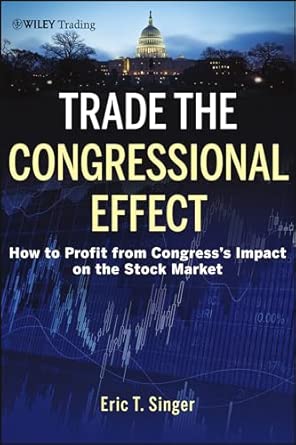
The Congressional Effect when Congress is in session, there is a negative effect on equities markets is based on solid historical research. While the statistics prove the validity of the Congressional Effect, the reasoning behind it is most probably due to investor uncertainty concerning government action or inaction as well as the unintended consequences of Congressional legislative initiatives on the stock market. In Trade the Congressional Effect, Eric T. Singer a financial professional with over twenty-five years of experience and an expert on this phenomenon offers guidance on how you can put this effect to work for you.
Throughout the book, Singer offers an in-depth examination of the Congressional Effect and recommends several strategies for how to optimize your portfolio. Once you understand the nature of the incentives that each politician proposes (which collectively result in Congress relentlessly working against your portfolio), you can better use their efforts to your advantage. Step by step, Singer walks you through the process and provides practical guidance regarding the possible pitfalls and opportunities you’ll face when using this technique.
Supported by more than forty-five years of real-world data, the Congressional Effect has proven profitable to those who know how to use it. This timely guide will show you exactly what it takes to make this phenomenon work for you.
Praise for Trade the Congressional Effect
“Once in a while, an idea, a small gem, comes along that reflects the whole world. Singer’s book is it, a thesis to live from, learn from, and make money from. Singer provides that which we all long for: a way to make money from political insight.”
Amity Shlaes, author, The Forgotten Man
“Thanks to Mark Twain, we know that nobody’s ‘life, liberty, or property is safe while the legislature is in session.’ Now, thanks to Eric Singer, we know why, and what to do about it. In these pages, he admirably succeeds in the important task he has set for himself. To wit: how to protect yourself, and your net worth, from the depredations of Congress. “
James Grant, Editor of Grant’s Interest Rate Observer
“The author’s straightforward idea that Congress harms wealth creation provides many insights into politics, the economy, and investing. Trade the Congressional Effect will appeal to serious investors, as well as policy wonks and libertarians … but it should be taken to heed by the 535 men and women who pass some of their days on Capitol Hill. Some surprising insights a devastating attack on Modern Portfolio Theory … a look at what caused the Great Depression … Congressmen as traders and speculators … the effect of split governments, lame ducks, and litigated elections on the stock market … Reading Trade the Congressional Effect will provide much guidance about Congress’s ‘unintended consequences’ that are so persistent, casually dangerous, and impoverishing.”
Adrian Day, President, Adrian Day Asset Management
About the Author
ERIC T. SINGER manages the Congressional Effect Fund, traded under the symbol CEFFX (CEFIX for institutional investors), a public mutual fund launched in 2008 through his registered investment advisor, Congressional Effect Management, LLC (www.congressionaleffect.com). He was the first to document the general effect of Congress on daily stock prices in an article published in Barron’s in 1992. His opinion pieces have appeared in Investor’s Business Daily as well as Forbes, the American Spectator, American Thinker, Townhall, Seeking Alpha, and Newsmax, and he has been featured on national TV and radio, including Fox Business News and Bloomberg TV.
 Wow! eBook