Wow! eBook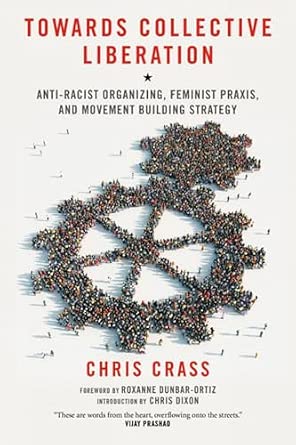
Towards Collective Liberation: Anti-Racist Organizing, Feminist Praxis, and Movement Building Strategy 2.5.2013 Edition
Author(s): Chris Crass (Author)
- Publisher: PM PRESS
- Publication Date: 7 Mar. 2013
- Edition: 2.5.2013
- Language: English
- Print length: 300 pages
- ISBN-10: 1604866543
- ISBN-13: 9781604866544
Book Description
Editorial Reviews
Review
“In his writing and organizing, Chris Crass has been at the forefront of building the grassroots, multi-racial, feminist movements for justice we need. Towards Collective Liberation takes on questions of leadership, building democratic organizations, and movement strategy, on a very personal level that invites us all to experiment and practice the way we live our values while struggling for systemic change.”
–Elizabeth ‘Betita’ Martinez, founder of the Institute for Multiracial Justice and author of De Colores Means All of Us: Latina Views for a Multi-Colored Century
“Chris Crass goes into the grassroots to produce a political vision that will catalyze political change. These are words from the heart, overflowing onto the streets.”
–Vijay Prashad, author of Darker Nations: A People’s History of the Third World
“A deeply important, engaged, and learned defense of anarchism, class politics, and anti-racism. Grounded in study, organizing, and struggle, Towards Collective Liberation is a significant contribution to the recent history of the U.S. left.”
–David Roediger, author of Wages of Whiteness
“In his activism and writing, Chris Crass has been able to articulate and practice a transformative model for social change. Guided by a vision of collective liberation that centers the experience and leadership of women of color, Chris has done groundbreaking work to realize the revolutionary potential of grassroots multiracial alliances.”
–Harsha Walia, co-founder of No One Is Illegal and Radical Desis
“Chris Crass offers penetrating analysis and a keen understanding of the political and cultural dynamics shaping the U.S. We can all learn from reading this.”
–Rev. David Billings, The People’s Institute for Survival and Beyond
About the Author
Chris Crass is a longtime organizer working to build powerful working class-based, feminist, multiracial movements for collective liberation. Throughout the 1990s he was an organizer with Food Not Bombs, an economic justice anti-poverty group, strengthening the direct action-based anti-capitalist Left. In the 2000s, he was an organizer with the Catalyst Project, which combines political education and organizing to develop and support anti-racist politics, leadership, and organization in white communities and builds dynamic multiracial alliances locally and nationally. He has written and spoken widely about anti-racist organizing, lessons from women of color feminism, strategies to build visionary movements, and leadership for liberation. From California, he currently lives in Knoxville, Tennessee with his partner and their son.
Chris Dixon, originally from Alaska, is a longtime anarchist organizer, writer, and educator who recently received his PhD from the University of California at Santa Cruz. Dixon’s writing has appeared in periodicals such as Clamor, Left Turn, Punk Planet, and Social Movement Studies, and book collections such as Global Uprising (New Society Press), Letters from Young Activists (Nation Books), Toward a New Socialism (Lexington Books), Men Speak Out (Routledge), and The Battle of the Story for the Battle of Seattle (AK Press). He is currently completing a book based on interviews with radical organizers across the U.S. and Canada focusing on anti-authoritarian politics in broader-based movements. Dixon serves on the board of the Institute for Anarchist Studies and the advisory board for the activist journal Upping the Anti.
Roxanne Dunbar-Ortiz grew up in rural Oklahoma, a child of landless farmers. As a veteran of the Sixties revolution, she has been involved in movements against the Vietnam War and imperialism, union organizing, and was one of the founders of the Women’s Liberation Movement in the late 1960s. Since 1973, she has worked with Indigenous communities for sovereignty and land rights and helped build the international Indigenous movement. A historian, writer, and professor emeritus in Native American Studies at California State University, she is author of many Indigenous related books and articles, including Roots of Resistance: A History of Land Tenure in New Mexico and The Great Sioux Nation, as well as a memoir trilogy: Red Dirt: Growing Up Okie; Outlaw Woman: A Memoir of the War Years, 1960-1975; and Blood on the Border: A Memoir of the Contra War.
Excerpt. © Reprinted by permission. All rights reserved.
Towards Collective Liberation
Anti-Racist Organizing, Feminist Praxis, and Movement
By Chris Crass
PM Press
Copyright © 2013 Chris Crass
All rights reserved.
ISBN: 978-1-60486-654-4
Contents
Acknowledgments,
Foreword Roxanne Dunbar-Ortiz,
From Collective Refusal to Collective Liberation: An Introduction Chris Dixon,
Towards Collective Liberation: What I Believe,
Section I “While Learning from the Past, We Work to Create a New World”: Building the Anarchist Left,
Section II “We Make the Road by Walking”: Developing Anti-Racist Feminist Practice,
Section III “Because Good Ideas Are Not Enough”: Lessons for Vision-Based,,
Section IV “Love in Our Hearts and Eyes on the Prize”: Lessons from Anti-Racist,
Section V Conclusion,
Author Bio,
Index,
CHAPTER 1
A NEW WORLD IN OUR HEARTS
Anarchism and the Need for Dynamic and Visionary Left Politics
I found Paul Avrich’s book The Haymarket Tragedy in the library while I was a freshman in high school and read it every chance I could. In doing so, I was transported from my Southern California suburb to the working-class, largely European immigrant, communities of Chicago and followed the lives of leading anarchist labor organizers who fought to build unions while also creating a vibrant culture of socialist theatre groups, community dances, athletic clubs, newspapers, singing groups, and schools. They took on the bosses and the state; they built a highly successful national campaign that successfully utilized the general strike. Some of them lost their lives. Ultimately, they won concrete improvements while invigorating an international working-class radical movement whose visions, analysis, victories, defeats, and legacies are still with us today.
The values of solidarity and collective action clashed with the alienation and individualism I felt all around me. Thus, when friends and I started an activist group, we were influenced not only by the anarchism of political punk music, but also began studying the theory and history of anarchism to help us develop our politics and plan of action. The strategy of working for immediate gains such as the eight-hour work day, the weekend, and improved working conditions, while simultaneously agitating against capitalism and for a democratic socialist society, ignited hope and possibility for ways we could take on war, poverty, and the suffocating culture of consumer capitalism. The connection I felt to a historical tradition of struggle for liberation was like a balm to the wounds I didn’t even know I had from growing up in the post-civil rights, Reagan-era right-wing backlash, assaults on historical memory, and the “pull yourself up by the bootstraps” myth that marked life in white working- and middle-class America in the 1980s.
For more than two decades, anarchist politics and a connection to the anarchist tradition have been fundamental to my efforts to build powerful working class-based, feminist, multiracial movements. Anarchism for me, however, is not a strict orthodoxy of beliefs. We can draw a lot from the anarchist tradition to help guide us forward, but a good amount of what I think we can learn is from the failures and shortcomings of anarchist politics. I believe in a praxis-based organizing approach in which we develop our analysis and strategy through a process that combines education, practice, reflection, and synthesis, so that our ideas and practices are evolving. While I draw from the anarchist tradition outlined in this chapter, one of the goals of this book is to break down ideological barriers in anarchist and radical politics that limit our ability to have a praxis-based organizing practice that encourages us to evolve and grow. Far too often, maintaining a correct line of what is and isn’t radical leads to political conformity in Left activist circles that stifles political and personal growth and leads to a culture of insecurity and infighting based on proving one’s radical credentials. This culture of “more radical than thou” isn’t welcoming, supportive, sustainable, healthy, or successful in achieving our goals.
One of the main lessons throughout this book is that we need a revitalized, dynamic, and visionary Left politics that draws from many traditions, not just anarchism, but also Marxism, socialism, feminism, revolutionary nationalism, and others. Additionally, I believe we need to draw insights, lessons, and examples from liberation struggles in communities of color, from working class-based struggles in the labor movement, from the struggle for queer liberation, and many other struggles and liberation movements in the United States and around the world. Furthermore, we need space to acknowledge and learn from the failures, mistakes, and shortcomings of all our traditions and struggles to draw lessons and insights and to help us stay humble and open. In order for us to develop the politics we need, we must also create the culture we need to support us.
We need Left culture that encourages growth and learning. We need culture that celebrates and nourishes the creativity, beauty, and joy of this world while we struggle against oppression and exploitation. We need culture that builds people up rather than tearing them down. We need culture that reminds us that there are many paths to the goals we seek, rather than one right answer. We need culture that nurtures, teaches, and encourages us to win and create the changes in society we need.
The goal of this essay is to provide a basic introduction to anarchist ideas and history as a window into an important set of politics and experiences critical for developing effective and visionary Left politics.
Anarchism and Contemporary Left Organizing
Anarchist organizations, strategies, methods and visions played a leading role in the economic justice upsurge of the Occupy Wall Street movement in 2011 that ignited the imagination of millions of people who participated in the largest Left-based movement in a generation. From general assemblies for decision-making to the emphasis on direct action as both a tactic of protest and strategy to build people-powered democratic movements and society, the Occupy movement revitalized Left politics and action in mainstream society.
At the turn of the past century, anarchist organizations, strategies, methods, and visions also played a leading role in the mass action convergences of the global justice movement in Seattle and beyond, with tens of thousands using anarchist organizing structures like affinity groups, spokescouncils, and consensus decision-making to take direct action. Again, direct action served as both a tactical way to confront unjust institutions of the global ruling class, such as the World Trade Organization, and a strategy for everyday people to take action beyond the rules of capitalism, opening a window to the world we seek to create. In both the Occupy movement and the global justice movement, anarchist influence is expressed in understanding that the power to make systemic social change come from the bottom up and that we must create what we are for while we work against what we oppose,
At the grassroots level around the country, groups and projects that are either explicitly anarchist or anarchist influenced are working for economic, racial, gender, environmental, and social justice. Anarchism operates as a theoretical framework to understand the world and an ethical approach to revolutionary social change. Most anarchists are also socialists and analyze society and social change from a socialist framework with an anarchist analysis of political and social power in addition to a materialist analysis of the economy. This leads anarchists to work not only against capitalism and the state but also patriarchy, white supremacy, and authoritarianism.
The principles of mutual aid, grassroots democracy, and equality that form the core of anarchism have been practiced in many societies and cultures around the world. Anarchists have looked to the communal practices of peasant societies, working-class mutual aid associations and unions, and the everyday cooperative practices in neighborhoods and families for guidance in developing a vision for a free society shaped by equality rather than injustice. As a political force, anarchism developed primarily in working-class and peasant communities throughout Europe, Asia, and the Americas in the late 1800s and influenced early union movements alongside the rise of industrial capitalism. From the late 1880s to the present, there have been many different types of anarchists, drawing on traditions from around the world and advocating universal human rights across race, gender, and nationality. There has never been a monolithic anarchist theory, tendency, or movement throughout history; there is not one anarchism, but many. Through studying this history, we can draw out its most useful aspects.
Today many anarchists work in anarchist groups and projects and many more are active in broader social justice efforts through their community groups, unions, workplaces, parent associations, places of worship, schools, and a vast array of formal and informal cooperative efforts from community gardens to childcare. Most anarchists do not wear their anarchist politics on their sleeves but practice them in their broader political work, families, communities, and organizations. Many are reluctant to identify as anarchists, even though they share core principles, because of the historic baggage that comes with the name, or because political labels can create obstacles when engaged in broad-based organizing. Many don’t identify as anarchists or have moved away from anarchism altogether because of significant shortcomings in the actual practice and dominant subculture of contemporary anarchism.
The political baggage of anarchism has its roots in repression against anarchists, as well as within anarchism itself. In efforts to undermine anarchist ideas in society and anarchist leadership within labor and social movements, the ruling class has equated anarchism with chaos, violence, and destruction. Anarchist-led unions and organizations have historically been targets of violent repression from the state and the bosses with organizations’ offices raided and their leaders arrested, deported, executed, and assassinated. The association of anarchism to chaos and violence has had a powerful effect, inoculating people to the ideas of worker and community self-management, of a society run cooperatively without economic inequality. Throughout society, anti-anarchist ideas are part of a larger anti-Left, anti-socialist effort to present capitalism and top-down authoritarianism as the only option. There can also be distrust of anarchists within the Left and broader social justice movements. This is largely due to controversial and at times counterproductive anarchist practices (frequently sensationalized by corporate media and the state as “violent attacks against society”) that have come to represent the totality of anarchism. There have also been a wide range of harmful practices by anarchists who have disrespected local organizing or have alienated many through arrogant attitudes of political superiority.
In this essay, however, I focus not on the differences that may have alienated anarchists from each other or the broader Left, but on mass anarchism or movement-based anarchism informed by the ability of everyday people to organize popular movements against systemic exploitation and oppression and work for social transformation towards mutual aid, cooperation, egalitarianism, self-determination, democracy, and socialism. There are many different tendencies of anarchism, and always have been. However most anarchists embrace the movement-based anarchist understanding that socialist values must be developed, supported, and expanded in the culture and institutions of society over the course of struggle. In other words: socialism will not drop from the sky because many have risen up against oppression, although such uprisings are critically important; socialism develops through the collective choices, actions, and practices of a people over time in the course of struggling for their freedom, dignity, and collective future. When I speak of movement- based anarchism, it includes anarcho-syndicalism, libertarian socialism, anarcha-feminism, social ecology, anarcho-pacifism, and the most common, anarcho-communism. When I use the term anarchism, I invoke the best from each of these historical traditions and current practices.
An Introduction to the Anarchist Tradition
Anarchism is a political tradition, a theoretical framework and an organizing practice that opposes tyranny in all forms and works to create liberatory social organizations that maximize equality, freedom, and cooperation while minimizing coercion, oppression, and exploitation. Rooted in the anti-capitalist socialist tradition, anarchism developed a critique of illegitimate authority that included the state and patriarchy. From the 1800s through the early 1900s, anarchism was the primary socialist politics in many parts of the world including China, Japan, Korea, South Africa, Argentina, Brazil, Chile, Cuba, Italy, and Spain. Anarchism, like other Left traditions, has changed in many ways through more than a hundred years of struggles. Yet some basic debates and insights from the movement’s earliest years still continue to serve as guideposts today
Classical anarchist theorists such as Russians Mikhail Bakunin and Peter Kropotkin agreed with Marx’s critique of capitalism and his understanding of historical materialism. The early anarchists and Marxists agreed that the working class was a primary revolutionary force for socialism because of its role in the economy and its lived experience of exploitation, and that working-class people exercising political power was key to building a socialist society. However, these anarchists also challenged the Marxists by arguing that a classless and stateless society could not be built through seizing the state, establishing a “dictatorship of the proletariat” and centralizing power in a vanguard leadership body. They believed a system of planning and coordination would be necessary but emphasized the decentralization of power into the hands of everyday people. They envisioned self-management of the economy through democratic worker associations and self-governance through community associations and popular assemblies. They believed that regions could organize to exchange resources and culture, and that larger-scale federations would develop to facilitate communication and cooperation around the world. Based on this disagreement about the role of the existing state with Marx and Marxists, anarchists differentiated between authoritarian and libertarian socialism. As Bakunin wrote, “Freedom without socialism is privilege and injustice, and socialism without freedom is slavery and brutality.”
Anarchists argued that the state has both a material and ideological basis in domination, and reproduces inequality by design, regardless of the intent of those in power. As the state developed out of the needs of ruling classes to maintain and perpetuate inequality, it is not a system designed for the people of a society to make decisions about their communities and lives. Rather, it serves to advance and enforce the laws and logic of the ruling class. Thus, the anarchists believed that political power must be organized from the bottom up and remain rooted in the people through self-governing institutions. For revolutionaries to set their eyes on the existing state as the form of working-class power in a revolutionary society was to condemn the revolution to reproducing a new ruling class.
Anarchist theorists believed that revolutionaries should work for social change and be prepared to play leading roles to build organizations and campaigns that are crucial to bring about mass movement, but that the people themselves ultimately create mass movements, and have the power to counter and defeat systemic injustice as well as win and create systemic liberation. Anarchists such as Emma Goldman believed in the creative power of everyday people to develop liberatory alternatives in the course of struggle. She argued that as people expand freedom through collective action, their ability to imagine what freedom looks like will also expand.
Anarchists warned that any revolutionary organization that sees itself as a constant vanguard leading the revolution was building the foundation for the tyranny of an elite to dominate the masses during and after revolutionary change. Many anarchists believed in the need for revolutionary organizations to play leadership roles in mass movements but maintained that this leadership must come from democratic consent and respect from within the mass movement in order to be legitimate. For example, they believed that revolutionaries could and should bring all their talents, skills, and resources to help movements achieve their goals, but that in that process, leadership should not be assumed, but earned. Furthermore, they rejected the idea that any one person or organization should become a permanent leader, and argued for leadership structures that allowed for more and more people to share in the responsibilities of leadership.
While anarchists and Marxists debated the role of the state in revolutionary change, they all pointed to the self-governing structures of the short-lived Paris Commune in 1871 as an example of how working people could reorganize society. During the Commune, working-class communities were in control of Paris for two months, and formed popular assemblies to organize public life and defend themselves from the state and the ruling class. They passed resolutions for women’s equality and the rights of workers. The high degree of cooperation and unity between many different radical forces led many to look to the Commune for both inspiration and guidance. That both anarchists and Marxists claimed the Commune as an example for future working-class movements demonstrates two things. First, that anarchists and Marxists have a much higher level of political unity than is often understood. Second, that in the course of struggle, oppressed people have historically developed new forms of social organization that advance democracy and equality. For anarchists, constantly learning from the new forms of social organization requires a commitment to constantly update and renew the strategy and vision of revolutionary politics.
The anarchist vision, one shared by many on the Left, looks to social organization that decentralizes power and is controlled from the bottom up. These local forms of community-based self-governance would then federate regionally and globally to meet economic, social and cultural needs and wants. To get there, the classical anarchist theorists advanced the strategy of mass collective struggle against the ruling class to open and win the political space for socialism to develop from below. In general, the anarchist tradition has been vague in its articulation of how to transition from capitalism to socialism on a large scale. However, in keeping with the commitment to support and prepare people to take democratic control over their lives and build justice and equality in the process of struggle, anarchists have put forward the strategy of prefigurative politics as a way to begin building the new world in the shell of the old.
(Continues…)Excerpted from Towards Collective Liberation by Chris Crass. Copyright © 2013 Chris Crass. Excerpted by permission of PM Press.
All rights reserved. No part of this excerpt may be reproduced or reprinted without permission in writing from the publisher.
Excerpts are provided by Dial-A-Book Inc. solely for the personal use of visitors to this web site.