Wow! eBook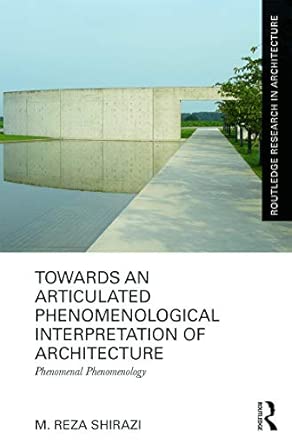
Towards an Articulated Phenomenological Interpretation of Architecture: Phenomenal Phenomenology
Author(s): M. Reza Shirazi (Author)
- Publisher: Routledge
- Publication Date: 23 July 2013
- Edition: 1st
- Language: English
- Print length: 216 pages
- ISBN-10: 0415637953
- ISBN-13: 9780415637954
Book Description
This book sheds light on the contemporary status of phenomenological discourse in architecture and investigates its current scholastic as well as practical position. Starting with a concise introduction to the philosophical grounds of phenomenology from the points of view of Husserl, Merleau-Ponty and Heidegger, it presents a critical reading of the works of some leading figures of architectural phenomenology in both theory and practice, such as Christian Norberg-Schultz, Kenneth Frampton, Juhani Pallasmaa, and Steven Holl.
Highlighting the main challenges of the current phenomenological discourse in architecture, this book formulates a more articulated method of ‘phenomenological interpretation’ – dubbed ‘phenomenal phenomenology’ – as a new and innovative method of interpreting the built environment. Finally, using Tadao Ando’s Langen Foundation Museum as a case study, it investigates the architect’s contribution to phenomenological discourse, interprets and analyzes the Museum building using the new heuristic method, and thus provides a clear example of its applicability.
By introducing a clear, articulated, and practical method of interpretation, this book is of interest to academics and students analyzing and studying architecture and the built environment at various scales.