 Wow! eBook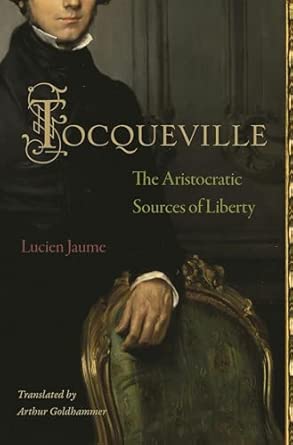
Tocqueville: The Aristocratic Sources of Liberty Translation Edition
Author(s): Lucien Jaume (Author), Arthur Goldhammer (Author)
- Publisher: Princeton University Press
- Publication Date: 24 Mar. 2013
- Edition: Translation
- Language: English
- Print length: 360 pages
- ISBN-10: 0691152047
- ISBN-13: 9780691152042
Book Description
Editorial Reviews
Review
From the Inside Flap
“Tocqueville remains the most endlessly fascinating of all modern writers about democracy. Lucien Jaume, one of France’s leading intellectual historians, is an outstanding interpreter of his thought, in all its political variety. Jaume wants to re-establish the distance between ‘our’ Tocqueville and the man himself, a product of his time and of a distinctive aristocratic social and intellectual milieu. In doing so, he allows us to see why Tocqueville is still such an appealing and unsettling figure for our own times. A wonderfully lucid book and an indispensable guide.”–David Runciman, University of Cambridge
“Long in gestation, this is a major work by a major political theorist who is insufficiently known in the Anglophone world. Lucien Jaume succeeds admirably in providing a fresh reading of Tocqueville’sDemocracy in America. Based on deep and wide knowledge, this magisterial interpretation will immediately be recognized as significant by Tocqueville scholars, and it also makes an important contribution to current debates about the complex relationships between religion, democracy, and liberalism.”–Cheryl B. Welch, Harvard University
From the Back Cover
“Tocqueville remains the most endlessly fascinating of all modern writers about democracy. Lucien Jaume, one of France’s leading intellectual historians, is an outstanding interpreter of his thought, in all its political variety. Jaume wants to re-establish the distance between ‘our’ Tocqueville and the man himself, a product of his time and of a distinctive aristocratic social and intellectual milieu. In doing so, he allows us to see why Tocqueville is still such an appealing and unsettling figure for our own times. A wonderfully lucid book and an indispensable guide.”–David Runciman, University of Cambridge
“Long in gestation, this is a major work by a major political theorist who is insufficiently known in the Anglophone world. Lucien Jaume succeeds admirably in providing a fresh reading of Tocqueville’s Democracy in America. Based on deep and wide knowledge, this magisterial interpretation will immediately be recognized as significant by Tocqueville scholars, and it also makes an important contribution to current debates about the complex relationships between religion, democracy, and liberalism.”–Cheryl B. Welch, Harvard University
About the Author
Excerpt. © Reprinted by permission. All rights reserved.
Tocqueville
THE ARISTOCRATIC SOURCES OF LIBERTYBy Lucien Jaume
PRINCETON UNIVERSITY PRESS
Copyright © 2008 Librairie Arthème Fayard
All right reserved.
ISBN: 978-0-691-15204-2
Contents
Introduction…………………………………………………………………………………………..1Part One. What Did Tocqueville Mean by “Democracy”?………………………………………………………..151. Attacking the French Tradition: Popular Sovereignty Redefined in and through Local Liberties…………………212. Democracy as Modern Religion………………………………………………………………………….653. Democracy as Expectation of Material Pleasures………………………………………………………….82Part Two. Tocqueville as Sociologist……………………………………………………………………..954. In the Tradition of Montesquieu: The State-Society Analogy……………………………………………….1015. Counterrevolutionary Traditionalism: A Muffled Polemic…………………………………………………..1066. The Discovery of the Collective……………………………………………………………………….1157. Tocqueville and the Protestantism of His Time: The Insistent Reality of the Collective………………………129Part Three. Tocqueville as Moralist………………………………………………………………………1458. The Moralist and the Question of l’Honnête…………………………………………………………1479. Tocqueville’s Relation to Jansenism……………………………………………………………………159Part Four. Tocqueville in Literature: Democratic Language without Declared Authority…………………………..19310. Resisting the Democratic Tendencies of Language………………………………………………………..19911. Tocqueville in the Debate about Literature and Society………………………………………………….226Part Five. The Great Contemporaries: Models and Countermodels……………………………………………….24912. Tocqueville and Guizot: Two Conceptions of Authority……………………………………………………25113. Tutelary Figures from Malesherbes to Chateaubriand……………………………………………………..291Conclusion…………………………………………………………………………………………….319Appendix 1. The Use of Anthologies and Summaries in Tocqueville’s Time……………………………………….327Appendix 2. Silvestre de Sacy, Review of Democracy in America……………………………………………….328Appendix 3. Letter from Alexis de Tocqueville to Silvestre de Sacy…………………………………………..335Index…………………………………………………………………………………………………337
Chapter One
Attacking the French Tradition
Popular Sovereignty Redefined in and through Local Liberties
The Gap between France and America
When Tocqueville decided to introduce the United States to the French public, he had no choice but to begin with what had been first the sphinx of the French Revolution and then the nightmare of the moderates: popular sovereignty. The fourth chapter of book 1 of the first volume of Democracy in America was devoted to this overwhelming idea: “Any discussion of the political laws of the United States has to begin with the dogma of popular sovereignty.” The word “dogma” indicated how the question was to be approached. But this particular dogma gave rise to two very different religions, as noted by one of Tocqueville’s readers, Édouard Laboulaye, who taught a course on the history of the United States at the Collège de France. While “the people reign over the American political world as God reigns over the universe,” the same was not true of France. It would be too simple to say that the difference stemmed from the difference between a republic and a monarchy (the so-called July Monarchy of Louis-Philippe). Tocqueville knew French history and knew that popular sovereignty had been brandished as a banner by various forms of strong state: the Convention, the Terror, the seizure of power by the men of Brumaire, and Napoleon’s authoritarian rule. The restored Bourbons had maintained administrative centralization, and their Orleanist successors did little after 1830 to make government more responsive to local concerns. The state therefore maintained its ascendancy over the nominally sovereign people.
Napoleon is particularly significant in this regard because he claimed legitimacy as the representative of the sovereign people, in particular thanks to his use of the plebiscite. Later in French history, the popular sovereign was transformed into the sovereign representative, sometimes in the form of an elected assembly, sometimes as incarnated in the person of an individual in whom the nation saw its unity reflected. Despite the differences among them, Napoleon, Napoleon III, Thiers, and de Gaulle all fulfilled this role. It was in the apex of the pyramid of state that the people recognized themselves as sovereign, acknowledged and consulted as such. This way of thinking dated back to 1789, when an assembly of the common people declared itself first the National Assembly and then the Constituent Assembly. The assembly claimed legitimacy by proclaiming the sovereignty of the nation (as against that of the king) and by portraying the nation as one and indivisible (despite differences among corporations, privileges, the distinction between pays d’État, with their own representative “estates,” and pays d’élection, without them, etc.). The united nation fictively sat on the benches of the assembly, where it embodied the national will represented nowhere else. The “general will” resided in the representative body, not outside it. The act of voting created the national will but did not express it.
The mystical operation that allowed each deputy “to represent the entire nation” (as the Constitution of 1791 put it) and that gave rise to the general will within the walls of parliament transformed the sovereignty of the people into a sovereignty of the representative body and therefore of the state. As Abbé Sieyès put it on September 7, 1789, the people exists as political reality and can act (that is, legislate) only through its assembly, its representatives.
Sieyès’s doctrine imparted a certain stability to this idea (which owed a great deal to the Church), but it soon gave rise to repeated conflicts between the “will of the people” and representatives deemed to be “unfaithful.” Competition to see who was the more authentic “representative” of the popular will marked all the challenges raised against the Constituent and Legislative Assemblies and the Convention. Between 1789 and 1793 the Jacobins took advantage of these conflicts, taking to heart Rousseau’s celebrated words about the nonrepresentability of the general will, which resides in the individual citizen and in the citizens’ assembly but not in a body of delegates speaking in the people’s name.
The conflict between represented sovereignty and inalienable sovereignty has been responsible for various oscillations or swerves in French political history. In Tocqueville’s youth, “the sovereignty of the people” was a resounding battle cry: if it were to be realized in the streets, assemblies, or political clubs, would not the Revolution be reignited? As François Furet has shown, moderates throughout the nineteenth century were perpetually asking themselves how the Revolution could be stopped.
When Tocqueville sat down to write his masterpiece, the French faced two or three major problems linked to this historic conflict: (1) the fear of intermediate bodies, which were seen as a permanent invitation to revert to the corporatist society of the past, encouraging both the Church (via the law of congregations) and socialist agitation (worker defense); (2) the difficulty of conceiving popular sovereignty from below, as embedded in society and reflective of regional diversity (indeed, both the citizen and the political representative were highly abstract concepts owing to the requirements that had to be met in order to “raise oneself to the level of the general interest”); and (3) the question of executive power, a perpetual problem for republicans because of Louis XVI’s failure to lead the Revolution and then the drama of the regicide, which left republicans saddled with obsessive fears that something like a monarchy might somehow be resurrected. To see this, one has only to glance at the debates that took place in the constituent assemblies of 1793, 1848, and 1871–75.
Tocqueville knew that these three problems were linked in French history, and he also knew that America had offered a novel solution by combining local government with federalism and administrative decentralization. Popular sovereignty was not embodied in the president of the United States, who was not a monarch (or even a republican monarch), because constitutional checks and balances subjected the unity of the political will to the corrective of moderation as virtue and negotiation as practice. Nor was popular sovereignty embodied in Congress, because the American representative was neither an undifferentiated image of the states (in the Senate) nor an image of the nation as a whole (in the House of Representatives). Popular sovereignty remained with the people. Hence to observe it one had to go to the base of society, the New England town, and look at the very concrete issues dealt with at that level (land use, law and order, education). The town was the primitive fact, the basic “cell” of the organism, as Tocqueville sometimes called it. It was in the first instance a collection of families and therefore possessed a natural and prepolitical reality. In addition, it helped American independence to flourish: “Then came the American Revolution. The dogma of popular sovereignty emerged from the towns and took possession of the government…. It became the law of laws.”
Owing to this dual origin (quasi-natural primitiveness and revolutionary genesis), popular sovereignty in the United States worked not as in France, from the top down (and for the benefit of the state), but from the bottom up: “Sometimes the people as a body make the laws as in Athens; at other times deputies created by universal suffrage represent them and act in their name, under their almost immediate surveillance.”
Tocqueville was very struck by the fact that the New England town was governed by a town meeting rather than a council. Citizens were not represented but deliberated directly on the issues of the day. This led him to a general proposition that implicitly condemned the way in which the French organized their political life: “Without local institutions, a nation may give itself a free government, but it will not have a free spirit.” Indeed, the French would debate decentralization interminably and endlessly discuss the advantages of “self-government” along English or American lines, but they would continue to worry about the fragmentation of sovereignty that might ensue. Tocqueville himself, in 1848, did nothing to push the issue in the National Assembly—a silence that astonished observers at the time.
In one of his manuscripts, Tocqueville observed that “in our minds, the word ‘decentralization’ stands for nothing but a host of petty sovereigns.” It was indeed a question of representations: the obsession with federalism dated back to the spring of 1789. Antifederalist rhetoric would later legitimate the frontal assault first on the Girondins (who were attacked on May 31 and June 2, 1793) and then on the Terror (September–December 1793). But the Girondins were by no means federalists. The real issue was the (largely imaginary) obsession with the idea that France might fracture as well as the fear that the Third Estate might lose the unity that its leaders needed in order to abolish privileged corporations. In France antifederalism and antipluralism both stemmed in large part from the monarchical and Catholic mindset, which the new ruling class refocused onto its aristocratic enemy.
Under these conditions, the decentralization of power, even to decide issues of purely local interest, could be seen as inciting local resistance to Paris and encouraging “the parochial spirit” against the national spirit. Indeed, the very idea of local interests was problematic for major figures. When the Chamber of Deputies debated the municipal law in 1831, Guizot said: “Do not think, Gentlemen, that it is easy to separate local interests from general interests; this distinction is never as real as some imagine.” So when Benjamin Constant praised “municipal power” as a fourth branch of government, he was actually taking the risk of lending support to traditionalists and legitimists, such as Joseph Fiévée, a friend of the Ultra party and for a while a candidate to lead it. Almost until the adoption of the municipal law of 1884, there was a persistent idea in France of local government as part of the administrative order, so that the mayor was first of all an official of the executive branch, like the prefect. Tocqueville, writing about local government in the United States, wrote that “the [federal] state governs and does not administer,” whereas in France the first move was to distinguish the administrative from the political and then to place both under the control of the state. From the time of Napoleon on, mayors were appointed by the central government, and their primary function was to enforce national laws and regulations rather than to represent local interests. In 1791 and Year III there was lively debate about the dual role of “local administrators,” as one said at the time. In 1841 Louis Blanc jestingly referred to the mayor as “a hermaphroditic power.”
For Tocqueville, the New England town represented a different vision. Rather than distinguish between the administrative and the political, the Americans availed themselves of a subtle “subsidiarity” between the private and the public, or between particular, local interests and general, national interests. In his eyes, local democracy was a school in which the subject was political liberty: “Local institutions not only teach the art of using noble political freedom but also instill a true taste for liberty.” Like John Stuart Mill somewhat later, Tocqueville believed that when neighbors developed the habit of deliberating and negotiating with one another, they would also develop the ability and desire to take a larger view of politics: local democracy could thus provide a way into political responsibility, collective decision making, and acceptance of majority rule. Tocqueville also insisted on local government as a form of civic education: “Local institutions are to liberty what elementary schools are to knowledge; they bring it within reach of the people.”
It was this idea of civic education on different levels that led Tocqueville to the distinction between political centralization, which he believed to be essential, and administrative centralization, which he believed sapped the spirit of liberty. Insofar as popular sovereignty was desirable, it would inevitably have to be “dispersed” across pieces of the territory. There was nothing to fear in plural diversity if order was assured locally and political centralization was maintained. Yet in making this point, Tocqueville was aware of challenging the entire French conception of administrative centralization, which he would continue to attack in later years. But what did “the state” mean on the other side of the Atlantic? “What most strikes the European who travels through the United States is the absence of what we would call government or administration…. Things seem to be in motion all around you, yet the force that drives them is not apparent. The hand that guides the social machinery constantly evades detection.”
A Frenchman, Tocqueville continued, expects to see “only one administrative official, the mayor,” but he would find “in the New England town … some nineteen town officials.” He would also expect someone like a prefect to supervise local affairs on behalf of the central administration, but in America one sees “scarcely any trace of administrative hierarchy.” The conclusion of this passage is surprising (“Hence there is no central hub toward which the spokes of administrative power converge”), but it introduces a lengthy reflection on judicial power in the United States—a power that in Tocqueville’s eyes was both judicial and administrative and therefore unacceptable in post-revolutionary France. Note, too, that in his manuscripts and correspondence, Tocqueville voiced worries about the mixing of functions.
* * *
The description of the American system in terms of towns and counties is one of Tocqueville’s bravura passages. We will return to it later because it was in the self-governed town that Tocqueville saw the political, the moral, and the sociological coming together: this was the “living democracy” that he promised to show the French to make them think. Remember that in his eyes America was an example but not a model: he did not believe for a second that American institutions (such as federalism, judicial power, and perhaps decentralization) could be transplanted to French soil. Indeed, mores, history, and the “social constitution” (of which I will say more in a moment) were the primary factors, more powerful than laws. American social philosophy, based on “self-interest properly understood,” social relations among groups and families as a check on individualism, and the very structure of the political sphere (collective action without the state as the central axis) all converge in Tocqueville’s text on one and the same reality: local life.
Tocqueville’s Portrait of the New England Town: Passions, Interests, and Authority
Tocqueville’s concept of local democracy was rather different from today’s idea of “participatory democracy.” And when politicians today speak of “decentralization,” what they have in mind is usually to fortify their local electoral base. For Tocqueville, by contrast, the local was the essence of the democratic spirit: “In the United States, therefore, local liberty is a consequence of the dogma of popular sovereignty itself.”
Yet Tocqueville also believed that the natural tendency of popular sovereignty was to increase centralization. He therefore set out to show (1) how popular sovereignty could exist in the routine tasks of local life, and (2) how what the French called “administrative” decentralization would serve to increase popular sovereignty defined in these pragmatic, quotidian terms.
In the first volume of Democracy in America, Tocqueville combined the political and psychosociological points of view in his discussion of the town, while in the second volume, at the heart of a key chapter on social morality and self-interest properly understood, he returned to the town as model. It is impossible to understand his use of the concept of “self-interest properly understood”—a sort of disinterested self-interest—without relating it to “local liberties” and the “local spirit” (to borrow his terms): “Thus local liberties, in consequence of which large numbers of citizens come to value the affection of their neighbors and relatives, regularly bring men together, despite the instincts that divide them, and force them to help one another.”
(Continues…)
Excerpted from Tocquevilleby Lucien Jaume Copyright © 2008 by Librairie Arthème Fayard. Excerpted by permission of PRINCETON UNIVERSITY PRESS. All rights reserved. No part of this excerpt may be reproduced or reprinted without permission in writing from the publisher.
Excerpts are provided by Dial-A-Book Inc. solely for the personal use of visitors to this web site.


