Wow! eBook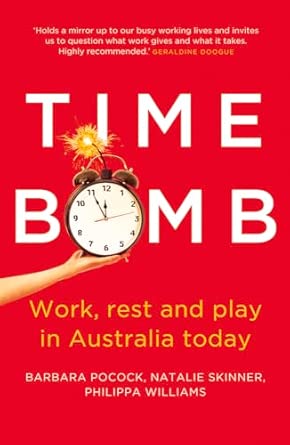
Time Bomb: Work, Rest and Play in Australi Today
Author(s): Barbara Pocock (Author), Natalie Skinner (Author), Philippa Williams (Author)
- Publisher: NewSouth Publishing
- Publication Date: 1 Jan. 2012
- Edition: Illustrated
- Language: English
- Print length: 256 pages
- ISBN-10: 1742232957
- ISBN-13: 9781742232959
Book Description
Relevant and sharp, this record turns a careful eye to the issue of time poverty, throwing light on poor urban planning, workplace policies, and other sociopolitical issues that rob working families of time. While maximising productivity and enhancing professional skills, Australians must raise their children, care for their elderly, be involved in their communities, and shrink their carbon footprints. This book investigates what it costs Australian families to do it all: how men’s time is taken up by work, crowding out their capacity to care, and how women struggle to strike a balance between professional ambition and household obligations. It also investigates how work impacts the response to the greatest concern of the 21st century―the planet’s sustainability.
Editorial Reviews
Review
"A must read for politicians and policy makers who want to help Australians live better lives--and an antidote to the pressures that many of us face or create for others." --The Hon Jay Weatherill, Premier of South Australia
"Australia once led the world on a decent working time regime, but not any more. This readable book shows how much this matters--and points to new ways forward with ideas that are relevant in Australia as well as many other parts of the world." --Sharan Burrow, General Secretary, International Confederation of Trade Unions, Brussells
About the Author
Barbara Pocock is the inaugural director of the Center for Work + Life at the University of South Australia. Natalie Skinner is a research fellow at the Center for Work + Life, managing the Australian Work and Life Index. Philippa Williams is a research fellow at the Centre for Work + Life, managing the Work, Home, and Community Project.
Excerpt. © Reprinted by permission. All rights reserved.
Time Bomb
Work, Rest and Play in Australia Today
By Barbara Pocock, Natalie Skinner, Philippa Williams
University of New South Wales Press Ltd
Copyright © 2012 Barbara Pocock, Natalie Skinner and Philippa Williams
All rights reserved.
ISBN: 978-1-74223-295-9
Contents
Acknowledgments,
Abbreviations,
1 Set your alarm clock early,
2 We need to talk about work, Kevin,
3 Caring by the clock,
4 Yearning for community,
5 Growing up in the suburbs,
6 Learn, earn and burn?,
7 Work, rest and play,
8 Finding time for sustainable living,
9 Defusing the time bomb,
Notes,
Index,
CHAPTER 1
Set your alarm clock early
Time is our most basic human resource. It is our life: indeed it is the only true resource that we who are alive now have. And we all have a limited amount of it: our time will end. How we 'spend' our time – and what it gives and takes from us – are the sum of our life-times.
Australians are giving more and more time to paid work. Where children are present, our households often include two earners, and actual hours of work are amplified by the extra time it takes getting to and from work, catching up on work at home, and recovering from it; especially among those who feel that work is becoming more demanding and intensive. In this light, working time is about more than the hours we give to it: it is also about how those hours affect us, and the additional time demands that arise beyond the formal hours of work.
Australians start work young, and we increasingly work into old age. Our governments want us to work more, to work longer into old age, to be more productive and to increase our skills for work. At the same time, they want us to maintain or increase our population, contribute to a strong social fabric, raise our children well, care for our aged, and shrink our carbon footprint – a footprint that is powerfully shaped by the patterns and habits of our work, our social obligations and households, and our commuting between them.
Work maketh the Australian citizen
Readiness to work is increasingly a requirement for access to public support. Prime Minister Julia Gillard reveres 'decent, hard working' citizens. As her 2011 Whitlam Address shows, hard work is at the heart of her vision:
To work hard, to set your alarm clock early, to ensure your children are in school. We are the party of work not welfare, that's why we respect the efforts of the brickie and look with a jaundiced eye at the lifestyle of the socialite ... This is our continuing culture, born in Barcaldine and Balmain, the culture of mateship and the fair go, hard work and respect.
Making work central to moral worth in twenty-first century Australia in this way, perfectly illustrates the kind of 'labourist' society we have become. Over the twentieth century of 'labouring man' – as Guy Standing puts it – we have moved rapidly from clamour for the rights of labour, into an era promoting the right to labour, and ending with the call for a duty to labour. This duty now saturates twenty-first century Australian life.
To place work at the core of citizenship pushes life activities that are 'not work' into the shade: they are less worthy, they deserve a 'jaundiced eye'. To give work such weight implies an obligation to understand the terms of work and its wider effects. Not all work is the same, and not all non-work activities are on a par with the 'lifestyle of the socialite': parenting, rest, sleep, learning, caring for each other, participation in all kinds of social and community activity. If the only use of our time that is worth venerating is hard work, what of the rest of life? What kind of society does this make us? And what confidence can we have that such a hard working society will be a happy one, with healthy children, workers, workplaces and communities? If the hard workers of Labor's historic heartlands (Barcaldine and Balmain) are fatigued, stretched and overworked, and living in communities where more households are similarly stretched, what are the implications for social well-being? Work is not always, in itself, a social good. It is time to take a closer look.
Work maketh the man – and woman?
And what is the gender of this decent, hard working citizen? At Barcaldine and Balmain it was a man. Women's participation rate in paid work is now almost equal to that of men in Australia. The fruit of the post-1970s second wave women's liberation has been women's right – now indeed, a requirement – to join men in their work citizenship. This is a revolution. But unfortunately, only half of one. The 'culture of mateship and the fair go, hard work and respect' that Prime Minister Gillard suggests arrives with work, does not quite reach to the fair redistribution of domestic work, the elimination of wage discrimination, the underpayment of carers, the removal of sexual harassment at work or the double load of putting together a 'decent hard working job' with the care of children or others. As Eva Cox puts it in her 2011 International Women's Day speech, this is just 'equality on male terms'. Venerating work as the source of decency and sourcing citizenship through it, entitles women to exhaustion alongside the important positives of a pay packet and economic independence. This is not quite the equality that 1970s liberationists had in mind: becoming male and joining the Balmain mob. A second revolution is required if women are to join men in real, effective, equal citizenship and it involves spheres of achievement and effort beyond paid work: in the home, community, and social life.
Some of the hottest political debates of our times link to these issues: how we use our time, how working time should be regulated, how to give enough time to care well for our young and ageing populations, how to find the time for life-long education and skill development, and work participation over the life-cycle, and how to find the time to respond to environmental challenges.
How are we organising and experiencing our life 'times' now, and with what implications for the quality of our community, environmental and social lives? How should we organise ourselves in the future? Are we sitting on a time bomb, where demands on our time and energy simply outrun the resources we can bring to them? How conscious are we about how we are spending our lifetimes? Are some of us – like the proverbial boiled frog – unthoughtfully climbing into the work vat, only to find ourselves diabolically over-heated over time, urged on by our politicians, bosses and powerful, internalised social norms? And how do experiences differ – between women and men, between rich and poor, by occupation, age, generation and suburb?
Work giveth and work taketh away
Work clearly gives us a great deal: it sustains us and our homes and communities. It creates a sense of efficacy, skill and meaning for many. But it takes as well. What it gives and takes, and for whom, and with what consequences, is the concern of this book. For some, and perhaps for whole sections of our society, especially the less powerful and those who need care, the consequences of work and its fit with the rest of our lives, tick away like a time bomb.
In this circumstance, our true wealth is not measured in the economics of Gross National Product but in the enjoyment of our life-times and the avoidance of overloaded lives. Perhaps the most basic measure of the potential for happiness lies in having enough time to work, care, rest and play in ways that allow us to enjoy our relationships, good health and a strong social fabric.
These debates are at the heart of the quality of our personal lives and happiness, as well as the quality, real productivity and coherence of Australian society. In this book we examine how work is changing in Australia in its larger social context. We ask how work affects how we live – whether we are rich or poor, living in a country town or a harbourside tower block. We examine how work is unfolding in Australia for men, women and children at different stages of the life-cycle – whether working as a teenager, putting together a job and a young family, or retired. We find that questions of time, space and relative power are critical to the very variable experiences that people live.
This is a human story that touches on the nature of work regulation, workplace systems and management, gender cultures and urban planning. Making sense of our changing personal experiences, and improving them, means more than the right employment laws or parental leave system. It also means facilitating the 'putting together' of our worlds of work, home and community life, and understanding them simultaneously. It is not adequate to analyse work as if it does not occur in socially-embedded ways: it is vital to link up analysis of work with that of household and community life. Together and reciprocally, these linked spheres shape our experience. And making things better requires a deeper understanding of these spheres, how they connect, and how they can together be changed to result in better outcomes for us as individuals, workers, employers and community members. Defusing the time bomb of work requires first and foremost a critical consideration of experience. This means making the familiar strange: unpacking the consequences of 'decent hard work' for those who do it, and those who are affected by it.
What is different about time today?
Why is time so central in our discussions about work, home and community life? Why 'time bomb'?
Time is something we take for granted. And we take a particular form of time for granted: clock time and the calendar. There are other forms of time. This is hard to imagine for those of us who have internalised and naturalised a form of 'clock time' that shapes our days and nights.
However, 'time' was not always clocked. Prior to the industrial revolution, working time (especially in agricultural production) often related to the completion of tasks: sowing or reaping for example. Living in this type of seasonal, task-related time, where work activities were often spatially and temporarily aligned to other social activities like harvest festivals, meant a close relationship between work and other social relations: labour processes and other life activities proceeded more in integrated tandem, driven by natural time. Historians point out that in this pre-industrial world, workers experienced an integration of work and other life activities, rather than conflict:
A community in which task-orientation is common appears to show least demarcation between 'work' and 'life'. Social intercourse and labour are intermingled – and the working day lengthens or contracts according to the task – and there is no great sense of conflict between labour and 'passing the time of day'.
The onset of 'clock time' changed this. In a mature capitalist society, it is offensive for workers merely to 'pass the time' and in this new clock world, work becomes 'separated from life'.
Clock time is different from the time of nature and seasons. It is different from the time of the body and health: we do not – if left to our own devices – give birth by the clock, heal by it or die by it. Our food does not grow by it. 'Natural time' refers to the structuring of activities around natural phenomena such as day and night, the seasons, the weather and the body. It is imprecise, variable and often related to processes or tasks. 'Natural time' includes 'body time'; that is, the time that the body takes to grow, heal, reproduce and live. It is time that, in the pre-industrial era, guided the seasonal sowing and harvest of food, the daily practices of agricultural life (when to get up, when to go to sleep; when to stay inside or go out; when to reap or sow or hold cultural festivals and celebrations). These forms of 'natural' time are very different from clock time, which is standardised, regular, linear, predictable, universal, and measured in seconds, minutes and hours – and now in nanoseconds.
These two types of times (natural and clock) can operate simultaneously: they are not mutually exclusive. However, in our world – and especially in the world of work – clock time dominates natural or body time. As time sociologist Barbara Adam puts it: 'when the invariable time of the clock is superimposed on living systems, it tends to be the living systems that are required to adapt to the machine-time rather than the other way around'. Once time becomes (by means of the clock) a quantifiable commodity, then its use, control and budgeting are shaped by particular relations of power. Clock time can be controlled, and with it the activities of those who live under the clock. Of course what can be controlled can also be resisted, and resisting the reach of clock time has been a major focus of worker organisation and trade unionism around the globe since the onset of the industrial revolution.
The clash of different time regimes
Clock time is now international time, de-contextualised from natural cycles and 'body' time. In this world, who times and on what terms and with what effects, reflects social power. However, while clock time is dominant, people can never leave natural time entirely behind. Workers have bodies that are affected by night and day, by season and by physical and mental functions like reproduction, health, illness, healing, grief, growing and ageing.
While clock time came into its own with the factory of the industrial revolution, it has not been eclipsed in 'post-industrial' workplaces like the service industries that now dominate our economies. Clock time has not been made less relevant by new technologies which stretch time, allow more to happen very quickly, and can take work activities well beyond prescribed working hours. While clock time strongly shaped the working life of the factory worker, its effects have not escaped professional and managerial workers. However, these effects are changing with the different work regimes in which many service sector, professional and managerial workers now work and live. Similarly, many of the growing proportion of women workers live simultaneously in the worlds of clock and natural time as we explore in chapter 2. Working carers are differently affected by the clash of clock and natural time.
For these workers, the clock makes a good servant but a bad master. In becoming a dominating master, it crowds out the acts of care and reproduction which run by another natural clock – but one that our working world makes subservient to the master clock and calendar. Living busy lives in two types of time adds up to a time bomb for the many workers who attempt to reconcile the irreconcilable – and blame themselves when they are exhausted by the effort.
Gender and the collision of clock and natural time
Most of us do not live in clock time alone, as Barbara Adam points out:
While clock time dominates the world of work and the global economy, the great majority of the world's people function in the shadows of the time economy of money. Children and the elderly, the unemployed, carers the world over and subsistence farmers of the majority world inhabit the shadowlands of un- and undervalued time. Women dwell there in unequal numbers. Their time does not register on the radar of commodified time.
EP Thompson's historical account of the evolution of time under early industrial capitalism also recognised the different time 'shadowlands' for women. He saw that in pre-industrial society 'the most arduous and prolonged work of all was that of the labourer's wife in the rural economy' whose care of infants – a demanding and unbounded 'task' – was combined with field labour. Thompson felt that this arduousness was endurable 'only because the work of care was necessary and inevitable' rather than an external imposition (how he thought inevitability alleviated arduousness is not clear). Thompson commented that even in his (1967) day, 'despite school times and television times, the rhythms of women's work in the home are not wholly attuned to the measurement of the clock. The mother of young children has an imperfect sense of time and attends to other human tides. She has not yet altogether moved out of the conventions of "pre-industrial" society'.
So what happens when she does? When this modern woman – living and caring in natural time – takes a paid job ruled by the clock, she must reconcile two times: clock time and natural or body time. Working women, indeed anyone affected by natural or bodily processes such as childbearing and breastfeeding, must live these two times simultaneously. More and more must do so: women now make up almost half of civilian employment in industrialised countries. Women comprise the majority of workers in many sectors of greatest 'post-industrial' job growth: retail, hospitality, education, health, professional services and so on. When half the workforce is made up of people who live in a time of bodies and nature, but who must also respond to the discipline of the clock, we have a deep conflict over time. Many of us are increasingly governed by the workplace clock, without having given up the natural clock.
And our times are busy. When we rush from activity to activity, trying to put together different forms of time, with their clockwork and unclocked bodily and natural demands, we are busy. Such busyness is the enemy of thought, planning and perspective. We are often so busy that we cannot see what we are doing, remember why we are doing it, and keep our priorities clear. As long as we are spinning our wheels chasing our work lists, struggling to get enough sleep, work, holidays, money, and to keep our friendships and family running well, we lack time for thought and perspective.
(Continues...)Excerpted from Time Bomb by Barbara Pocock, Natalie Skinner, Philippa Williams. Copyright © 2012 Barbara Pocock, Natalie Skinner and Philippa Williams. Excerpted by permission of University of New South Wales Press Ltd.
All rights reserved. No part of this excerpt may be reproduced or reprinted without permission in writing from the publisher.
Excerpts are provided by Dial-A-Book Inc. solely for the personal use of visitors to this web site.