 Wow! eBook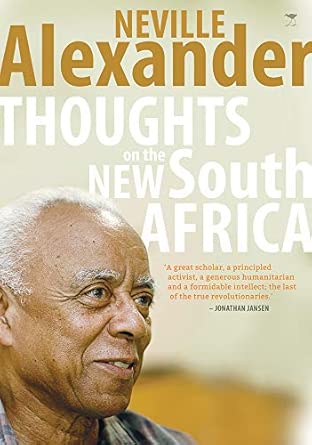
Thoughts on the new South Africa
Author(s): Neville Alexander (Author)
- Publisher: Jacana Media
- Publication Date: 14 Jun. 2014
- Language: English
- Print length: 256 pages
- ISBN-10: 1431405868
- ISBN-13: 9781431405862
Book Description
Editorial Reviews
Review
About the Author
Excerpt. © Reprinted by permission. All rights reserved.
Thoughts on the New South Africa
By Neville Alexander
Jacana Media (Pty) Ltd
Copyright © 2013 The Estate of Neville Alexander
All rights reserved.
ISBN: 978-1-4314-0586-2
Contents
Introduction,
Part 1: Strands of struggle,
1. Rhythms and patterns of history,
2. Reflections on the Unity Movement,
3. Azanian moments and meanings,
Part 2: Continuities and discontinuities – transitional questions,
4. The elephant in the room,
5. Education in crisis,
6. Language in the new South African university,
7. Language, class and power in the new South Africa,
Part 3: Nation building on a dying culture – rainbow or Garieb?,
8. On ‘race’ in South Africa,
9. Affirmative action and black economic empowerment in post-apartheid South Africa,
10. Has the rainbow vanished? The meaning of national unity in the new South Africa,
11. Afrophobia and the racial habitus in the new South Africa,
12. Enough is as good as a feast,
List of abbreviations,
Notes,
CHAPTER 1
Rhythms and patterns of history
There has been at work a mole of history of a special kind. It is a species of rodent that seems to be more myopic and blinkered than your common or garden mole. Whether intended or not, one of the most reprehensible outcomes of its burrowing and sniffing around has been the virtual blocking of all channels of memory that do not in one way or another relate to the historic activities of the Congress Movement. In order not to be misunderstood or, more likely, misrepresented, it is essential that I make it clear that the struggle for national liberation in South Africa was, and is, a multifaceted process in which the African National Congress (ANC) and its allies came to play a dominant and even a hegemonic role. By way of helping us to understand the forces at work in this struggle, a brief sketch of the historical background is desirable.
In South Africa, the period of primary resistance can be said to stretch from that fateful day in the first week of February 1488 when the first Khoe herder threw the first stone at the Portuguese buccaneers commanded by Bartolomeu Dias in the Bahia dos Vaqueiros (probably Mossel Bay) until – more than 400 years later – the day on which Chief Bambatha was killed in April 1906. However, beginning in April 1652, the specific modalities of the colonising process and of the penetration of capital led over a period of some 250 years to a contradictory and uneven process of resistance, accommodation and collaboration on the part of the indigenous people across the sub- continent. Thus, for example, by the end of the 17th century, when the children of the first slaves and the conquered Khoe clans were well on the way to becoming enforced subjects of the Dutch colony, beyond the Hex River mountains virtually all of the indigenous people were still living in independent, if fragile, sovereign political entities. Many of them continued to do so until the second half of the 19th century when, as the result of the discovery of diamonds, gold and other minerals, they were rapidly and forcibly subjugated and dispossessed. The patriarchal racial- caste system of the pre-capitalist period provided the sociological materials from which the subsequent system of racial capitalism came to be fashioned.
If we take as given these 250 years of the evolution of the modern capitalist system in southern Africa by the time the Union of South Africa came into being in 1910, it suffices that we characterise the resultant social formation with broad brushstrokes. The negotiated settlement between the British government and the defeated Boer generals created or, in some respects, reinforced the template upon which political dynamics over the next century would be shaped. In brief, the socio- political system of segregation and of its successor, apartheid, was established in laws derived from the blueprint contained in the Report of the South African Native Affairs Commission of 1903–5, which met under the chairmanship of Sir Godfrey Lagden. The most decisive recommendations of the Commission were the macro-apartheid scheme of territorial segregation by which blacks in the rural hinterland would be ghettoised in ‘native reserves’ subject to control by hereditary and government-appointed chiefs, who had the power to allocate land, and into urban locations (today’s townships), ‘influx’ into which would be regulated by means of a system of pass laws. Political segregation was recommended along the lines that black people who fulfilled certain literacy and property requirements would be represented in parliament by whites. All of these recommendations formed the strategic matrix that generated the hundreds of segregation and apartheid laws for more than 60 years after 1910. These measures were notoriously justified in terms of social Darwinist and other so-called ‘scientific’ racism (including Nazi) ideologies.
Bluebeard’s Castle and the shattered dream
The struggle for national liberation, that is, the political and cultural as well as the organisational response of the oppressed black majority section of the population to these strategies of the white supremacist administrations, had been shaped by the acceptance by the ‘mission elite’ and other incipient middle class individuals among the oppressed groups in the course of more than a century that the attainment of freedom and equality within the emerging system was not only necessary but also possible. In this regard, the hegemony of the Christian mission and of the politics of liberal philanthropy had become etched very deeply into the consciousness of the prospective leadership of the political movements of the oppressed. Elsewhere, I have described in detail how the caste consciousness of this leadership gave rise to the notion of four ‘national groups’, three of which (Africans, coloureds and Indians) – in the words of the ANC Youth League in 1944 – were ‘oppressed’ and three of which (whites, coloureds and Indians) were ‘minorities’. Each leadership cadre struggled for the improvement of the status and prospects of ‘their’ community although, on occasion, they would form ‘alliances’ for joint action against particularly onerous measures. This happened, for instance, at the time when the Act of Union was being discussed in London (1908–9) and, much later, during the Defiance Campaign of 1952–3.
The belief that British ‘fair play’ and liberal-democratic principles would eventually allow the oppressed to ‘go inside’ was a tenacious delusion in the ranks of this middle class leadership, one that can only be compared with the tragic allegory of Bartok’s operatic version of Bluebeard’s Castle, as narrated inimitably by Derek Bell in order to explain the unending quest of the civil rights activists in the USA. In retrospect, apologists for this gradualist and pacifist strategy would argue that the cumulative effect and moral impact of their approach bore fruit, even if it did take the best part of a century. Such a claim, however, abstracts from important details, besides eliding the fact that the authors of the strategy clearly intended to get immediate relief from the oppressive measures in each case. Indeed, it would be no exaggeration to maintain that in the South African case, until the beginning of the 1970s, the curve of attainment in human rights terms was a downward-sloping one. Previous ‘achievements’, such as the limited racial franchise of the 1910 Constitution and the limited access to university education and to apprenticeships for certain categories of ‘non-Europeans’, were systematically dismantled through the repeal of the relevant legislation by the apartheid regime.
It is also a fact, one which explains the set of dispositions referred to here, that with episodic exceptions the movement for national liberation accepted the international legality, but not the legitimacy, of the South African state. The key to synchronising these two spheres lay in the attainment of the franchise for all adult male (later also female) South Africans. The territorial integrity of the South African state, as defined in 1910, was never questioned seriously by any tendency within the movement, although the Communist Party of South Africa (CPSA) in the early 1930s briefly floated the idea of a Southern African Federation of Independent Soviet Socialist Republics based on linguistic-ethnic criteria. If truth be told, it is doubtful whether even the collaborationist Bantustan leaders of the 1970s and 1980s seriously believed in the gratuitous ‘independence’ that they had thrust upon them and ‘their’ peoples.
Non-collaboration and non-violence
Until 1960, when the massacre of Sharpeville removed the blinkers from the eyes of the entire pro-democracy political leadership of the oppressed people, non-violent approaches to the attainment of reforms and improvements – ranging from abject petitioning of the relevant authorities by respectful delegations of prominent black people, to consistently militant tactics of boycotting racially defined political institutions of government on the basis of the principle of non- collaboration with the oppressor – were the stock-in-trade of the movement for national liberation, taken as a whole. In spite of profound philosophical and strategic differences, a range of non-violent methods of struggle, which included street protests, passive resistance and defiance campaigns, strikes, boycotts, petitions, mass meetings, conferences and memoranda, were tried in many different contexts and for many different purposes, some excessively opportunistic, others hopelessly rigid and self-defeating. But, before 1960, there was seldom any serious talk about armed revolution or insurrection, even though on the Left there was much rhetoric about ‘overthrowing the state’. Even those, such as many members of the Non-European Unity Movement (NEUM), who accused the leaders of the Congress Movement of being ‘pacifist’ and ‘compromisist’, at best believed that one fine day a general strike would lead to the implosion of the racist regime.
Political programmes
The fact of the matter is that after 1949, with many detailed tactical exceptions, the strategic differences between and among the different (African nationalist, socialist, communist and pan-Africanist) tendencies in the liberation movement were hardly significant in practice, simply because the overwhelming might of the apartheid state limited the strategic options available to the forces of liberation.
The ideological terrain on which the struggle for national liberation was conducted can be sketched briefly. In South Africa, as elsewhere, the advent of the Russian Revolution and, after 1945, more markedly, the Cold War left an enduring imprint on the ideological dynamics within the movement as a whole. The entire spectrum from the liberal-democratic centre to the extreme socialist Left was represented in this political landscape. Though there were numerous variants within each of these political milieus, and the ever-changing perception of the salience of ‘race’ complicates any analysis in terms of class position, it is possible and, at a certain level, permissible to generalise.
Essentially, all these movements accepted the basic legacy of the ‘rights of man’ which had become an integral component of all political discourse in all the colonies of Europe, especially after 1945. However, the socialist Left and the CPSA considered these demands for equality and liberty to be ‘minimum demands’ rather than the end of the struggle, since socio-economic rights were either never articulated in the numerous variants of the bourgeois democratic programme, or they tended to be hobbled by explicit acceptance of the right to private property in the means of production – that is, any redistributive trajectory was obstructed at the outset. Between the non-Communist Left and the CPSA (later the South African Communist Party (SACP)) there was, generally speaking, a deep disagreement about whether the struggle for the attainment of the civil and political rights associated with the ‘minimum programme’ implied a segmentation of the national liberation struggle into two stages, in the first of which the minimum programme would be realised; following on that, the second stage of struggle (for socialist democracy) would be conducted in a relatively peaceful manner. For some tendencies within the non-Communist Left (for example in organisations such as the NEUM), the right to the land was ‘the alpha and omega’ of the struggle. Because the ‘peasants’, that is, the rural and migrant workers, would be unable to buy the land on the morrow of the bourgeois democratic revolution, even though they would have attained the right to buy and sell land, that revolution would remain ‘incomplete’. This fact would serve as the pivot on which the bourgeois democratic revolution would ‘grow over’ into the socialist revolution. Put differently, for these tendencies in the national liberation movement the struggle for national liberation was – nominally – an aspect, not a stage, of the socialist revolution.
Real historical developments have rendered much of these axial debates of the 1940s and 1950s irrelevant. However, besides the fact that the debate on ‘the land question’, among many others, demonstrates an acute awareness of the difference between substantive notions of democracy and mere procedural or minimalist understandings of the concept, they were all clearly informed by the global divide between radical and liberal notions of social transformation. More important, however, is the fact that in all these discussions there was invariably the assumption that democratic rule would necessarily be ‘black majority’ rule. Of course, the conservative tendencies took it for granted that this would be a secular process, the tempo of which would be dictated by the speed with which ‘the white man’ would jettison his racist beliefs and practices.
Thus, beginning with the seminal discussions in the CPSA about the ‘Black Republic’ towards the end of the 1920s, it was assumed as a matter of course that – in the earlier male chauvinist discourse – ‘one man one vote’ was the goal of the struggle. Group rights hardly featured as a point of discussion, except in the mid-1950s, around the time when the Freedom Charter was being debated in the Congress Movement (between ‘Charterists’ and ‘Africanists’). Even clause 2 of the Charter, ‘All national groups shall have equal rights’, is generally interpreted as referring to the right of individuals to live out their social and cultural preferences within the social category with which they identify. Besides revealing the hegemony of the individualist liberal paradigm, the main reason for this way of seeing reality was undoubtedly the fear of playing into the hands of the apartheid strategists and ideologues. Indeed, it can be said that one of the major challenges facing the post-apartheid dispensation is the creative resolution of the tension between the historically evolved ethnic and racial consciousness (race thinking) of the population and the intuitive aversion to group affiliation in the political sphere because of the ways in which segregation–apartheid had imposed and abused such racial and ‘ethnic’ categories in order to further the divide-and-rule agenda of successive white supremacist regimes. The promotion of national unity, a national identity and social cohesion more generally, with due regard to the contradictory and often conflictual potential of these goals, will depend ultimately on how this fundamental issue is approached in the future.
Whatever the particular interpretations of the various programmatic documents of the South African struggle, the inarticulate major premise of most of them was, and is, that a democratic South Africa would inevitably be framed in terms of a non-racial ethos, a system in which ideas and practices based on the concept of ‘race’, whether viewed through the discredited lens of biology or through the more realistic lens of sociology, would tend to wither away because of the demographic reality of a black majority that had been brutally oppressed on precisely the basis of these notions of ‘race’. It is, therefore, pertinent to note that it was the Congress Movement, with its multiracial focus based on the undoubted social reality of the four ‘races’ (African, white, coloured and Indian), that became the heir to the apartheid regime, rather than any of the other tendencies that stressed their ‘non-racial’ orientation explicitly. The dilemmas and ambivalences of different organisations about these critical ideological issues became particularly manifest in the 1970s and the 1980s when the BCM set out to create a unifying paradigm for the liberation movement as a whole, one that was to be based on the paramountcy of the interests and independence of ‘the black man’ but was also intended to inaugurate a ‘non-racial’ dispensation after the expected demise of apartheid. The mobilisations of the 1980s under the banner of the National Forum and, much more prominently and enduringly, under that of the United Democratic Front appeared to have shifted the focus of the oppressed people decisively towards the non-racial traditions of the movement, but it was clear to more perceptive analysts and commentators that the focus could easily be changed, depending on the balance of political forces.
At the time of writing, there is no doubt at all that this focus has indeed shifted ‘back’, as it were, towards the contending multiracial traditions. The fact that the relationship between an unavoidable national South African identity and the possible sub-national identities continues to constitute the stuff of political contestation in post-apartheid South Africa today demonstrates clearly how tenacious the hold of history is on the consciousness of the masses of the people. The most optimistic conclusion we can draw from a consideration of this ongoing contestation is that it is continuing, that no ‘end of South African history’ is in sight.
(Continues…)Excerpted from Thoughts on the New South Africa by Neville Alexander. Copyright © 2013 The Estate of Neville Alexander. Excerpted by permission of Jacana Media (Pty) Ltd.
All rights reserved. No part of this excerpt may be reproduced or reprinted without permission in writing from the publisher.
Excerpts are provided by Dial-A-Book Inc. solely for the personal use of visitors to this web site.


