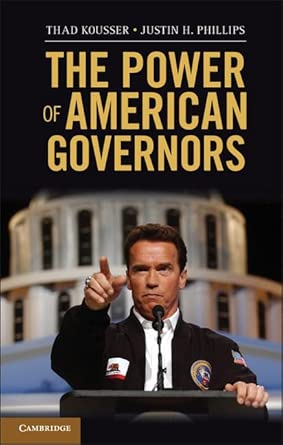
The Power of American Governors: Winning on Budgets and Losing on Policy
Author(s): Thad Kousser (Author), Justin H. Phillips (Author)
Publisher: Cambridge University Press
Publication Date: 8 Nov. 2012
Edition: Illustrated
Language: English
Print length: 296 pages
ISBN-10: 110702224X
ISBN-13: 9781107022249
Book Description
With limited authority over state lawmaking, but ultimate responsibility for the performance of government, how effective are governors in moving their programs through the legislature? This book advances a new theory about what makes chief executives most successful and explores this theory through original data. Thad Kousser and Justin H. Phillips argue that negotiations over the budget, on the one hand, and policy bills on the other are driven by fundamentally different dynamics. They capture these dynamics in models informed by interviews with gubernatorial advisors, cabinet members, press secretaries and governors themselves. Through a series of novel empirical analyses and rich case studies, the authors demonstrate that governors can be powerful actors in the lawmaking process, but that what they’re bargaining over – the budget or policy – shapes both how they play the game and how often they can win it.
Editorial Reviews
Review
‘This is the best book, perhaps ever, on the influence that US governors have on the policy- and budget-making processes in the states. Clearly written, insightful, and full of well-constructed evidence, this is a must-read for serious observers of state government.’ Bruce Cain, Stanford University
‘I cannot imagine a better combination of scholars than Kousser and Phillips to illuminate the state of American governors. They bring the full set of tools for the job – command of theory, data, and empirical methods; a keen eye for natural experiments and an intuitive sense of why they matter; and, finally, a beat reporter’s attention to the quirks of statehouse politics and how legislative deals get struck. [They] show how bargaining over budgets differs from bargaining over other legislation, the factors that drive whether legislators will hold out or scramble to accept a deal, and when and how a governor’s popularity enters the equation. Best of all, the book is about more than American state politics – it delivers a theory of executive power relevant to students of legislative politics anywhere.’ John Carey, Dartmouth College
‘Thad Kousser and Justin Phillips have produced a masterful account of governors’ powers in dealing with the fifty state legislatures. They offer a theoretical model of how the dynamics of budget negotiations advantages governors, while bargaining over policy bills advantages legislators. The authors skilfully weave game theory, statistical analyses of original data, case studies, and information from extensive interviewing into evidence supporting their theory. Their book represents a major advance in the study of political executives.’ Virginia Gray, University of North Carolina, Chapel Hill
‘This innovative and rigorous examination of gubernatorial leadership ought to be required reading for anyone involved with or interested in the politics of the American states.’ Alan Rosenthal, Rutgers University
Book Description
Governors can be powerful actors in the lawmaking process, but what they’re bargaining over shapes their strategy and effectiveness.
About the Author
Thad Kousser is Associate Professor in the Department of Political Science at the University of California, San Diego. He has written or edited several books, including Politics in the American States (10th edition, 2012), The Logic of American Politics (5th edition, 2011) and Term Limits and the Dismantling of State Legislative Professionalism (2005). He is a recipient of the UCSD Academic Senate’s Distinguished Teaching Award, as well as the Faculty Mentor of the Year Award.
Justin H. Phillips is Associate Professor in the Department of Political Science at Columbia University. His research has been published in the American Political Science Review and the American Journal of Political Science. He is a fellow at the Columbia University Applied Statistics Center and at the Institute for Social and Economic Research.
 Wow! eBook