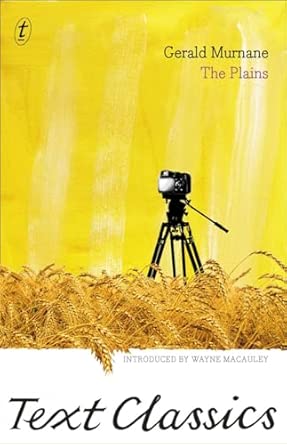
There is no novel in all of Australian literature that is quite comparable to The Plains. A nameless young man arrives on “”the plains”” and begins to document the strange and rich culture of the plains families, with intention of producing a film. As his story unfolds, the novel becomes, in the words of Murray Bail, “”a mirage of landscape, memory, love and literature itself””. The vast, incomprehensible landscape of Australia becomes not a tangible place but an abstract and mythological concept. Published in 1982, this haunting novel has earned its status as a classic.
Editorial Reviews
Review
A man travels to Australia’s interior plains planning to make a film about the region’s people and culture, but mostly he ruminates in this wry, evocative novel….Murnane touches on foibles and philosophy, plays with the makings of a fable or allegory, and all the while toys with tone, moving easily from earnest to deadpan to lightly ironic…A provocative, delightful, diverting must-reread.’–Kirkus Reviews [starred]; ‘One of Australia’s most important writers.’–Publishers Weekly ‘A distinguished, distinctive, unforgettable novel.’–Shirley Hazzard; ‘A piece of imaginative writing so remarkably sustained that it is a subject for meditation rather than a mere reading … In the depths and surfaces of this extraordinary fable you will see your inner self eerily reflected again and again.’–Sydney Morning Herald; ‘Widely regarded as Australia’s greatest living writer, Murnane has long cultivated an air of myth and geographical limit…One could fill a room with a conversation about him.’–Full Stop; ‘Known for its sharp yet defamiliarizing take on the landscape and an aesthetic of purity historically associated with it, The Plains is uniformly described as a masterpiece of Australian literature. Look closer, though, and it’s a haunting nineteenth-century novel of colonial violence captured inside the machine’s test-pattern image–a distant, unassuming house on the plains.’ –Bomb
“Reading Murnane, one cares less about what is happening in the story and more about what one is thinking about as one reads. The effect of his writing is to induce images in the reader’s own mind, and to hold the reader inside a world in which the reader is at every turn encouraged to turn his or her attention to those fast flocking images.” –New York Times
The Plains is a bright and inviting novel, full of humour yet without resort to slapstick. As it beckons you along its secrets keep receding.’
London Review of Books
‘I’ve heard Murnane called an outsider artist, but I don’t think that’s quite right. Plenty of writers emerge as if out of nowhere (after steeping themselves in canonical authors), then proceed to become more and more their eccentric selves. It might be said, however, that Murnane qualifies as an outsider literary theorist.’ —London Review of Books
About the Author
Gerald Murnane was born in Melbourne in 1939. He has been a primary teacher, an editor and a university lecturer. His debut novel, Tamarisk Row (1974), was followed by eleven other works of fiction, including The Plains, A Million Windows and, most recently, Border Districts [shortlisted for the Miles Franklin Award]. In 1999 Murnane won the Patrick White Award and in 2009 he won the Melbourne Prize for Literature. He lives in western Victoria.
 Wow! eBook