 Wow! eBook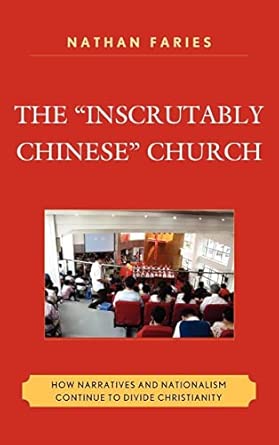
The "Inscrutably Chinese" Church: How Narratives and Nationalism Continue to Divide Christianity
Author(s): Nathan Faries (Author)
- Publisher: Lexington Books
- Publication Date: 23 Sept. 2010
- Language: English
- Print length: 310 pages
- ISBN-10: 0739139576
- ISBN-13: 9780739139578
Book Description
Editorial Reviews
Review
The “Inscrutably Chinese” Church opens a window of opportunity for us to view Protestant churches in contemporary China through a different lens….This book will help all of us see more clearly the true face of the Chinese church, close some gaps caused by cultural miscommunication, draw together the perception of those inside and those outside China, and bring the ‘inscrutably Chinese’ church into clearer view. ―
International Bulletin of Mission ResearchNathan Faries’ The “Inscrutably Chinese” Church: How Narratives and Nationalism Continue to Divide Christianity, provides a valuable guide to some of the current realities in the church life of China….His book is rich in illuminating detail, and it offers important correctives to typical characterizations by Western Christians with lesser experience and capability in spoken and written Chinese.
About the Author
Excerpt. © Reprinted by permission. All rights reserved.
The “Inscrutably Chinese” Church
How Narratives and Nationalism Continue to Divide Christianity
By Nathan Faries
ROWMAN & LITTLEFIELD PUBLISHERS, INC.
Copyright © 2010 Lexington Books
All rights reserved.
ISBN: 978-0-7391-3957-8
Contents
Acknowledgments,
Part I: Introductions,
1 Introduction: “Inscrutably Chinese” Narratives,
2 The “True Face” of the Chinese Church,
Part II: The Tales Nations Tell,
3 National Narratives from Outside China,
4 National Narratives from Within China,
Part III: Missionary Narratives,
5 Missionary Stories from the Past,
6 “Missionary” Stories from Contemporary China,
Part IV: Chinese Christianity in American Literature,
7 Literary Narratives from before China’s Reform Era,
8 Foreign Travelers in the New China,
9 Chinese-American Voices and Living White Males,
Part V: Christianity in Chinese Literature,
10 Pre-Modern and Modern Literature,
11 Reform Era Writers Test the Waters,
12 Shi Tiesheng and Bei Cun Dive into the Deep End,
Part VI: Conclusions,
13 The Narratives of Chinese Christianity,
14 Conclusion: Cause for Hope amid Unresolved Tensions,
Bibliography,
Index,
About the Author,
CHAPTER 1
Introduction: “Inscrutably Chinese” Narratives
The first half of the twenty-first century promises to be a time of great change for the Christian church in the People’s Republic of China. Jason Kindopp, in God and Caesar in China, cites a host of social and economic forces—increasing liberties in the marketplace, the gradual loosening of the state apron strings—that are likely to make China’s next few years a “critical juncture in church-state relations.” David Aikman, the former Time Bureau Chief in Beijing, recently predicted a fully Christianized China emerging over the next thirty years. After years of reporting on the Chinese church, Aikman envisions the real possibility of a more tolerant, even churchgoing, leadership arising in the coming days to rule a Chinese Christian population that could number in the hundreds of millions. There are already approximately three times more Catholics in China than in Ireland (fourteen million vs. four million in rough round numbers using latest estimates); Aikman imagines a future China in which there are more Protestant Christians than there are now citizens of the United States (over 300 million, which could be close to 20 percent of that future Chinese population). This could be a reality, he says, before we are even halfway through this century. “The moment may occur,” Aikman concludes, “when the Chinese dragon is tamed by the power of the Christian Lamb.” Francesco Sisci does not lag behind in his optimism for Chinese Catholicism. He writes in First Things in 2009 that “we are near a Constantinian moment for the Chinese Empire.” As the Chinese government looks to work in concert with religious believers to effect its United Front goals of building the nation, Sisci claims the Communist Party is looking to Catholic Christianity as an “instrument of social cohesion.”
Whether or not Aikman and Sisci are correctly foreseeing the future of China, their enthusiasm for the subject is well-founded; Christianity in China is a fascinating topic at this point in history and quite possibly essential reading for anyone interested in the tea leaves that foretell that powerful nation’s future: “If you want to know what China will be like in the future, you have to consider the future of Christianity in China,” says one Christian convert, formerly a member of the Communist Party. The situation is complex and fluid, and the information gap between those inside China and those outside is still significant, though shrinking. It is this division between insider points of view and those from the outside to which the subtitle of this book refers, and this is the gap in understanding which this book attempts to close.
Foreign Christians talking about China tend to divide the Chinese church neatly into “official” and “underground,” by which they often connote a value-laden difference between two groups in their freedom to be faithful to Christian orthodoxy: the official church is compromised by its relationship to the Chinese government, and the underground church is persecuted by a repressive regime for being a countercultural prophetic voice. Chinese Christians in general do not necessarily engage in this same sort of conversation or find this bipartite analysis fruitful. This binary summary of the complex case is more a part of the foreign Christian perspective, less a part of the domestic. Rather than reiterate the old outsider’s two-part paradigm, this book will resist and hopefully break down many of the old stereotypes about China that still persist in Christian circles outside of the People’s Republic. This book will move readers nearer to the Chinese Christian experience, help foreign readers to see more clearly how Chinese Christians view their government and themselves in relation to the ruling powers. For the outsider, there exists still a measure of “inscrutability” about China that needs to be revealed and made “scrutable.”
That “inscrutable” part of the book’s title invites comment. The concept of the “inscrutable Chinese” is a dated and arguably racist phrase that suggests foreigners have trouble “reading” Chinese faces and actions. More negatively, the phrase implies that the Chinese have something to hide, that an outsider’s inability to fathom the motives of a Chinese person might mean danger for that outsider. The racist underpinnings of the phrase are hopefully on the wane, but a quick internet search will demonstrate that the phrase is not dead; it springs to the minds of bloggers and journalists anytime some cultural difference seems too difficult to explain or some international business deal seems particularly advantageous to the Chinese side. Those outside Chinese culture still frequently describe a peculiar difference and cultural gap between themselves and the Chinese people. “‘We’ don’t easily understand ‘them.'” The perceived gap between “us” and China’s ruling authorities is probably even more pronounced than that between “us” and the Chinese people. Old political and racial distrust seem alive and well when we consider some portrayals of the last remaining Chinese “villains,” the heirs of the “yellow peril” and Dr. Fu Manchu: that is, the Communist Party, the ruling party of Chinese government since 1949.
These leaders have a lot to answer for according to many observers (the following words in quotation marks signal rhetoric which may be controversial to one side or another in these debates): the Tian’anmen “massacre” of 1989; the “suppression” of the Falungong movement ten years later; the continued “unlawful” rule over Tibet; and new questions about the treatment of minority Muslims in the other “autonomous” region in western China, Xinjiang Province. Consider the suspicion expressed by many outside China during the 2008 Beijing Olympics: apart from the politicized protests during the torch relay in Paris and London, there were also questions raised about the Chinese government’s honesty and ethics regarding allegedly underage female gymnasts and regarding a child who sang for the opening ceremony while a “cuter” child lip-synced for the cameras. Audiences watched the majestic opening and closing ceremonies in Beijing with wonder, but also with some cynical comments about how an authoritarian government could rally so many “volunteers.”
This book should not be read as an apologetics for the Chinese government or a defense of its imperfections. Yet it seems clear that the Chinese people as a rule, including Christians and members of other religious faiths, view their leadership in terms very different from those outsider portrayals of the “Communist regime” (a politically incorrect phrase among intellectuals in China). This single Chinese/outsider difference accounts for a great deal of the continuing cross-cultural miscommunication and the perception gap between foreigner and Chinese. Chinese will criticize, but will rarely demonize the Communist Party; they will view the Party as made up of individuals (some noble and some of bad character) and of factions with various motivations (some of which serve the people and some their own interests); and they tend to side with their government on many of the issues which outsiders might use as examples of inscrutable wrongheadedness or injustice. Chinese people generally see their government as a fact of life, a system that is currently working fairly well, or a system that they have little power to change even if they wanted to; its imperfections are susceptible to reform, not revolution. If Chinese citizens are forced to choose between their own government and the opinions of a foreign power, the choice is not difficult.
The Olympics singing “scandal” is a relatively innocuous example which can stand in for issues of greater moment: it was revealed that a “better-looking” girl, Lin Miaoke, was asked to lip-sync as the “plainer” Yang Peiyi sang “Ode to the Motherland” at the Olympics opening ceremony in 2008. Many foreign media outlets ran the story as an ironic embarrassment for a country so intent on saving face by this decision. Time made the incident one of its top-ten scandals of the year along with the marital indiscretions of American politicians. The CNN version of the story quoted Chinese bloggers who were as angry as CNN’s foreign audiences about the unfairness of the situation. In short, the story ran under the assumption that this decision by the Chinese government was foolish at best, despicable at worst; the story further supposed that its intended English-speaking audience outside China would share these sympathies against the government intervention; and by citing two angry Chinese bloggers, the writer implied that the Chinese people are also on the same anti-government side of the issue. An informal poll of several Chinese friends and acquaintances and a scan of Chinese online discussion sites reveal that the Chinese people are at best split on the issue and probably favor the government’s decision over the foreign indignation. All of my respondents on the issue found something to lament about the situation, most commonly the involvement of the two girls as “victims” in the debacle. A minority of replies, about a quarter, were disappointed and angry and had nothing to say in favor of the system that produced the ceremony. The remaining replies were conflicted about the issue and spent at least some time defending or explaining the situation to their foreign audience. Most agreed that this is a “normal phenomenon in China” which “most Chinese people will not even care about.” Yang Peiyi, the young singer whose voice was used in the Olympic recording, apparently took the incident as a matter of course.
One does not have to live in China long to understand that the concept of setting forth an ideal “face” both internationally and domestically is standard practice in China (one of my Chinese correspondents terms this “a tradition of externalism”) and is not inscrutable at all. Lip-syncing to recorded songs in high-pressure live-TV situations is part of this impulse and is a common technique in Chinese media where it carries far less of a stigma than it does elsewhere. (Curiously, the Spring Festival (Chinese New Year) television variety show did away with lip-syncing for the first time in its annual broadcast history in 2009, so the country’s perception of this style seems to be shifting, perhaps in part as a reaction to the 2008 Olympics.) One of the outraged Chinese bloggers cited in the CNN story (as did one of my e-mail correspondents on the issue) ironically based his or her objection on the same concept of “face” that the foreign media was holding up for scrutiny: “If foreigners found out, they’d think we can’t even find a girl who is good at both [looking good and singing well].” This Chinese commentator is more concerned with what this incident means for the reputation of China than with justice for the individuals involved; this blogger is agreeing, in a particularly Chinese manner, with the government’s intentions, even as he criticizes its actions. Chinese public opinion is not controlled lockstep by its own or by foreign media, but this example illustrates an overall Chinese lean toward home loyalty (heavily influenced by Chinese media, no doubt) even as the foreign media sometimes sets up a fictional sharp division between the Chinese government and the Chinese people.
The same suspicion and cynicism about government is at work when foreigners worry about religious freedom in China, and the same disconnect between Chinese perspectives and foreign perspectives persists from the previous analogy. The Party puts up a good front regarding religious liberty, outside views suggest, but under the inscrutable mask lurk evil intentions and dangerous weapons. In spite of many truly “underground” Christians who do live within China’s borders, this attitude of suspicion is far less common among Chinese; a sense of caution and fear is real in many quarters, but is far less prominent than it is outside China, and it is cut with a Chinese resignation or willingness to work within the status quo that rebellious outsiders do not always understand. And so this book is titled The “Inscrutably Chinese” Church. The persistent problem of “inscrutability” is part of the barrier that separates outsider thinking about China from Chinese thinking about itself.
And what is the key to breaking down this wall? A clearer understanding of Chinese culture and particularly modern Chinese nationalism will move these issues much of the distance from obscurity to transparency, from inscrutable to scrutable. The central thesis of this book is that outsiders tend to miss what is distinctly “Chinese” about Chinese Christianity: simply put, the Chinese church consists almost entirely of a people group who are inextricably bound up with their own ancient culture and who, more or less, identify themselves with their own contemporary government. The former is almost too obvious to require mention—the Chinese church is Chinese—yet bridging this cultural gap is far from simple; the latter claim about loyalty to or identification with the communist-led government is less obvious and may strike some readers as difficult to countenance. The depth and intricacy of Chinese culture is difficult for the outsider to comprehend, and the Communist government is difficult for the outsider to embrace, peculiarly difficult for many outsiders who claim a faith in the supernatural realm that Communism rejects. But if one is to see Chinese Christianity as Chinese Christians see it, one must essay these obstacles and attempt to understand something about the Chinese national spirit. The example of the 2008 Olympics is again instructive. Many people outside China would have been glad to see the torch pass by the People’s Republic in order to promote human rights reform in China; very few people within China would give up the Olympics or the Communist Party that brought the Olympics to their nation. The ties between citizen and government are not easily dismissed, at least not when the government is one’s own.
A word about the author’s background is relevant at this point in order to prepare the reader for the approaches taken in the following pages. I am primarily a student of literature, and this bias will show in this study; I hold degrees in English Literature and in Comparative Literature with a Chinese emphasis. I have lived and taught at universities in Hong Kong for one year and in Beijing for three years and have made additional trips to the mainland since those years, the most recent covering two months in the summer of 2009. While living in Beijing, I learned to speak and read Mandarin Chinese, so I have been able to read many primary documents, conduct interviews with Christians, and worship in Chinese churches in Beijing and a handful of other cities, large and small. Several of my own translations of portions of Chinese literary and church texts are included in this book.
Because of the author’s background in literature, much of the information that follows is based on the textual and rhetorical analysis of narratives, both literary and autobiographical, by Chinese and foreign Christians. Chapter 2 will begin with facts, with a portrait of the contemporary Chinese church that is as accurate as I can hope to be, but the rest of the book will concern itself largely with stories, perceptions, world views—not with observable reportable truths, but the “truth” about China as it is perceived from within China and from without. The optimistic predictions of Aikman and Sisci that began this introduction seem excessively hopeful just as evangelical stories of persecution in China sometimes seem unjustifiably alarmist; both extreme perspectives are part of the same narrative current. This study will not attempt to judge the accuracy of these forecasts, but rather will concern itself with how these perspectives fit into various narrative frameworks surrounding Chinese Christianity. What are the origins of these narratives? What are the motivations that lie behind triumphalist predictions? How do we reconcile these optimistic perspectives with the seemingly contradictory negative portrayals of the Chinese government and of China’s religious freedom that we hear so frequently from similar foreign sources?
Narrative and world view are symbiotic intertwining vines growing around our minds and hearts; the stories we tell about the world are shaped by, and also shape, the subjective world as we experience it. This study makes the case that certain kinds of narrative are part of the problem, perpetuating uncompromising and blinkering forms of nationalism that keep us from empathizing with, or even acknowledging, another’s loyalties. And the study proposes that reading alternative narratives, many of which appear in these pages, performs some of the task of moving the outsider toward the insider perspective.
(Continues…)Excerpted from The “Inscrutably Chinese” Church by Nathan Faries. Copyright © 2010 Lexington Books. Excerpted by permission of ROWMAN & LITTLEFIELD PUBLISHERS, INC..
All rights reserved. No part of this excerpt may be reproduced or reprinted without permission in writing from the publisher.
Excerpts are provided by Dial-A-Book Inc. solely for the personal use of visitors to this web site.


