Wow! eBook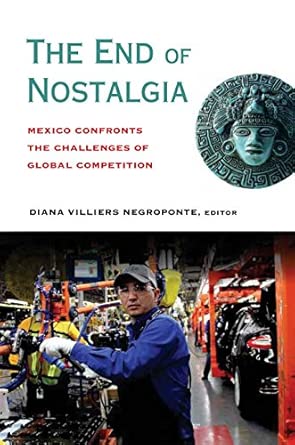
The End of Nostalgia: Mexico Confronts the Challenges of Global Competition
Author(s): Diana illiers Negroponte
- Publisher: Brookings Institution Press
- Publication Date: 17 Jun. 2013
- Edition: 1st
- Language: English
- Print length: 217 pages
- ISBN-10: 0815724942
- ISBN-13: 9780815724940
Book Description
Editorial Reviews
About the Author
Excerpt. © Reprinted by permission. All rights reserved.
The End of Nostalgia
Mexico Confronts the Challenges of Global Competition
By Diana Villiers Negroponte
Brookings Institution Press
Copyright © 2013 THE BROOKINGS INSTITUTION
All rights reserved.
ISBN: 978-0-8157-2494-0
Contents
Acknowledgments............................................................vii1 The End of Nostalgia: Mexico Confronts the Challenges of a Global Era
Diana Villiers Negroponte..................................................12 Piecing Together the Puzzle of Mexico's Growth Arturo Franco............103 Unlocking Mexico's Political Gridlock Arturo Franco.....................404 Energy Challenges for the Peña Nieto Administration Duncan Wood.........575 Toward a Regional Competitiveness Agenda: U.S.-Mexico Trade and
Investment Christopher E. Wilson..........................................736 The Priority of Education in Mexico Armando Chacón......................927 Security Policy and the Crisis of Violence in Mexico Eduardo Guerrero...1128 The Mérida Initiative: A Mechanism for Bilateral Cooperation Diana
Villiers Negroponte........................................................1529 Mexico and the United States: Where Are We and Where Should We Be?
Andrés Rozental............................................................170Acronyms...................................................................189About the Authors..........................................................193Index......................................................................197
CHAPTER 1
The End of Nostalgia: Mexico Confrontsthe Challenges of a Global Era
Mexicans are proud of their noble ancestors: the most ancient Olmecs;Zapotec artists; Mayan traders; and Aztec warriors, who created a century-longempire. Later, Spanish conquerors, bringing with them both disease andCatholicism, melded with the indigenous populations to form a complex peoplewhose adherence to a glorious past and whose fierce nationalism havebecome an integral part of the national discourse. Every school child absorbstales of conquest, religion, and art derived from Mexico's ancient roots. Theoversized national flag, emblazoned with an eagle devouring a serpent,reminds citizens that they are both a conquering and a conquered people.
In the nineteenth and twentieth centuries, the United States presented anexistential threat. The Mexican-American War (1846–48) represented the loss ofvast tracts of Pacific coast and inland deserts, and it served to remind Mexicansthat the outside world was avaricious. Accordingly, for more than a hundredyears, relations between Mexico and its northern neighbor were contentious.What Mexico needed was a defensive posture toward the emerging North Americangiant, whose interference was evident in President Woodrow Wilson's attackon Veracruz (1914) and General Pershing's raid deep into Mexico's heartland(1916). In response, relations with nonaligned countries were preferred preciselybecause those countries contested U.S. hegemony.
The Mexican Revolution (1910–20) was merciless in its savagery. After tenyears of brutality, Mexico's leaders were determined to avoid war. Meantime,the "Great Revolution" provided the justification for an authoritarian governmentthat co-opted the power of the army, peasants, business community, andemerging trade unions. The grand bargain between each constituent groupand the Mexican presidency was constructed to provide a means for the respectiveinterests of each group to reach up to the highest authority. However, it wasalso a means for the president to send his instructions down to the groups. Cooptionrather than conflict became an essential feature of the Mexican politicalsystem, and patronage was ingrained throughout the nation. Powerfulsponsors ensured access to employment, food for the family, and advancementin the political sphere. In exchange, few groups contested presidential mandates.Tacit acceptance of the patronage system formed between the governmentand the people, assuring citizens of security and moderate economicprosperity. For seventy-one years, the president of the dominant party, the PRI(Partido Revolucionario Institucional [Institutional Revolutionary Party]),appointed his successor and ensured that opposition was never strong enoughto threaten the state.
The doubtful legitimacy of the 1988 presidential election began the unravelingof the old regime. The patronage system continued to ensure Mexico'scentury-long single-party rule, but signs of its demise began to appear. PresidentErnesto Zedillo recognized the need to dismember the one-party stateand, like Mikhail Gorbachev in the Soviet Union, spurred the process of politicaldemocratization. In Mexico, this process was viewed as weakness becauseit resulted in victory for the opposition party, the center-right PAN (PartidoAcción Nacional [National Action Party]). However, there appeared to be nostopping Mexico's historic march toward a multi-party system.
The PAN won the presidency in 2000 but struggled to negotiate legislationwith a congress that was no longer compliant. The transition of a society fromauthoritarian rule to a government based on consensus building is necessarilyslow, and the tendency to return to the old authoritarian ways remainsstrong. Political players found the freedom to contest the president throughthe media as well as in the halls of congress, and the 1998 decision to distributefederal resources to the thirty-one state governors, without demandingcommensurate accountability, resulted in the diminution of the president'sauthority. State governors acquired new powers based on the transfer of federalfunds, and a new power equilibrium ensuring greater rights for citizensspread throughout the nation. It also affected foreign relations.
Mexico's history reflects the national pride of its people, a hierarchical statestructure that provided security, and a tradition of commercial trading. Mexicans,like the British, are traders. They have always ventured into new watersto find different goods, enriching their churches and homes with jade fromMeso-America, turquoise from the deserts of modern-day Arizona, silk fromChina, and ivory from the Philippines. In exchange, they exported gold, silver,and foods. Apart from the times of intense internal turmoil during the War ofIndependence and the Revolution, Mexicans have always looked beyond theirnation's borders; thus, their contemporary engagement with the modernworld is a phenomenon with ancient roots.
President Miguel de la Madrid's decision to join the General Agreement onTariffs and Trade (GATT) in 1986 and the pursuit of a free trade agreementwith Canada and the United States by his successor, Carlos Salinas de Gortari,opened the economy to new trading opportunities. But was the nation thathad protected itself behind high tariff walls ready to engage with internationalcompetitive forces? In 1993, this author's speech before an associationof engineering companies in Guadalajara on the opportunities presented bythe North American Free Trade Agreement (NAFTA) was greeted with significantcriticism. The prospects of competitive trade implied a threat, and allthe questions from the audience centered on how their businesses might survive.Twenty years later, the same companies have either gone out of businessor adapted to the reality of international trade and global competition.
Today, Mexico has become a manufacturing center, with family-ownedcompanies engaging in international trade and acquiring new technologies.Protectionist regulations are being dismantled, and young business leaderslearn colloquial English, study at international business schools, and connecteasily with foreigners. The young men and women whom I met over twoyears at a business summit held in the colonial city of Queretaro are not re signedto the new reality; instead, they seek to thrive in a competitive world.Their network is global, including colleagues encountered at school, at professionalconferences, and on social media. They interact with foreigners withenthusiasm; they take on new international contracts with excitement.
But the old ways are hard to eradicate. The yearning for the predictabilityof government contracts, dependence on political patrons, and reliance onfamily ties have not disappeared. The authors of these chapters thereforeagreed on the need to analyze and relate how the old Mexican system is changing.Metamorphosis is not easy; economic and political transformation, inparticular, is hard. However, a proud trading people can find confidence intheir heritage. I believe that continued democratization and exposure to foreigncompetition is inevitable, but efforts to put the brakes on that processshould not be ruled out. Therefore this volume is also about protest and conflictdeep within the Mexican political economy.
In chapter 2, "Piecing Together the Puzzle of Mexico's Growth," ArturoFranco seeks to understand why the lusty 7 percent growth of the 1960s and1970s has declined to an average of 3 percent growth today. He provides acomprehensive review of the factors that might explain Mexico's lack of competitiveness—rigidlabor markets, inadequate infrastructure and access tofinance, size of the informal labor sector, high cost of energy, poor educationsystem, and Chinese competition—and asks whether those factors explainMexico's economic underperformance. Using data from Harvard's Center forInternational Development, Franco asserts that there is no single constraintto growth that affects the Mexican economy across a broad range of activities.He concludes that Mexico's weak economic growth remains a puzzle.
What is known is that if its economic constraints can be overcome, Mexicohas very high growth potential. Franco notes that a BRIC paper drafted in2005 by Goldman Sachs concluded that Mexico, given its distinctive geopoliticallocation, ample natural and human resources, and highly competitivecharacteristics, had the potential to rival Brazil, Russia, India, and China. Mexico'sGoldman Sachs Growth Environment Score ranks in the upper third,above Brazil's but below China's. Moreover, according to Harvard's Atlas ofEconomic Complexity Index, which measures growth potential, Mexico's percapita GDP is expected to increase 3.5 percent a year during the 2013–20period. In addition, overall GDP is expected to grow by 4.56 percent over thesame period. Such growth is essential if Mexico is to meet the expectations ofthe 2 million citizens who enter the work force each year in search of qualityjobs.
In chapter 3, "Unlocking Mexico's Political Gridlock," Franco examines theMexican legislative agenda. He observes that in the last twenty years, Mexicohas moved from a hegemonic party system under the PRI to a political equilibriumin which the three major political parties together account for 90 percentof the votes but none exceeds 42 percent. Since the election of a presidentfrom the PAN in 2000, no president has enjoyed a majority in congress, andcoalitions must be formed to pass legislation. Historical review suggests thatthis is feasible during the first three years of a president's six-year term (sexenio)but becomes much harder in the second three years—a situation familiarto observers of the U.S. Congress.
Franco asks whether the accusation that the national legislature is a "SiestaCongress" is fair, pointing out that a good number of constitutional reformsrequiring two-thirds approval were initiated and passed during PresidentFelipe Calderón's first three years in office. A slight decrease is shown in thelast three years, but the number should silence those who claim that a "do-nothing"congress appears during that period. In response to the critique thatthe bills passed were relatively insignificant with respect to the national interest,Franco notes that in the last ten years Mexico's congress has passed majorhealth care reform, pension reform, judicial reform, and labor reform. It alsocreated a new freedom of information law and a corresponding agency, as wellas less significant changes with respect to electoral laws, the energy sector,and the fiscal regime.
However, political reforms that Calderón proposed in 2009—which wouldhave allowed for reelection of legislators, a run-off election for presidentialcandidates, reduced campaign costs, participation of independent candidatesin elections, and an increased voice for the electorate in forming legislation—wereblocked by the PRI's intransigence. Franco asks whether the PRI, with anincreased number of legislative seats in 2012, will find it advantageous tointroduce similar political reforms. If so, how might the PAN and PRD (Partidode la Revolución Democrática [Party of the Democratic Revolution])now respond?
Duncan Wood, in chapter 4, "Energy Challenges for the Peña Nieto Administration,"examines the serious decline in petroleum reserves in Mexico andpresents specific solutions to augment energy supplies. Wood diagnoses internalproblems within PEMEX (Petróleos Mexicanos), the state-owned petroleumcompany—political interference, corrupt practices, and lack of accountability—andthe role played by STPRM (Sindicato de Trabajadores Petroleros de laRepública Mexicana), the oil workers' union. Without significant changes toallow opening of the oil industry to private investors, he fears that PEMEX willnot be able to take advantage of new exploration in the Gulf of Mexico and theshale fields of northeastern Mexico. Wood analyzes the consequences of developingshale gas and warns that given the high projected cost of developing thefields and the current low market price of gas, it makes little immediate sense todevelop Mexico's shale reserves. He also examines Mexico's renewable energypotential, concluding that the long-term outlook for Mexican energy output isextraordinarily positive.
In chapter 5, "Toward a Regional Competitiveness Agenda: U.S.-MexicoTrade and Investment," Christopher Wilson examines the record for Mexicantrade and investment and demonstrates that both are strategic drivers of theU.S.-Mexican relationship. Mexico is the United States' second-largest exportmarket, and the United States is by far Mexico's largest export destination.Merchandise trade has quintupled since 1993, and bilateral foreign directinvestment holdings have grown sixfold. However, the high growth rate ofbilateral trade and investment between 1994 and 2000 has slowed, leadingWilson to ask what more could be done to spur trade and increase regionalcompetitiveness.
With the technological and logistical improvements that define modernmanufacturing, labor costs now account for less and less of production costs.The consequences are critical for Mexico: foreign manufacturers are less likelyto move their plants abroad in search of low wages and more likely to seek outlocations where needed human capital and robust supply chains exist. Thereforethe quality of Mexican engineers, the education of its workforce, and itscapacity to innovate become critical components of regional trade, investment,and competitiveness.
Wilson favors a strategic regional approach to the Trans-Pacific Partnership(TPP), a nine-nation free trade group that Mexico and Canada joined in 2012.He believes that a joint pivot toward Asia by Mexico, Canada, and the UnitedStates to coordinate trade policy and negotiate agreements would benefit allthree nations. He also believes that the TPP creates an opportunity to strengthenNAFTA without renegotiating it because the TPP seeks to create common standardsand regulations in multiple areas, including financial services and intellectualproperty, that should facilitate the joint production of North Americangoods destined for the global market.
In chapter 6, "The Priority of Education in Mexico," Armando Chacónexamines both the quantity and quality of education in Mexico, noting its bottomrank in Program for International Student Assessment (PISA) scores forOECD countries. He points out the value added with respect to earnings,health, absorption of new technologies, and parenting skills for every additionalyear of schooling beyond the sixth grade. Recognizing that all recentpresidential candidates have made improved education one of their highest priorities,Chacón examines public policies to reach that goal. He advocates acomprehensive assessment of teachers, their capabilities, and their performancein the classroom, but he recognizes the opposition from both the largest teachers'union, the SNTE (Sindicato Nacional de Trabajadores de la Educación[National Educational Workers Union]), and the CNTE (CoordinadoraNacional de Trabajadores de la Educación [National Coordinator of EducationalWorkers]). With the arrest of the SNTE's leader in February 2013, theunion may become more reasonable and willing to work with the new government.Meantime, Chacón calls for continuing teacher training, with coursesand level of training determined both by the needs of specific teachers and bythe level and performance of specific schools—a lengthy and costly undertaking.A recent performance measurement, RENAME (Registro Nacional deAlumnos, Maestros, y Escuelas [National Registry of Students, Teachers, andSchools]), provides detailed information on school infrastructure as well as themonitoring of teacher and student performance. Chacón recommends thatthis information be published so that parents and the public may distinguishschools that add value from those that detract. With the publication of thisinformation, government, civil society, and the business community can coordinatetheir responses to meet the needs of Mexican students.
The location of schools and the socioeconomic background of both studentsand teachers make a difference. Programs to improve education must beevaluated against carefully designed criteria in order to develop programsthat stretch the value of public funds and achieve more positive results. Meantime,Chacón notes that Peña Nieto's administration has yet to propose abudget that provides the funding needed to implement critical educationalreforms.
In chapter 7, "Security Policy and the Crisis of Violence in Mexico," EduardoGuerrero presents a critical assessment of the current public security situationin Mexico and argues in favor of the process to alter security strategies. Guerreroidentifies the weaknesses in President Calderón's efforts to stop drug traffickingand discusses Calderón's shift toward reducing violence and crime, ashift that is accentuated and ongoing under President Peña Nieto. The numberof intentional homicides in Mexico has diminished since the fourth quarterof 2011 as a result of four factors: increasing public demand to stop theviolence; more effective intervention by the federal and state governments;reduced availability of new recruits; and a shift to a selective law enforcementstrategy.However, serious problems still remain, such as the slow pace of implementingreforms to criminal justice procedures; inadequate resources to reformthe correction system; and inadequate domestic intelligence capabilities.
Guerrero presents eight recommendations that are tailored to address themain sources and consequences of organized crime–related violence. The goalis to reduce predatory crime, such as extortion and kidnapping; reduce violencethroughout Mexico; improve the criminal justice system; and regain control ofthe prisons. To achieve these goals, Guerrero proposes a combination of short-termmeasures intended to deliver results in a six-month period, such as imposinga curfew on main roads to ensure public safety, conducting a prisonpopulation survey, and separating the marijuana market from the market formore damaging drugs. He also recommends medium-term interventions,intended to deliver results in a two-year period, to strengthen security-relatedinstitutions. In order to undertake intensive institution building, Guerrerocalls on outsiders with meaningful international experience to help designeffective interventions for Mexico.
(Continues...)Excerpted from The End of Nostalgia by Diana Villiers Negroponte. Copyright © 2013 THE BROOKINGS INSTITUTION. Excerpted by permission of Brookings Institution Press.
All rights reserved. No part of this excerpt may be reproduced or reprinted without permission in writing from the publisher.
Excerpts are provided by Dial-A-Book Inc. solely for the personal use of visitors to this web site.