What causes systemic risk in economic markets? What are the signals that there could be problems? How do you prevent systemic risk? And how should we change our risk management practices to take this risk into account? Chincarini looks at the financial crises of the past 15 years – starting with a comprehensive analysis of the Long-Term Capital Management crisis in 1998 and ending with the Euro-debt crisis of 2012 – and argues convincingly that the central risk in these crises was accentuated from within the financial system rather than from external economic forces (it includes the best analysis I have read on the LTCM crisis). This bold new theory has important implications for both industry practices as well as for new regulations. It is essential that we learn the lessons from the past (or else we will repeat the same mistakes). Chincarini’s book should be required reading for anyone who wants to understand and help prevent financial crises.
– Eric Rosenfeld, Co-Founder of Long-Term Capital Management and JWM Partners
Chincarini connects the dots between LTCM, mispriced risk, the 2008 financial crisis, the flash crash, and the Greek debt crisis. The instability created by the crowded trades, interconnected financial institutions, and too much debt is the recurring theme. For those interested in understanding the quantitative approach to investment, the section of the book focused on LTCM is a very useful reference. It contains, for example, a comprehensive inventory of the types of trades LTCM had entered into and an inventory of lessons learned. This book is not only a useful history of recent financial crises, but a treasure trove of insightful quotations from interviews with many luminaries among modern financial practitioners and academics.
– Robert Litterman, Former Partner and Head of Risk Management at Goldman Sachs; co-inventor of the Black-Litterman Model
Chincarini returns to the proverbial crime scene of a decade earlier to find the origins of the crisis of 2008. Based on new interviews with key players and his own analysis, the book argues that the LTCM collapse of 1998 should have been the early warning signal of fragility in the financial system rooted in the fact that holders of sophisticated financial products so often just end up copying each other’s behavior. It also provides a cautionary tale about the unintended consequences of financial regulations. Chincarini’s book, which combines a narrative style with an overview of economic fundamentals, should be on the reading list of anyone interested in the roots of our financial meltdown.
– Austan Goolsbee, Former Chairman of the Council of Economic Advisers to the President; Professor of Economics at the University of Chicago
The Crisis of Crowding is an excellent account of the financial crisis of 2008. This book has everything: an analysis of the trades, interviews with key players, and most importantly, a simple, entertaining explanation of how we got into this mess. It stretches from the LTCM crisis in 1998 to the Greek Crisis of 2012. Anyone who wants to know how our financial system works and how we can improve it should read this book.
– Frank Fabozzi, Professor at EDHEC Business School and Former Professor at the Yale School of Management
Dr. Chincarini gives an engaging description of the various crises over the last decade and how they are connected. It’s as if Chincarini was in the trading room taking notes as the crisis unfolded.
– Ken Kroner, Chief Investment Officer and head of the firm’s scientific active equity business, Blackrock
Do we need yet another book on the financial crisis? Yes, we do. Some books are fun to read, but leave you confused about what the actors actually did. Others give you a great deal of technical information, but can be a hard slog. The book by Ludwig Chincarini fills the middle. It is fun to read, and it tells you exactly who did what and how. Read, enjoy, and learn.
– Olivier Blanchard, Chief Economist at the IMF
One of the lessons from the crisis, rarely discussed, are the problems caused by crowded trading places. Chincarini takes the reader down a path not looked at by many analysts. An excellent read.
– Jimmy Cayne, Former CEO and Chairman of the Board of Bear Stearns
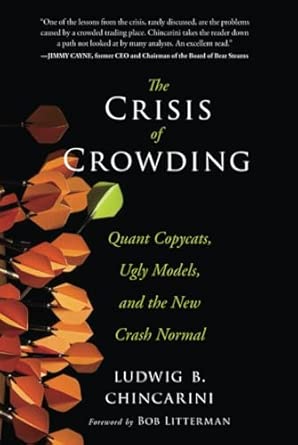
The financial markets are dangerously over-crowded. Investors follow popular trends or latch onto profitable new strategies with herd-like single-mindedness, and an increasingly globalized and interconnected world has only exacerbated the problem. The Crisis of Crowding: Quant Copycats, Ugly Models, and the New Crash Normal explores how the dramatic overcrowding we’ve seen over the last quarter century has yielded terrifying results, including the 2008 financial crisis that continues to reverberate around the globe.
The story of overcrowding as we know it now began in 1998, with the failure of the profoundly successful Long-Term Capital Management (LTCM) hedge fund. Exploring how this seemingly isolated event signaled a much larger problem within the financial industry, The Crisis of Crowding traces the story of LTCM and the subsequent hedge funds started by its founder, John Meriwether and his former partners, through the events of 2008, and up to the ongoing European debt crisis.
Part narrative, part quantitative analysis, the book is filled with firsthand recollections from those on the front lines of the crowding crisis, including several LTCM partners. Featuring insights from key banking and hedge fund authorities, it brings the events that led to the current crisis vividly to life, showing how and why the market has evolved in new and dangerous ways, and what can be done about it.
Much that should have been obvious after the fall of LTCM could have prevented the crises that followed. Instead, the problems of overcrowding went unchecked so that when the next economic disaster hit, increased leverage, policy mishaps, and an even more crowded trading space resulted in a far bigger collapse. We failed to learn our lesson the first time around, but that doesn’t mean it’s too late. Future economic crises are all but guaranteed, and The Crisis of Crowding reveals exactly what we need to know so we’re prepared for next time.
From the Back Cover
The financial markets are dangerously over-crowded. Investors follow popular trends or latch onto profitable new strategies with herd-like single-mindedness, and an increasingly globalized and interconnected world has only exacerbated the problem. The Crisis of Crowding: Quant Copycats, Ugly Models, and the New Crash Normal explores how the dramatic overcrowding we’ve seen over the last quarter century has yielded terrifying results, including the 2008 financial crisis that continues to reverberate around the globe.
The story of overcrowding as we know it now began in 1998, with the failure of the profoundly successful Long-Term Capital Management (LTCM) hedge fund. Exploring how this seemingly isolated event signaled a much larger problem within the financial industry, The Crisis of Crowding traces the story of LTCM and the subsequent hedge funds started by its founder, John Meriwether and his former partners, through the events of 2008, and up to the ongoing European debt crisis.
Part narrative, part quantitative analysis, the book is filled with firsthand recollections from those on the front lines of the crowding crisis, including several LTCM partners. Featuring insights from key banking and hedge fund authorities, it brings the events that led to the current crisis vividly to life, showing how and why the market has evolved in new and dangerous ways, and what can be done about it.
Much that should have been obvious after the fall of LTCM could have prevented the crises that followed. Instead, the problems of overcrowding went unchecked so that when the next economic disaster hit, increased leverage, policy mishaps, and an even more crowded trading space resulted in a far bigger collapse. We failed to learn our lesson the first time around, but that doesn’t mean it’s too late. Future economic crises are all but guaranteed, and The Crisis of Crowding reveals exactly what we need to know so we’re prepared for next time.
About the Author
LUDWIG B. CHINCARINI, CFA, PHD, is a Professor of Finance in the School of Management at the University of San Francisco and Director of Quantitative Strategies for United States Commodity Funds, with over fifteen years of experience in the financial industry specializing in portfolio management, quantitative equity management, and derivatives. Prior to this, he was creative advisor to Index IQ. He was also Director of Research at Rydex Global Advisors, where he co-developed the S&P 500 equal-weight index and helped launch the Rydex ETF program. He helped build an internet brokerage firm, FOLIOfn, designing its innovative basket trading and portfolio management platform. He also worked at the Bank for International Settlements (BIS) and Schroders. He is the coauthor of Quantitative Equity Portfolio Management. He received a PhD from the Massachusetts Institute of Technology and a BA from the University of California at Berkeley.
 Wow! eBook