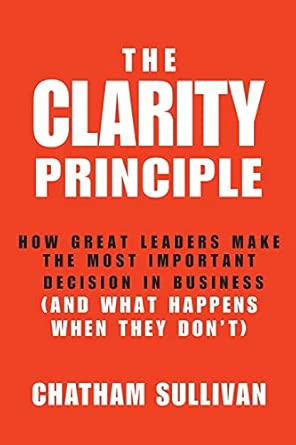
Turf wars, low morale, bad politics, and misguided strategies: these kinds of dysfunctions and messy "people" problems consume much of a leader's time. But strategy and leadership expert Chatham Sullivan shows us that when these issues become chronic and pervasive, it's a tell-tale sign that something more fundamental is broken. The organization has lost sight of its purpose.
Beyond making money, every company has a purpose; it exists to solve a particular kind of problem in the world. Whether you are a pharmaceutical company carving out a unique way to treat patients or a global retailer satisfying a particular consumer desire, your market, your customers, and the people in your organization need to know clearly what the business is about. Just like individuals, companies must know "who" they??are, what they're up to, and why it matters.
When leaders find their organization steeped in dysfunction and mired in an identity crisis, their most important responsibilitythe vital choice they must makeis to restore clarity. But in the face of conflicting visions and tough decisions that will have profound political, personal, and cultural consequences for the organization, leaders often flinch. As a result, their most carefully crafted strategies misfire, morale sags, and competitive advantage melts away.
Featuring compelling stories of leaders who have successfully resolved their organization's identity crisesand some who have succumbedThe Clarity Principle bridges the divide between leadership and strategy, demonstrating the tremendous gains to be achieved by leaders willing to clearly define their organization's core purpose.
Turf wars, low morale, bad politics, and misguided strategies: these kinds of dysfunctions and messy "people" problems consume much of a leader's time. But strategy and leadership expert Chatham Sullivan shows us that when these issues become chronic and pervasive, it's a tell-tale sign that something more fundamental is broken. The organization has lost sight of its purpose.
Beyond making money, every company has a purpose; it exists to solve a particular kind of problem in the world. Whether you are a pharmaceutical company carving out a unique way to treat patients or a global retailer satisfying a particular consumer desire, your market, your customers, and the people in your organization need to know clearly what the business is about. Just like individuals, companies must know "who" they??are, what they're up to, and why it matters.
When leaders find their organization steeped in dysfunction and mired in an identity crisis, their most important responsibility the vital choice they must make is to restore clarity. But in the face of conflicting visions and tough decisions that will have profound political, personal, and cultural consequences for the organization, leaders often flinch. As a result, their most carefully crafted strategies misfire, morale sags, and competitive advantage melts away.
Featuring compelling stories of leaders who have successfully resolved their organization's identity crises and some who have succumbed The Clarity Principle bridges the divide between leadership and strategy, demonstrating the tremendous gains to be achieved by leaders willing to clearly define their organization's core purpose.
About the Author
CHATHAM SULLIVAN is an organizational psychologist and a partner at Pivot, a strategic leadership boutique that helps Fortune 500 executives lead through environments of disruption, uncertainty, and complexity. Chatham has taught at the Wharton School of Business and the School of Social Policy at the University of Pennsylvania and worked closely with executives at many of the world's leading companies. Chatham currently lives in Belmont, Massachusetts, with his wife, Elizabeth, and their three children, Sophia, Abraham, and Lyra. For more information, please visit http://www.pivotleadership.com
 Wow! eBook