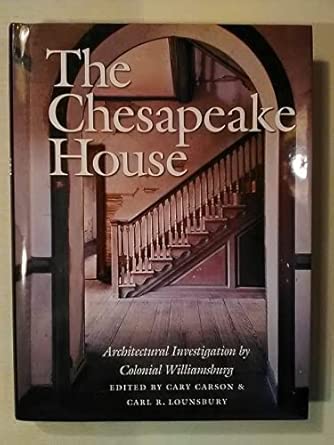
The Chesapeake House: Architectural Investigation by Colonial Williamsburg
Author(s): Carl R. Lounsbury
Publisher: University North Carolina Pr
Publication Date: 15 Jan. 2013
Edition: New
Language: English
Print length: 488 pages
ISBN-10: 0807835773
ISBN-13: 9780807835777
Book Description
For more than thirty years, the architectural research department at Colonial Williamsburg has engaged in comprehensive study of early buildings, landscapes, and social history in the Chesapeake region. Its painstaking work has transformed our understanding of building practices in the colonial and early national periods and thereby greatly enriched the experience of visiting historic sites. In this beautifully illustrated volume, a team of historians, curators, and conservators draw on their far-reaching knowledge of historic structures in Virginia and Maryland to illuminate the formation, development, and spread of one of the hallmark building traditions in America architecture. The essays describe how building design, hardware, wall coverings, furniture, and even paint colors telegraphed social signals about the status of builders and owners and choreographed social interactions among everyone who lived or worked in gentry houses, modest farmsteads, and slave quarters. The analyses of materials, finishes, and carpentry work will fascinate old-house buffs, preservationists, and historians alike. The lavish color photography is a delight to behold, and the detailed catalogues of architectural elements provide a reliable guide to the form, style, and chronology of the region’s distinctive historic architecture.
Editorial Reviews
Review
“The Chesapeake House is an important addition to the literature of the period and region and should be considered for both public and academic libraries.”–Arts Libraries Society of North America
“[This] book transforms our understanding of Chesapeake region buildings . . . [It] should become an essential reference for anyone interested in early American architecture.” —
Colonial Williamsburg
“A tour de force of fieldwork, analysis, and synthesis, providing the most thorough and nuanced understanding of Chesapeake buildings available.” —
Pennsylvania Magazine of History and Biography
“An important handbook to curators, scholars, and students in the field. . . . It is a seminal work in the field and will be referred to for years to come.” —
Virginia Magazine
“Perhaps once in a generation there appears a published architectural history that achieves landmark status at the onset.
The Chesapeake House deserves that status and more. . . . This work can truly be called a paradigm shift for how we should see and understand a significant regional development of American architecture.” –Southeastern Society of Architectural Historians 2013 Book Award
“Sure to inform, move, and delight.” —
Winterthur Portfolio
“This collection of essays is a milestone for architectural historians. While it will appeal to historians in any field, meeting rigorous expectations of scholarship, it will delight and inform a much wider audience beyond academe, just as the editors hope.” —
Journal of American History
“This important volume. . . is richly illustrated with measured floor plans, paintings, and photographs. . . . Recommended. Upper-division undergraduates and above; general readers.” —
Choice
“This magisterial volume delights on many levels. . . . For anyone planning a trip to Virginia or Maryland, this book would be essential background reading.” —
Vernacular Architecture
“This volume will serve as a valuable tool for historians who want to broaden their use of evidence and perhaps uncover a new perspective on the past.” —
Journal of Southern History
From the Inside Flap
For more than thirty years, the architectural research department at Colonial Williamsburg has engaged in comprehensive study of early buildings, landscapes, and social history in the Chesapeake region. Its painstaking work has transformed our understanding of building practices in the colonial and early national periods and thereby greatly enriched the experience of visiting historic sites. In this beautifully illustrated volume, a team of historians, curators, and conservators draw on their far-reaching knowledge of historic structures in Virginia and Maryland to illuminate the formation, development, and spread of one of the hallmark building traditions in America architecture.
From the Back Cover
For more than thirty years, the architectural research department at Colonial Williamsburg has engaged in comprehensive study of early buildings, landscapes, and social history in the Chesapeake region. Its painstaking work has transformed our understanding of building practices in the colonial and early national periods and thereby greatly enriched the experience of visiting historic sites. In this beautifully illustrated volume, a team of historians, curators, and conservators draw on their far-reaching knowledge of historic structures in Virginia and Maryland to illuminate the formation, development, and spread of one of the hallmark building traditions in America architecture.
About the Author
Cary Carson is retired vice president of the research division at Colonial Williamsburg.||Carl R. Lounsbury is senior architectural historian at the Colonial Williamsburg Foundation and teaches history at the College of William and Mary
 Wow! eBook