Wow! eBook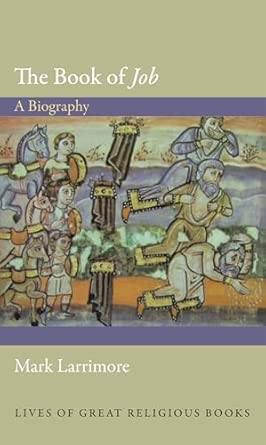
The Book of "Job": A Biography (Lives of Great Religious Books): 15 Illustrated. Edition
Author(s): Mark Larrimore (Author)
- Publisher: Princeton University Press
- Publication Date: 30 Sept. 2013
- Edition: Illustrated.
- Language: English
- Print length: 296 pages
- ISBN-10: 0691147590
- ISBN-13: 9780691147598
Book Description
Editorial Reviews
Review
"[A] remarkable book. . . . As captivating an introduction to Job as it is to the Bible's reception history and Western intellectual history. No small triumph for a handsome little book of less than 300 pages."
---Davis Hankins, Theology Today"[A]n excellent summary of the historical and spiritual impact of this most controversial of biblical books."
---Charles H. Middleburgh, Charles Middleburgh Blog"Ever since the tale was told, writers and painters and poets and thinkers have tried to make sense of it. Scholar Mark Larrimore tells that tale--of the rolling interpretations--with such verve in
The Book of Job: A Biography. It's a theology course, a philosophy course, a cultural history course and a very relevant meditation on life's trials all rolled into one. Incredible rate of ideas per inch."---Tom Ashbrook, WBUR "On Point""He perspicuously illuminates the philosophical and theological as well as spiritual backgrounds of the different works. Larrimore's . . . survey delivers insight into the long and sophisticated reception history of the suffering and rebellious Job and the disturbing biblical book carrying his name. This comprehensible presentation is in any case worth reading and a fine piece of writing on the reception history of a biblical book."
---Agnethe Siquans, Society for Biblical Literature"Is there such a thing as disinterested faith? Will people go on believing in God if they are not rewarded--indeed, if they are unjustly punished? And why
should they be faithful to a God who allows the wicked to triumph and the innocent to suffer? Mark Larrimore . . . chronicl[es] the answers given to that riddle by commentators from the midrash--the rabbinical meditations that were first compiled in the third century--down to Elie Wiesel."---Joan Acocella, New Yorker"Larrimore gets a lot into a comparatively small space. He examines the retellings of the Job story in the Testament of Job and the Talmud, summarizes Gregory's massively important Christian typology of Job, the Moralia, and discusses how medieval writers from Maimonides to Thomas view the book as a philosophical disputation on providence."
---Peter J. Leithart, First Things"Larrimore is particularly good at helping us understand ancient and medieval readings of Job."
---David Wolf, Prospect"Manage[s] to condense a vast amount of material into [a] handy-sized compendium."
---Gareth J. Medway, Magonia Blog"One of Larrimore's most interesting chapters discusses the liturgical use of Job in the medieval Office of the Dead, where quite long excerpts from Job's speeches appear as readings, interspersed with psalms of lamentation. . . . The Book of
Job is . . . still a live issue, and certainly appropriate for treatment in a series such as this."---John Barton, Times Literary Supplement"Princeton University's excellent series on the lives--meaning the changing interpretations--of great religious books continues with this study of the knottiest of all Biblical texts, a key work in Western culture's eternal debate over why bad things happen to good people. . . . [Larrimore] is subtle and superbly thorough as he navigates his way not just through Jewish, Christian and secular readings but also the uncertainties about the text and the misconceptions that have grown up around it."
---Brian Bethune, Maclean's Magazine"This beautifully written and presented book should be compulsory reading for anyone concerned with the irrationality of life, atheist and believer alike. . . . Superb."
---Canon Anthony Phillips, Church Times"This book helps the readers in their struggle to articulate the meaning of the story while at the same time providing both comfort and provocation as it speaks to and for broken people who have suffered loss. A worthwhile addition to all synagogue and Hebrew School libraries."
---Nathan Rosen, Association of Jewish Libraries"This is a fascinating book, ideal for undergraduates, and one that for biblical scholars (Job scholars in particular) ought to be required reading."
---Michael S. Moore, Society for Biblical Literature"This is an excellent resource for those interested in digging deeper into biblical sources, the Book of Job itself, or the history of biblical interpretation."
---John Jaeger, Library JournalFrom the Back Cover
"As eloquent and engaging as it is carefully researched and richly insightful, Larrimore's biography of the Book of Job delves deeply into the staying power of this wonderfully disturbing story. An outstanding book from a gifted scholar and teacher."--Timothy Beal, author of The Rise and Fall of the Bible: The Unexpected History of an Accidental Book
"Larrimore provides an elegant and insightful survey of the ways that the Book of Job was transmitted and understood in writing, art, and interpretation. Written in a remarkably engaging style, this short book offers a broad view of how Job has been read and used by Jews, Christians, and secularists, from ancient to modern times. There is no more economical way of getting a sophisticated sense of the theological issues at stake in the Book of Job than in reading Larrimore's book."--Edward L. Greenstein, Bar-Ilan University
"In the brief compass of this well-researched, well-written, and well-illustrated book, Mark Larrimore has brilliantly captured the most salient aspects of the rich afterlife of the Book of Job, including the interpretations evident in translations and theological and philosophical writings, as well as in the literary, visual, and performing arts. This handsome and accessible volume tells the fascinating story of the reception of the biblical book through the centuries and across cultures."--C. L. Seow, Princeton Theological Seminary
"Larrimore gives Job a new lease on life with a deft and sometimes surprising selection of landmarks and defining moments. As with all great biographies, we feel he knows his subjects intimately, though he presents them to us with an admirable lightness of touch."--Yvonne Sherwood, University of Kent
"A most useful and enjoyable addition to the Joban literature."--Bruce Zuckerman, author of Job the Silent
"A superb general survey of the multiple uses of this remarkable book. The very multiplicity of those readings and performative uses, which could make work difficult for conventional biblical scholars, becomes grist for Larrimore's mill, and offers windows on Job's broader impact."--David B. Burrell, author of Deconstructing Theodicy: Why Job Has Nothing to Say to the Puzzle of Suffering
About the Author
Excerpt. © Reprinted by permission. All rights reserved.
The Book of Job
A BIOGRAPHY
By Mark Larrimore
PRINCETON UNIVERSITY PRESS
Copyright © 2013 Princeton University Press
All rights reserved.
ISBN: 978-0-691-14759-8
Contents
LIST OF FIGURES............................................................viiIntroduction...............................................................1CHAPTER 1 Job in the Ancient Interpreters..................................25CHAPTER 2 Job in Disputation...............................................78CHAPTER 3 Job Enacted......................................................116CHAPTER 4 Job in Theodicy..................................................154CHAPTER 5 Job in Exile.....................................................195Conclusion.................................................................240NOTES......................................................................249INDEX LOCORUM..............................................................269SUBJECT INDEX..............................................................273
CHAPTER 1
Job in the Ancient Interpreters
As modern readers informed by Enlightenmentpresuppositions and decades of historical criticalscholarship, we think we know what the book ofJob is and how to approach it. Like any other book,we assume it must be a fixed text with a beginning,middle, and end. We take for granted that it waswritten at a particular time by a particular person.We might (or might not) also ask for what purposeit was written. Knowing this is enough for usto know what the book is about, and to judge laterinterpretations and adaptations. We praise as legitimatethose that illuminate things we too see in thetext. We are skeptical of those that make claims thatseem only weakly borne out by the text in question.And we dismiss, perhaps with disdain, those interpretationsthat interpret it in terms of things outsideof it, especially if, as it seems to us, they at thesame time ignore the plain meaning of the text.
All of these considerations impede our abilityto assess early biblical interpreters. It looks to us asif they aren't reading the same text at all. So consistentlydo they miss what we think is the plainmeaning that we suspect they're not even trying toread it faithfully. Indeed, they may seem to us willfullyto ignore and obscure the meaning. In the caseof the book of Job, the traditional "patient Job"reading seems to us to be painted over the actualstory of Job, which is, at the very least, much morecomplicated.
The extent of early readers' ignoring or obscuringis much exaggerated, however. The result may appearobfuscatory, but they were trying to do somethingquite different from this. To appreciate whatthey were up to, we need to pluralize our sense ofways of reading—and of books. In this chapter we'lldevelop these new senses by looking at the book ofJob as one of multiple renditions of a story, and asone of multiple texts in scripture. We'll explore theformer through the Testament of Job, the most substantialresidue of the popular and largely oral traditionsometimes known as the legend of Job. Forthe latter we'll look at the Talmud's midrashim onJob, and at Gregory the Great's moral and allegoricalreading of Job. Each of these is doing somethingfundamentally different, and we need to dwell onthose differences. But as a group they exemplify adistinctive way of approaching texts unfamiliar tous today which may yet have something to teach us.To help us shed the expectation that the book ofJob is a clearly defined and self-interpreting piece oftext, we start with a quick survey of the forms andsettings in which it has been encountered over thecenturies.
Books of Job
Whatever your image of the book of Job, it is probablya poor guide to understanding its history. Welive in the only period in its history when it is widelyavailable in translations without commentary andmarketed on its own as a freestanding book. Themateriality of independent binding might lead us tosuppose the book of Job was always understood tobe at least implicitly self-sufficient, but the story isquite different. The forms in which people encounteredit emphasized that it was part of the libraryof scripture (biblia comes from the Greek word forbooks, plural) and, until very recently, was thoughtimpossible to read unassisted.
The Bible was never read in a linear way, onebook following another, but the organization of itsbooks remained significant and a subject of muchdiscussion. In the Hebrew Bible, the Tanakh, thebook of Job forms part of the third section, Ketubim(Writings); it often—but not always—cameafter Psalms and Proverbs and before the five Megillotor "little scrolls," the Song of Songs, Ruth, Lamentations,Ecclesiastes, and Esther. It offers God'slongest speech in scripture, and, in the chronologyof the Tanakh, his last. If one read the Tanakh asif it were a biography of God, one might concludethat after the encounter with Job "God subsides,"and that divine silence begins within, not after, thetime of the Bible.
The Christian Old Testament shares most bookswith the Tanakh but not their order. In the Tanakhthe Ketubim is the last of three divisions, comingafter Torah and Prophets. In Christian Bibles theWritings come between the Pentateuch and theProphets. Read a Christian Old Testament fromstart to finish and you will not find God subsidingwith Job. Through his prophets he has a lot moreto say, all of it interpreted by Christian readers assetting the stage for the Christ. Many interpretersthought Job was a kind of prophet, too:
For I know that my Redeemer [go'el] lives,and that at the last he will stand upon the earth;and after my skin has been thus destroyed,then in my flesh I shall see God,whom I shall see on my side,and my eyes shall behold, and not another.(19:25-27a)
Job was also a "type" of Christ. "Job dolens interpretatur,typum Christi ferebat," Jerome wrote:Job's very name means sorrowing or suffering, andhe was a prefiguration of Christ. As we will seewith Gregory the Great's Morals in Job, the manfrom Uz's every word and gesture were understoodto anticipate the life and message of Christ.
While the Bible was regarded as the book parexcellence, the library of scripture wasn't a text likeothers. For one thing, it didn't look like other texts.The care taken in the writing, reading, and preservationof Torah scrolls is well known. Elaboratelybound and beautifully scripted Christian codicespresented the Bible monumentally as well—andnot just because it was a great deal of text to presentbetween two covers.
Many manuscript Bibles were illustrated. Thebook of Job offered artists many novel opportunitiesfor visualization. The events of the destructionof Job's life and livelihood were dramatic spectacles,but the figurative language of the speeches thatmake up the bulk of the text offered opportunitiesof its own. The book of Job is distinguished amongbiblical texts by the richness of the natural imageryemployed in its speeches, many of which were alsounderstood allegorically. Byzantine illuminatedBibles show long-standing traditions and subtraditionsin the representation of these figures andfigurations. These visual representations were importantto the experience of the text even for thosewho could read. Much of the drama of Job concernsthe limits of language and the power of representationsthat go beyond them.
For most of its history, encountering the biblicaltext on its own was as good as impossible. Scripturediffered from merely human literary productionsthrough a depth of meaning which demandedelaborate apparatuses of theological commentary.The clarifications of inspired and authorized interpreterswere indispensable and the production oftexts reflected this. Manuscripts and early printededitions of the Bible were often encased in so manylayers of commentary that the words of the biblicaltext themselves seem mere islands in a sea of smaller,handwritten commentary. The twelfth century sawthe emergence of a standardized synthesis of thecommentaries that had been welling up around themargins and even between the lines of ChristianBibles, the Glossa Ordinaria. Approaching the textwithout reference to (or at least awareness of ) theauthoritative commentaries of church fathers andothers was literally impossible. Commentary wasn'ttrying to bar access to the text, but to facilitate it(see figure 3).
How would a Christian reader in the MiddleAges have encountered Job? Jerome's pronouncementthat Job means suffering and that he was atype of Christ was the entry point:
Typically, approaching the beginning of Job,one is first greeted by a double prologue contributedby Jerome, one part bearing on theSeptuagint and the other on the Hebrew text.This is followed by an expositio of the secondpart of the prologue and a double praefatioby Nicholas de Lyra, to which is appended ananonymous additio. Thereupon comes a somewhatlengthy "Prothemata in Job" based onGregory's Moralia. Only now have we finallyarrived at the first verse of the book of Job.5
Even then, it was slow going. Commentary illuminatingthe significance of the words "There wasa man in the land of Uz by the name of Job" (1:1)took up several pages, as every word was parsed andreparsed. Our discussion of Gregory's Morals in Jobwill give a taste of the kind of significations offered.
Most people didn't have access to the Bible, andwouldn't have been able to read it if they had. TheBible was accessible to many more in visual form,and even in Bibles, images were more than mereillustrations. Works like the twelfth-century BiblesMoralisées and the cycles of stained glass windowsthey informed paired images of Old Testamentand new Testament scenes, showing the way everyChristian was to understand the Old Testament.Arguably these images illustrate the play of typeand antitype that defined the way medieval Christiansviewed the Bible more directly than textualcommentaries can. The claims being made werenot about words. Through typological anticipationGod wrote in events and scenes. To see the samestructure, the same postures of different bodies, inscenes paired in this way is to understand how divinepurpose wove through events. It was not necessaryfor the faithful to be able to read written languageto understand the way God wrote history.
The larger structure of history and saving knowledgewas made clear in a different way in thefifteenth-century works known as Bibles of thepoor, Biblia Pauperum. Here scenes from the lifeof Christ (mainly his miracles and passion) arepresented in sequence, each in an elaborate architecturalframe. Appearing on either side, like buttressesholding up a gothic church nave, are typologicallyrelated Old Testament scenes. Supportingtext scrolls from pairs of prophets unfurl above andbelow, so the new Testament scene is framed by sixallegorical, typological, or prophetic anticipations.The only significant blocks of text decode the twoOld Testament scenes depicted.
The correlations are anything but straightforward.On one page, celebrating the feast awaitingthe resurrected, we see Job's children feasting as asupport to an image of Christ gathering the blessedin his mantel (see figure 4). The accompanying textexplains:
We read in the Book of Job, chapter 1[:5], thatJob's sons after sending for their sisters so theycould eat and drink with them held a feast ineach of their homes. The sons of Job are theholy ones who held feasts daily, sending forthose who were to be saved so they could cometo eternal joy and enjoy God forever, amen.
That Job's children are killed in the middle of oneof their daily feasts just a few verses later (1:19) isbeside the point; this is an image of heaven. Refractedin the light of the gospel, however, thismay be irrelevant. What was important may simplyhave been that Job's sons numbered seven andtheir sisters three (significant numbers both), andthat they held feasts daily. But we shouldn't supposereaders weren't familiar with the story ofJob, which could add further shadings of meaning.Job 1:5 also tells us that Job "offer[ed] burnt-offerings"for his children, thinking " 'It may bethat my children have sinned, and cursed God intheir hearts'." Perhaps "Everyman"-like reflectionwas called for? The central panel, referring to thestory of Dives and Lazarus (Luke 16:22), doesn'tportend well for feasters, either.
Despite the idea of sola scriptura, the printedBibles of the Reformers didn't immediately dispensewith glosses, or with illustrations. Editionsof Martin Luther's German Bible soon included analready stock image conflating a number of scenesfrom Job (see figure 5). Messengers bring news ofthe calamities we see in the background behindthem—fire from heaven, camel abduction, and thecollapsed house of Job's sons—to a Job who is alreadyafflicted with sores and attended by friends—friendswhose gazes mirror the flames above them.(The youngest, Elihu, seems to be speaking.) Job'swife remonstrates from the side, her profile continuouswith the destruction above her. In lateriterations of this image, storm clouds are brewingoverhead; in some, Job is illuminated by a beam oflight coming from an opening in the clouds, makingevery part of the story simultaneous.
It is not only for reasons of economy that such illustrationspresent all that happens in Job's story atonce. The Bible doesn't merely narrate a history—aseries of events whose meaning lies only in theirplace in the sequence. Each element is significanton its own and potentially relevant at any time.Different parts may be relevant simultaneously. Acomposite image, which the eye can take in at a singleglance or navigate in endlessly different ways,gives us a better picture of how a familiar narrativelike Job's was experienced. In this world, prosperityis always haunted by calamity, just as tragedyis attended by hope. Even if Job passed throughthe storm only once, for the faithful encounteringhis story over and over—as text, and in their ownlives—he may seem to be spinning in it still, just aswe are.
The allegorical realms of the Glossa have lost theirsway, but Bibles full of clarification and commentarycontinue to shape the way we understand thebook of Job. Even among literalist Protestants whoallow no extra-biblical sources for interpretation,the Bible has been mined to reveal a dense networkof internal references and clarifications (see figure10). Texts like the Jewish Study Bible balance the bestmodern translation with interpretive suggestionsbased on philological work of medieval and modernprovenance, suggesting that passages might (ormight not) benefit from reordering (see figure 9).And the book of Job continues to reach new readerships,as Christian missionary translation programsreach out to hundreds of languages, and engage newworlds of signification (see figure 11).
Filling Gaps
The book of Job as we know it today seems to speakout of both sides of its mouth. Job helps God wina wager by not cursing him, and then comes veryclose to cursing God. After being challenged byGod for speaking without knowledge, Job is vindicatedby God for having spoken rightly. To confusethings further, the final outcome of Job's storylooks a lot like that which the friends (condemnedfor not having spoken rightly) predicted: recantand you will be restored. In the middle of it all, Jobspeaks with great wisdom about the unattainabilityof wisdom, a wisdom he otherwise complains ofnot finding.
Such tensions as these have been deeply unsettlingfor pious readers in the past, who did not havethe recourse modern readers do of seeing the textas composite or even corrupted. Premodern readersdid, however, have resources that we have lost,or are loath to use. notably, they had multiple versionsof the story of Job. Like Sophocles' telling ofthe story of Antigone, the canonical version wasonly one of many in circulation. It changes thingsquite a bit to see the canonical Job not as the source,the original impugned or misunderstood by laterinterpreters, but rather as one voice among otherscompeting to define Job and the significance ofhis story. The canonical book of Job may well havebeen the most important source on Job, but it wasnot the only one. The Bible itself offers training injuggling multiple versions of a story. There are twoversions of much of Genesis and Exodus and severalcreation narratives. Christians canonized fourof the gospels circulating in the early centuries ofthe Common Era.
I've mentioned that the Septuagint is the onlysignificant scriptural variant. A few of its departuresfrom the canonical text have an analog—perhapsa source—in an apocryphal work calledthe Testament of Job. This work seems to haveoriginated among an ascetic and ecstatic Egyptianmovement called the Therapeutae, but it is difficultto say which came first. The version of the Testamentof Job we know could date from any time fromthe second century BCE to the second century CE,and it may not have been the first. These versionsof the Job story, along with Targum found amongthe Dead Sea Scrolls and the Peshitta, are more likeeach other than like the canonical text. It seemsprobable that it was this tradition, rather than thecanonical text, to which the epistle of James referswhen it assumes its readers will have "heard of thepatience of Job" (5:1). While the term "patience"doesn't even appear in the canonical text, the patriarchof the Testament of Job tells the children assembledat his deathbed that "patience is better thananything" (XVII, 634).
(Continues...)Excerpted from The Book of Job by Mark Larrimore. Copyright © 2013 Princeton University Press. Excerpted by permission of PRINCETON UNIVERSITY PRESS.
All rights reserved. No part of this excerpt may be reproduced or reprinted without permission in writing from the publisher.
Excerpts are provided by Dial-A-Book Inc. solely for the personal use of visitors to this web site.