 Wow! eBook
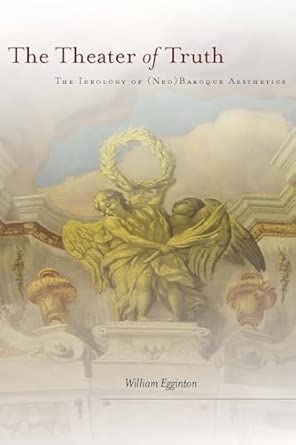
The Theater of Truth: The Ideology of (Neo)Baroque Aesthetics New Edition
Author(s): William Egginton (Author)
- Publisher: Stanford University Press
- Publication Date: 17 Dec. 2009
- Edition: New
- Language: English
- Print length: 184 pages
- ISBN-10: 0804769540
- ISBN-13: 9780804769549
Book Description
Editorial Reviews
Review
About the Author
Excerpt. © Reprinted by permission. All rights reserved.
The Theater of Truth
THE IDEOLOGY OF (NEO)BAROQUE AESTHETICSBy William Egginton
STANFORD UNIVERSITY PRESS
Copyright © 2010 Board of Trustees of the Leland Stanford Junior University
All right reserved.
ISBN: 978-0-8047-6954-9
Contents
Introduction: The Baroque as a Problem of Thought..................................................11. Of Baroque Holes and Baroque Folds..............................................................112. How to Build a Baroque House (Cervantes, Master Architect)......................................263. The Theater of Truth............................................................................394. The Opacity of Language and the Transparency of Being: On Gngora's Poetics.....................565. The Corporeal Image and the New World Baroque...................................................696. The Dream Life of Caldern and Borges...........................................................857. The World Well Dressed: The Later Cinema of Pedro Almodvar.....................................107Epilogue: A New Distinction........................................................................127Notes..............................................................................................131Works Cited........................................................................................149Index..............................................................................................163
Chapter One
Of Baroque Holes and Baroque Folds
The purpose of this chapter is to test a philosophical hypothesis about a historical period against literary evidence. The hypothesis belongs to Gilles Deleuze, and it concerns his description of the Baroque taken as a cultural and philosophical whole, albeit based on his reading of the works of Gottfried Leibniz. The literary evidence against which I wish to test this hypothesis comes from the seventeenth-century Spanish author Baltasar Gracin, in particular from several passages of his Criticn that deal with artifice and its relation to human being. In the chapter's first section I argue for describing the Baroque in philosophical terms as a problem concerning the separation between the space of representation and the space of spectatorship. I then explain this claim historically with reference to changes in the theater and painting from the late Middle ages to the Baroque, and support the claim by way of a discussion of baroque spatiality in literature and visual arts. In the next section I outline two philosophical strategies-a major and a minor one, which I respectively call, with Deleuze, holes and folds-for negotiating the fundamental separation of baroque space, and then indicate where these strategies are at work in a variety of baroque artifacts. In this section I also confront and ultimately reject Deleuze's appropriation of baroque cultural production exclusively for a philosophy of folds in order to claim, in the chapter's last section, that baroque cultural production-and here I work specifically with Gracin's writing-has, from the outset, created the possibilities of a minor strategy that undermines the pretenses of the major strategy.
TWO SPACES
Jos-Antonio Maravall famously argued that the Baroque should be considered as a historical structure rather than more specifically as a stylistic descriptor. Moreover, for Maravall the Baroque had to be understood as an international phenomenon; analysis that remained too focused on a single national context risked missing the forest for the trees (Maravall, Culture xvii). For the purposes of this discussion, I will assume the basic truth of these claims, but regarding the former I will expand the discussion and regarding the latter I will remain somewhat more specific. On the one hand, in respecting the notion of the Baroque as structure, I want to move beyond what for Maravall remained a mostly sociological view of the Baroque-and a largely functionalist one at that-and open up a philosophical perspective on the Baroque; on the other hand, although I will draw on some examples of baroque production outside of Spain, for the purposes of this discussion the emphasis will remain on the Spanish context.
Insisting that the Baroque be understood philosophically means that there is at work in everything we recognize as baroque an effort of thought to deal with a common problem. This problem of thought was not such an issue prior to the period of dominance of those artifacts we call baroque, and will have undergone some significant change in order for the dominance of baroque production to have waned. The common problem I identify at the heart of baroque phenomena is widely known, has been called by many names, and has been described in bewildering variety. For the moment let me borrow the term used first by T. S. Eliot and more recently by Geoffrey Thurley to describe a problem they associated more with romanticism than with any earlier period: namely, "the dissociation-of-sensibility" (Thurley 18). Dissociation-of-sensibility refers principally to the modernist critique of the romantic and realist tendencies of the nineteenth century, and specifically to the subordination of art to something outside of, greater than, or more important than art-such as the absolute, for romantics, or the world as it is in itself, for realists. But as Michel Foucault, in The Order of Things, and Martin Feidegger, in his entire oeuvre but specifically in his classic essay "The age of the World Picture" (Heidegger, "age" 115-54), have argued, dissociationism is perhaps the fundamental characteristic of a European modernity dating to more or less the beginning of the seventeenth century-to the period, in other words, known as the Baroque.
As I have argued elsewhere, if modernity can be characterized philosophically by a sort of generalized dissociation of the world of the senses from an interior world of the knowing subject, the model of this essentially spatial organization can be found in the thoroughgoing structural changes undergone by spectacle in the time leading up to the Baroque. This change in the organization of spectacle and its ramifications for conceptions of space are illustrated by the emergence during the sixteenth century of a technique in the staging of spectacle called "the theater in the theater." For a modern theater-going audience, it goes without saying that a theater scene could be part of what is represented on the stage in a theater. The modern audience, for instance, can be expected to negotiate the complexities of a performative action taking place on that stage within a stage-such as a wedding ritual or a religious conversion-without losing track of the several levels of reality being represented. To take an example from Lope de Vega's 1608 play, Lo fingido verdadero, Gins, actor to the roman emperor Diocletian, performs the conversion of a pagan to Christianity in which he himself, pagan actor, is converted to Christianity. At this point in the play one of the spectators within the play, a member of Diocletian's entourage, exclaims in admiration, "There's no difference between this and the real thing!" (Lope de Vega, Comedias 275). At first glance this might seem unproblematic. Upon closer examination, however, an apparent paradox creeps in. How, to be specific, are we to understand that there is "no difference" between Gins's performance and a real conversion? On the one hand, if the spectator is speaking truly, and there really is "no difference," how do we as spectators even...


