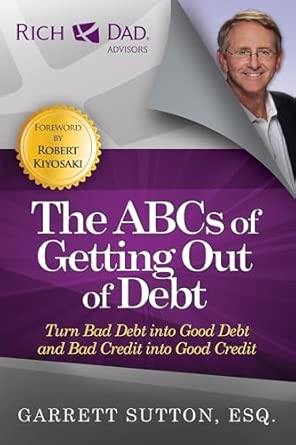
The ABCs of Getting Out of Debt: Turn Bad Debt into Good Debt and Bad Credit into Good Credit
Author(s): Garrett Sutton (Author)
Publisher: RDA Press, LLC
Publication Date: 1 Nov. 2012
Language: English
Print length: 220 pages
ISBN-10: 9781937832070
ISBN-13: 9781937832070
Book Description
In difficult times, debt can be a matter of life and death, happiness and despair. Controlling your debt can bring order and calm. Mastering debt can bring wealth and success.
As bestselling Rich Dad/Poor Dad author Robert Kiyosaki says, "Good debt makes you rich, and bad debt makes you poor."
The ABCs of Getting Out of Debt provides the necessary knowledge to navigate through a very challenging credit environment. A Rich Dad's Advisor and best-selling author of numerous business books, Garrett Sutton, Esq. clearly writes on the key strategies readers must follow to get out of debt. Unlike other superficial offerings, Sutton explores the psychology and health effects of debt. From there, the reader learns how to beat the lenders at their own game, and how to understand and repair your own credit. Using real-life illustrative stories, Sutton shares how to deal with debt collectors, avoid credit scams, and win with good credit.
"The reason Garrett Sutton's book is so important is that like it or not, debt is a powerful force in our world today. The financially intelligent are using debt to enrich themselves while the financially uneducated are using debt to destroy their lives."- Robert Kiyosaki
The times call for a book that offers hope and education on mastering credit and getting out of debt.
To learn more visit: RARIPublishing.com
Editorial Reviews
Review
Kirkus Reviews, December 2012: In this guide, Sutton (Run Your Own Corporation, 2012, etc.) offers recommendations for avoiding and solving debt problems.
The author begins by asserting that “the credit industry actively entices all comers, especially the young and inexperienced.” In the first part of this book, he goes on to offer some overall guidelines for dealing with consumer debt. In Chapter Four, he explains a 10-step strategy, along with sample worksheets, used by one couple who “never seemed to make a dent” in the amount they owed. The author makes recommendations about debt consolidation and includes a lengthy chapter, “Getting Help,” that thoroughly explains the different kinds of bankruptcy and the process of borrowing against a 401(k). The second part of the book looks at specific kinds of debt, ranging from the timely mortgage troubles to tax debt. A section on student loans, for example, includes eight remedies for dealing with overwhelming loan payments. Sutton’s chapter on debt collectors asserts that negotiating with collection agencies is “one of the most important skills you can learn and hone.” The handbook’s third part deals primarily with credit reporting agencies, credit reports and how they’re compiled, and credit repair. Throughout, the author presents stories of real-life predicaments that enliven what might have otherwise been bone-dry material. For example, “Credit Reports” describes the years-long misery of a failed entrepreneur: “Roberto...had taken some risks on a restaurant that didn’t work out.” Finally, a chapter on credit scams and good uses of credit is followed by three appendices, including a list of other helpful books and websites.
A fact-packed, easy-to-navigate resource for consumers concerned about debt.
The Founder Of Corporate Direct And Sutton Law Center, And Bestselling Author Of 7 Books, Including: Start Your Own Corporation, Loopholes Of Real Estate, Writing Winning Business Plans And Run Your Own Corporation, Buying And Selling A Business, And The ABCs Of Getting Out Of Debt And His New Book, Scam Proof Your Assets.
He is also a Contributor to More Important Than Money, An Entrepreneur’s Team. Sutton is a nationally acclaimed corporate and asset protection attorney.
A graduate of the University of California, Berkeley, and Hastings College of the Law, the University of California’s law school in San Francisco, Garrett has written a number of books guiding entrepreneurs and investors.
Since 1988, Sutton’s Corporate Direct and Sutton Law Center have provided affordable asset protection and corporate formation and maintenance services for investors around the world. Sutton and his work have been featured on FOX and Friends, ESPN Cover Your Assets Radio Show, Think Realty Podcast, Forbes, and other media.
Learn more about Garrett Sutton ESQ at corporatedirect.com
One of the reasons this book is so important is that it is important to be financially responsible and to use the power of your credit and debt intelligently. Before turning you loose into this book, I would like to pass on three bits of information my rich dad taught me years ago.
They are:
1. Bad debt is easier to get than good debt. If any of you have ever tried to get a loan to buy a rental property or to start a business, you may know how difficult it is to get a loan for investment. Yet if you want a car loan or a new credit card, credit, debt, and money are easy to come by, even if you have horrible credit.
2. Bad debt makes it harder to get good debt. If you have too much bad debt, and you want to begin using the power of debt and credit more intelligently, like for starting a business or investing in rental property, bad debt makes it harder for you to get the good debt and hence to become richer. One big reason this book is so important is that getting rid of your bad debt is an important step toward you becoming richer and more financially free.
3. Debtors can get rich faster than savers. Many people think that saving is better than borrowing. In fact, I know that many people work hard to save money and get out of debt. In reality, it is those who save and get out of debt who fall behind those that borrow and get into debt.
 Wow! eBook