Wow! eBook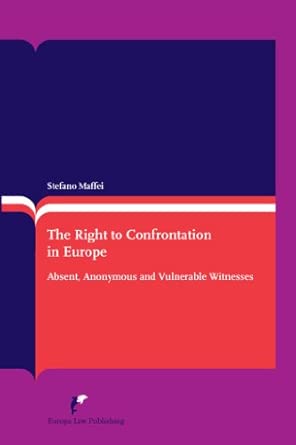
The Right to Confrontation in Europe: Absent, Anonymous and Vulnerable Witnesses 2nd Edition
Author(s): Stefano Maffei (Author)
- Publisher: Europa Law Publishing
- Publication Date: 10 Nov. 2012
- Edition: 2nd
- Language: English
- Print length: 280 pages
- ISBN-10: 9089520708
- ISBN-13: 9789089520708
Book Description
This book investigates the theory and practice of the Right to Confrontation – the right of accused persons to examine witnesses against them. Although exceptions to confrontation have always been recognized by domestic criminal courts, no European consensus exists on the values and interests that may legitimately allow incursions into this fundamental right. Based upon the concept of testimonial evidence – which was first developed by the U.S. Supreme Court in Crawford v. Washington in 2004 – this second edition identifies three categories of declarants whose statements may pose a threat to the fairness of criminal trials: the “absent,” “anonymous,” and “vulnerable” witnesses. In a truly supra-national perspective, attention focuses on the Confrontation clause of Article 6 of the European Convention of Human Rights, as interpreted by the case-law of the Strasbourg Court (including the 2011 leading case Al-Khawaja and Tahery v. UK). The book then provides a comparative study of the Right to Confrontation in the context of the rules of criminal evidence and procedure in Italy, France, and England/Wales.
Editorial Reviews
From the Inside Flap
The second edition of this book investigates the theory and practice of the Right to Confrontation, the right of an accused person to examine witnesses against him. The book tackles the crucial question of what values and interests should allow incursions into this fundamental right. A conceptual analysis is developed in order to define the concept of testimonial evidence and to establish three categories of declarants: the absent, anonymous and vulnerable witnesses. U.S. law on the Sixth Amendment of the Federal Constitution and ECHR jurisprudence on Article 6 of the European Convention are discussed in an attempt to develop a supra-national approach to confrontation. The book then moves on to provide a comparative study of the Right to Confrontation, drawing on the rules of criminal procedure and evidence of Italy, France and England and Wales.
From the Back Cover
The second edition of this book investigates the theory and practice of the Right to Confrontation, the right of an accused person to examine witnesses against him. The book tackles the crucial question of what values and interests should allow incursions into this fundamental right. A conceptual analysis is developed in order to define the concept of testimonial evidence and to establish three categories of declarants: the absent, anonymous and vulnerable witnesses. U.S. law on the Sixth Amendment of the Federal Constitution and ECHR jurisprudence on Article 6 of the European Convention are discussed in an attempt to develop a supra-national approach to confrontation. The book then moves on to provide a comparative study of the Right to Confrontation, drawing on the rules of criminal procedure and evidence of Italy, France and England and Wales.