 Wow! eBook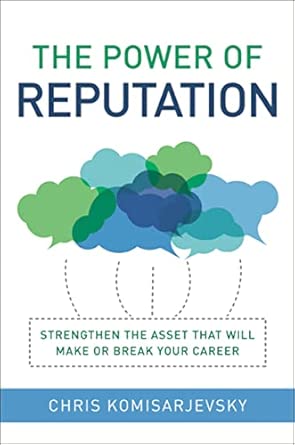
The Power of Reputation: Strengthen the Asset That Will Make or Break Your Career
Author(s): Chris Komisarjevsky (Author)
- Publisher: AMACOM
- Publication Date: 16 May 2012
- Language: English
- Print length: 224 pages
- ISBN-10: 0814417973
- ISBN-13: 9780814417973
Book Description
We judge people in business the same way we judge those in our personal lives. We listen to what they say, watch how they behave, and take note of the results of their actions. Success is ultimately built on a foundation of character, communication, and trust. To accomplish our goals, people must believe in us.
The Power of Reputation offers businesspeople an action plan for creating the kind of reputation that generates trust, inspires confidence, and paves the way for lasting success. Readers will discover how to:
Identify and reinforce the values behind their reputation • Earn respect by respecting others • Engage people through constructive, open communication • Build strong connections by personalizing their approach to everything they do
Featuring interviews with distinguished business figures and containing instructive real-world examples, this book reveals how to leverage the remarkable power of a reputation rooted in authenticity.
Editorial Reviews
From the Back Cover
To accomplish your goals—whatever they are—people must believe in you. In any business or field, success is built on a foundation of character, communication, and trust—the building blocks of reputation.
Your reputation is what enables you to forge bonds, get your ideas across, convince, and sell. It’s not only what makes others want to work with and for you—it’s also what encourages them to give you their all. A positive reputation enables you to overcome myriad career challenges. And it can often mean the difference between failure and great success.
The Power of Reputation gives you an action plan for creating the kind of reputation that generates trust and paves the way for lasting success. With instructive real-world examples, this book lays out step by step how to build a platform of respect for and confidence in your decisions—and a commitment from others to your goals. Filled with enlightening insights from interviews with numerous distinguished business figures, this definitive guide to reputation and your career shows you how to:
• Leverage the communication techniques that engage others and create positive, open dialogues.
• Take swift and decisive action to deal with challenges and recover from mistakes.
• Build strong connections by personalizing your approach.
• React quickly in a digital world that demands it.
• Earn respect by demonstrating your respect for others.
• Build a circle of trust and ensure an enduring reputation that serves you well in both good times and bad.
Filled with straightforward, practical techniques for methodically crafting a strong, solid reputation, The Power of Reputation shows you how to be authentic, open to ideas, a strong communicator, and, by your actions, demonstrate over and over again that you are a person of character. You’ll learn how to express yourself in ways that give others the chance to voice their concerns and questions, and earn their trust even when you don’t share their point of view. And as a result, you’ll forge bonds that will stand the test of time.
In any professional arena, people listen to what you say, watch how you behave, and then ask themselves: Should this person be trusted? Will we do what this person says?
Reputation isn’t something that just happens…nor is it something you can afford to leave to chance. This invaluable book reveals powerful methods for building and leveraging a strong reputation—and using it to achieve extraordinary results.
Chris Komisarjevsky retired as worldwide chief executive officer of Burson-Marsteller, one of the world’s leading global public relations and public affairs firms in 2005, after a 35-year career in public relations. He is the coauthor of Peanut Butter and Jelly Management. He lives in Atlantic Beach, New York.
About the Author
Excerpt. © Reprinted by permission. All rights reserved.
Reality, Perception, and Your Most Powerful Asset
Regard your good name as the richest jewel you can possibly be possessed of. . . .
The way to gain a good reputation is to endeavor to be what you desire to appear.
—Socrates
AS THE SUMMER turned to fall I took my car to the dealership for repairs.
The weather was just starting to turn cold and I just didn’t like the sound
when I turned the key and the battery started to crank the engine. “No
time like the present,” I thought. I wouldn’t feel right if my wife, Reina, or
one of my kids needed to use the car and it wouldn’t start, especially if they
were by themselves.
When I spoke with Louis Ciolino, the lead service consultant I always ask
for, I tried politely to let him know how important it was that the battery be
tested and, if even just starting to go bad, be replaced. To Louis, this could
have been an unimportant request that he didn’t have to take seriously. But
I had hardly started to talk, expressing my concern, when Louis looked up
from his computer and said, “I haven’t changed my face in 30 years.”
Yes, Louis does have an interesting way of phrasing things. But I knew
exactly what he meant. Over the years, he’s never changed his priorities: to
remain customer focused and caring. Needless to say, Louis takes pride in
what he does. He is a professional and is one of those remarkable guys who
knows his customers by first name. He never needs much more than that
in order to recommend the best course of action.
This time was no different.
Louis knows what it takes to build a solid reputation for service. He
knows it means working hard, being personally committed, and building
relationships. Most of all, he knows that he has to be trusted, not just for
one day or one service visit, but for the long run.
This is the reality behind his reputation. He has earned it through
offering true service in a friendly way that everyone appreciates. That’s
why so many of us keep asking for him, why we tell our friends and
acquaintances about him, and why his career is successful.
Reputation Is Powerful
I’m no different from any other guy who brings his car in for repairs. But
I am assured of quality and can avoid the apprehension that many experience
because I simply take my car to Louis.
As a public relations professional, professor, board member, manager,
volunteer, combat veteran, and, most of all, a father, I am acutely aware of
the importance of reputation. And I’m not alone in doing so—people
everywhere keep their ears to the ground and follow up when they get a
good recommendation. If their first, second, and third experience with
someone demonstrates that there is reality behind a reputation, they will
continue doing business there. Moreover, when trust is there and proven
over time, they may even ask for new services, expanding the relationship.
Everyone, in turn, benefits from the increased business.
Over the years, I’ve been fortunate to have had the opportunity to
speak with people at all professional levels and in different types of organizations
about their views on reputation. In those conversations, I’ve never
been able to resist the temptation to ask a very simple question: “Do you
believe that reputation is important?”
The answer often comes quickly. While holding back a slight chuckle—
or maybe a laugh—they say, “Of course.” Some might punctuate their
reply by rolling their eyes, while others just look at me quizzically. I sense
that more than a few of them seem to think that just asking the question
means that I must have been living on the moon.
When I push for an answer, no one minces their words. They come
right out and tell me that, if anyone thinks reputation isn’t important, they
must be crazy.
Perhaps the fact that they are so direct and blunt is because they took
the time and effort to build reputations that have withstood the pressures,
endured good times and bad, and continued to serve as the foundation for
their success. Or perhaps a few have even learned the hard way that a loss
of reputation or unwillingness to live up to a commitment and fulfill a
promise can prove to be the leading edge of a major problem, if not
advance warning of a looming collapse. When I ask them to rate reputation
on a scale of importance, from one to five, it always rates high. Some
tell me that it is the most important—number five—while others rank it
at number four. It seems everyone agrees that reputation is at or near the
top when it comes to the ability to be successful.
Clearly, reputation is among our most treasured and powerful assets.
At its simplest, it is what others think of us. This simple fact affects everything
we do, everything we say, everyone around us, and everything we try
to accomplish . . . private and public, personal and professional.
For some, reputation makes the difference between success and failure.
For others, it closes the gap between mediocrity and success by creating
special opportunities to move beyond the ordinary and accomplish
the extraordinary. For still others, it offers a unique advantage to overcome
challenges that otherwise might have been considered daunting or
even impossible.
In my experience, on the road to success there is nothing more important
than reputation when it comes to a strong foundation on which we
build our relationships, decisions, achievements, and careers.
Think of the way reputation affects the way you relate to the businesses
and organizations in your life. We judge organizations much the
same way we judge the people around us. We look them in the eye, listen
to what they say, notice what they don’t say, watch how they behave, and
then we make our judgments. Subconsciously, we ask ourselves: Do we
think they can be trusted? Do we think they are reputable? Do we think
they will do what they say, and do we think that what they do will be
meaningful? We ascribe human values and characteristics to every kind of
organization—whether a for-profit or a not-for-profit. We use our
answers to decide whether we want to relate to that organization, whether
through buying a product or service, investing in them, or taking them on
as a vendor or client.
How we perceive, and therefore describe, those organizations can vary
dramatically. The words we use to describe them are the ones that most
often relate to our own values. When we think well of a company or an
organization and have a positive view of the values that underlie its decisions,
we use endearing human terms such as “good,” “warm,” “fair,”
“ethical,” “responsible,” “trustworthy,” and “personable.” Or we describe
an organization as one that “we like” and “treats us well.”
When it is an organization we don’t like, our descriptions turn nasty:
“doesn’t care,” “takes advantage of us,” “rips us off,” “is dishonest,” “misuses
our donations,” “is unfair,” and “chases the almighty buck at our
expense.”
To look at this from a completely different perspective, I asked some of
the people I’ve interviewed over the years to tell me what kind of animal
comes to mind when they think of some of the more widely recognized
companies. The answers were pretty graphic and telling. When they said
“snake,” it spoke volumes of what they thought about a company’s
integrity and honesty. Companies that were described as a lion or a tiger
suggested a reputation for aggressive competition. Sharks conjured up
images of financial avarice and ruthless behavior, with no compassion or
regard to the success of others. At the same time, puppies and house cats
were descriptions of kinder, gentler companies whose business activity was
mild, well meaning, pleasant, a Ma-and-Pop shop—and perhaps even easily
taken advantage of by ruthless companies.
It doesn’t take much thought to realize that these reactions to the reputations
of a range of companies tell an important story about our own
reputations as individuals. Reputation often has its base in an emotional
first reaction. It might be a gut response, based on what action has been
taken or what words have been communicated. The truth is that whether
or not a reputation has grounding in actions and experience, at the core of
reputation is simply a feeling or a belief.
This is why reputation can seem to be so hard to control or manage. Its
root is in the nebulous realm of emotions, in each person’s feeling about you
or your organization. The good news is that the seeds of a good reputation
are identifiable, and you can plant those seeds so that positive roots will grow
and positive experiences will flower. Plant the right seeds and success is yours.
Celia Berk, chief talent officer for Young & Rubicam Group, is often
called upon to help people with their professional development. She
explains it this way:
I tell them that they are the ones who must “manage” their own
careers. That includes their reputations inside and outside the
organization.
Most importantly, as they manage their careers and reputations,
they must remember that their actions have consequences. If there
are inconsistencies, there is little credibility.
Reputation Is Your Most Important Asset
If there is one message in this book to remember, it is just this: In every facet
of our lives, reputation is among our most treasured and powerful assets.
I intentionally choose to describe reputation as an asset, simply
because an asset is anything we own that has exchange value. This point
is important.
Think of it from two perspectives.
First of all, we own our reputation. Whether or not we feel we deserve
it, the responsibility for the views of us that have taken shape in other people’s
minds falls on us and us alone. When we take responsibility, when we
“own” our reputation—that is the moment we can do something about it,
when we can begin to consciously shape it.
Second, as an asset, reputation has an exchange value. We engage in
active exchanges based on our reputation—either attracting business,
attention, or support from those around us, or repelling it. Revenue
climbs, we earn a promotion, we land a long-term client, or we negotiate
great terms with a vendor we also respect. Or none of those things happen.
Margery Kraus is founder and chief executive of the worldwide consulting
firm APCO Worldwide, which developed a Return on Reputation
Indicator and Index in partnership with the Retail Industry Leaders
Association. Here’s what her research shows on the power of reputation to
affect the bottom line.
Our Return on Reputation research demonstrates that “doing the
right thing” is also “the right thing to do for business” . . . just as we
know that “doing the right thing” is so important to our success as
individuals. One of the interesting aspects of this research is that it
directly tracks the linkage from behavior to perception to action.
Using the retail industry research as an example, there is a direct
correlation between perceptions—those met, not met, or
exceeded—and the bottom line.
In any kind of reputation research, the underlying principles are no
different than those that determine the success of our own careers.
Through all of the work I have done with different organizations—
from trade associations to social service organizations, and from
governments to corporations—the data consistently show that reputation
and meeting expectations are key.
As you delve into this book, consider what your own reputation goals
are—what is your personal bottom line? Are you looking to build a business?
Do you want to earn a promotion? Lead a team effectively? Widen
your network of potential clients? Grow sales? Attract quality vendors
and allies?
All these things are possible when you have a positive reputation
because it is a major determining factor in the choice that people make
when considering their options. More often than not, your good reputation
is the reason they choose you.


