 Wow! eBook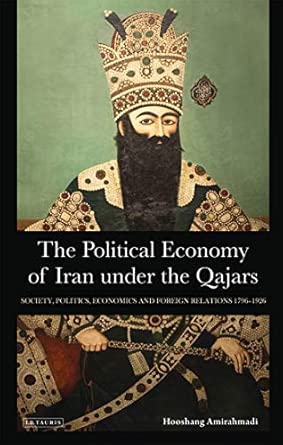
The Political Economy of Iran Under the Qajars: Society, Politics, Economics and Foreign Relations 1796-1926: 30
Author(s): Hooshang Amirahmadi (Author)
- Publisher: I.B. Tauris
- Publication Date: 30 July 2012
- Language: English
- Print length: 344 pages
- ISBN-10: 1848856725
- ISBN-13: 9781848856721
Book Description
The political economy of Iran underwent the fundamental transition from feudalism to modernity from the early 19th to the 20th century: a period which was a vital watershed in Iran’s historical development. This book provides a critical analysis of Iran’s economic, social and political development and shows how the path to modernity, far from smooth, was hindered by both internal and international factors. These included a powerful monarchy with little interest in administrative and economic reform, a large aristocracy frequently holding vital provincial governorships and frustrating effective central government and a failure to create a modern civil service, military, banking, finance or communications – the essential infrastructure for economic development. Reformers were marginalised and business suffered. And the all-powerful ulema were a further brake on modernisation. On the international front, the rivalry of Britain and Russia compounded the problems: both acting to control Iran and to further their own interests.
Hooshang Amirahmadi explores the roots of present-day challenges to modernisation and progress and, using a wealth of primary sources and original research, has produced a work which is invaluable for students of modern Iranian history, politics and Iran’s political economy.
Hooshang Amirahmadi explores the roots of present-day challenges to modernisation and progress and, using a wealth of primary sources and original research, has produced a work which is invaluable for students of modern Iranian history, politics and Iran’s political economy.
Editorial Reviews
Review
Why did Iran fail to become a developed and democratic country and how could an Islamic Revolution occur there in the modern times? The Political Economy of Iran under the Qajars helps answer these questions by examining developments in Iran s economic, political, social, ideological and territorial institutions as well as international relations during the critical nation-building period of the 1800s and 1920s. This comprehensive book on the convoluted and truncated transition to modernity is a must read for anyone wishing to develop a deeper understanding of the challenges facing Iran today and, indeed, many of the developing nations. — Shireen Hunter, Georgetown University
This is a lucid and succinct application of underdevelopment and dependency theories to Qajar Iran. It should become essential reading for anyone interested in the complex debates over the nature of the political economy of pre-modern Iran. — Ervand Abrahamian, Fellow of the American Academy of Arts and Sciences
About the Author
Hooshang Amirahmadi is a professor and former director of the Center for Middle Eastern Studies at Rutgers University. He holds a PhD from Cornell University and is the founder and president of the American Iranian Council. His publications include Revolution and Economic Transition: The Iranian Experience, three books in Farsi and numerous edited books and journal articles.


