 Wow! eBook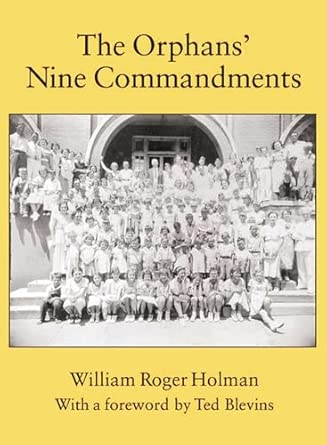
The Orphans' Nine Commandments
Author(s): William Roger Holman (Author), Ted Blevins (Foreword)
- Publisher: Texas Christian University Press
- Publication Date: 15 Nov. 2007
- Language: English
- Print length: 238 pages
- ISBN-10: 9780875653556
- ISBN-13: 0875653553
Book Description
Editorial Reviews
About the Author
Excerpt. © Reprinted by permission. All rights reserved.
The Orphans’ Nine Commandments
A Memoir
By William Roger Holman
TCU Press
Copyright © 2007 William Roger Holman
All rights reserved.
ISBN: 978-0-87565-355-6
CHAPTER 1
My father was an elusive fellow. He and my mother, Anna Bechan, fell in love and were close for several years, gave birth to me, and wove a covenant of secrecy that took over six decades to unravel. Because he was a prominent citizen, already with a wife and children, it was necessary to invent a myth about the birth of their child. A petition filed with the Oklahoma County Juvenile Court reported that my parents were separated and divorced before I was born. This gave me a legitimate beginning and let Momma save face. In the 1930s, there was no greater sin than to have a child outside a marriage.
Momma was tall with gentle hands and a loving nature, but she suffered from weak lungs and hard times. One lady recalled her as an attractive woman with a heap of blonde hair turning gray, blue eyes under light brows, a finely shaped nose, and rosy cheeks. She smelled of rose water and Ivory soap.
Momma and I lived in a small prairie town where by the middle of May, the cumulus clouds ghosted across the sky like fluffs of spun candy, and the fields were strewn with bluebonnets and blankets of daisies and yellow buttercups. My earliest childhood memories encompass hours of running barefooted, catching grasshoppers and roly-poly bugs, playing hide-and-seek, driving my yellow dump truck, and riding the trolley into Oklahoma City. All was right with the world.
My mind often searches into that lingering past where, on a warm Saturday in May 1932, a fresh breeze ruffled my hair as I stirred from the bliss of a six-year-old boy’s nap. I watched sleepily as Momma walked into the room and paused by the chest of drawers. She pulled out a pair of my pants, a shirt, underwear, and socks. Folding them neatly, she packed them into a small cardboard box, closed the lid, and tied it with one of her cloth belts.
I leaned up on one elbow. “Why pack my clothes?”
“Staying overnight in the city.”
I hopped out of bed and slipped on my white shirt and long pants, looking forward to visiting with our friend, Uncle Paul.
I followed Momma across the hall and watched as she tossed off her housecoat and put on a yellow summer dress. Turning side to side, she adjusted her slip and brushed her hair. She sat down and looked into a hand mirror, powdered her face and put on lipstick. Appearing rushed, she stood up and tied on a white head scarf.
“Come, Roger. It’s growing late.” She handed me my box of clothes.
Under the warm but descending sun, we walked a block up College Avenue to Main Street, purchased our tickets, and took a seat outside the Bethany Interurban Station. From around a stand of trees the red-and-white trolley clanged into view. I loved the colorful machine that flashed blue and yellow sparks and smelled of hot iron. Within minutes the car squealed to a halt, and the blue-suited motorman looked down at us.
We stepped aboard and handed our tickets to the cigar-puffing gentleman. He doffed his cap in greeting and shoved a lever forward. Clutching the handrails, we stumbled to our seats. With her head tilted to one side, Momma held a silent conversation with herself, from time to time pressing my hand into hers. The trolley clattered and swayed from side to side as we sped down the nine miles of track, but the rattling didn’t quiet the noisy children who scuffled in the rear.
As we sped through green fields, other trolleys flashed past, and, on each side, small wooden houses with open windows looked out on us. I strained to see the skyscrapers as the city loomed ahead. With the bell ringing, we skirted the tall buildings and rushed through a canyon of shadows. Within a few blocks, we approached Hudson Street and screeched to a stop in the Oklahoma City terminal, an arched metal structure open at both ends.
“Hurry along,” Momma said as we swung down, scattering a flock of pigeons, and boarded a waiting streetcar.
The car rumbled northward, block after block, leaving the tall buildings behind. Finally, we approached a wide avenue. With a hiss of air, the streetcar jolted to a stop and the door sprang open. We stepped down and entered the full growth of summer. Leafy elms arched overhead. Rows of sweet smelling honeysuckle, intertwined with red roses, crowded the street.
Swinging my box to and fro, I hopped and skipped down the sidewalk in my Buster Brown shoes. For good luck, I avoided every joint in the walk as I hummed, “Jumping jack, if you step on a crack, you’ll break your mother’s back.” On the second corner I tugged on Momma’s skirt. “Where are we going?”
She grasped my hand. “Be patient. We’ll soon be there.”
In the next block we walked alongside a rock wall and paused before an opening. I looked through an iron gate and saw a path leading to a brick mansion with tall windows and an ivy-covered tower on each side. From the distance, it beckoned like a gingerbread house.
Maybe we will visit here for a bit before we go see Uncle Paul. In the approaching twilight, Momma unlatched the gate and we walked down the path and onto the front porch where a woman in a white dress greeted us. She possessed a narrow face heightened by a stiff manner, a mop of gray hair, and wore black-rimmed glasses resting on the tip of her nose.
“I’m sorry for being late,” Momma said.
“It doesn’t matter.” The woman opened the screen door and ushered us into the house, down a carpeted hallway, and into a lofty room lighted by a round chandelier. She closed the door behind us. I looked up into Momma’s face, startled to see tears flowing down her cheeks.
“What’s wrong?” I tugged on her skirt.
Instead of replying, Momma slipped off her scarf and blotted her face. Then she knelt down and ran her fingers through my hair. She kissed me—soft brush of her warm lips on my forehead. “Give me a hug.” She held out her hands.
I set my clothes down and stretched my arms up around her but only for a moment. Without a word, the woman in white spun me around and grabbed my box. I turned to Momma for help, but she rushed out, her yellow skirt brushing the wall. The door banged behind her.
“Momma! Wait! Wait for me!” I dashed forward and pounded on the door, my heart hammering against my chest. This couldn’t be true! Momma had never left me before. My knees gave way and I slumped on the floor, sobbing. Why had she left? What was happening? Panic and despair flooded in as my strength ebbed.
The woman stepped to where I crouched near the door. “You’re staying here. Get up.”
I looked up at her through tears. She yanked me onto my feet and as I pulled away, she slapped me. I kicked back. She grabbed my collar and marched me upstairs. We entered a sweltering chamber with three windows at each end. Under a beamed ceiling, a row of baby cribs, several iron beds, and a couple of rocking chairs stood on a bare wood floor.
The woman shoved me onto one of the beds. Dim lightbulbs dangled from above. The cries and sniffles of babies filled the air. Several black oscillating fans stood before the windows, swinging from side to side like angry doodlebugs, whirring and clicking, straining to clear the stench of soiled diapers from the long room.
I lay in disbelief, clenching the edge of the sheet between my teeth as the onrush of night, like a giant bogeyman, grasped me and tossed me into a dungeon. It is black now. I am trembling and wrapped in a blanket of fear. The darkness has no corners, no shape, no movement. My mind quivers with the thought of Momma leaving me behind. Why didn’t she take me along? Had I done something wrong?
The hours crept by and I dozed off, only to awaken in the midst of a horrifying nightmare, entrapped by a wall of fire. The flames spread across the bed. I jumped up and screamed. Only silence. I screamed again. And again. But no one came to ease my mind. I laid there for hours talking to Momma. Tears slid down my cheeks as I prayed for her to rescue me in the morning. Sometime during the night, I drifted into a restless sleep.
I woke in a smelly puddle. During the dark hours, someone had moved me from the iron bed into a large crib in the middle of the room. A soggy baby lay on each side of me. I jumped up and rattled the headboard. The babies screamed and bawled. Fans clicked and droned. I crawled over the side rail in the half-light of morning to look for Momma.
Grasping a banister, I tiptoed down the wooden stairs and paused on a landing. A splinter of light came from below. I slipped down the last flight of stairs and entered the kitchen to the sound of pots and pans clattering. A teenage girl wearing a dirty apron stirred a kettle of oatmeal under the hood of a stove. Mingled with the scent of breakfast, a rich aroma percolated from a blue enameled pot. Yesterday’s gray-haired stranger sat at a long table. She spooned oats into her mouth and washed them down with coffee. Her dark eyes looked out from a hardened face smothered in powder. A smudge of rouge gave a glint of life to her cheeks.
“Mornin’ Roger,” she said around her cigarette. “I’m Tillie Banks, your matron.”
“Where’s Momma?” I’d never heard of a matron.
She paused, glanced at the girl filling bowls from the kettle, then turned back. “Your momma left you here. I take in children for William Wheeler. He’s head of the Home for the Friendless.”
No! I didn’t want to live with strangers. Momma wouldn’t leave me for long. I rubbed the tears from my eyes.
Bound within the walls of an unwanted home, I began my struggle to cope with the daily routines. I was the tallest boy. The other older kids were small tykes still in diapers. They couldn’t even play checkers. Bawling babies filled the cribs. Despite the noise, there were no more than a dozen children in the home.
Every night I prayed for Momma to return. In the morning, to speed up the Lord’s work, I crawled out at dawn, slipped on my clothes and sat on the windowsill where a garden of skyscrapers glimmered in the distance. I knew that one morning, any day now, Momma would come rushing up the front walk. I pictured her hand grasping mine as we caught the trolley home to Bethany.
Day after day, I yearned for her to return. I prayed with more fervor. With all of my efforts, surely the Lord would hear my pleas. Perhaps Momma had run out of money for the trolley.
A day or so after I arrived, Tillie waddled in, jabbering away. “Down for a nap.” Fumbling with a stack of blocks, I hesitated. She twisted my ear. I squealed. She clapped her hand over my mouth. My teeth caught her finger and blood spurted onto her dress. I took off running.
She shouted as she chased me around the baby cribs, drops of her blood spotting the wooden floor. I crawled under my iron bed.
“Come outta there, you little devil.” I curled into a ball. She turned away.
In a moment of quiet, I felt safe. Then Tillie’s legs reappeared. She wore white hose rolled below her knees. I began to sweat. She leaned over and thrust a broom handle under the side rail again and again until she poked me in the nose. The salty taste of blood trickled through my lips. After a few minutes she stomped off moaning about her bloody finger.
No matter how Tillie ruled my hours, I clung to my memory of Momma. She must be missing me by now. She was my warmest love. No father, no brothers or sisters, no grandmothers, grandfathers, aunts or uncles shared my life. Momma said Uncle Paul was merely our friend. While my father’s identity remained a mystery, Momma was my teacher and playmate.
Without Momma my life no longer had direction. In the mornings I lived within my daydreams, though these depended on where I was. I usually hid under the bed where I felt safe. There, Tillie could no longer slap me or twist my ears. In the afternoons, I sought the comfort of the warm brick wall on the west side of the building. I’d crouch down and lean back with my knees to my chin, and cry … always longing to return home.
* * *
Momma made our home in the village of Bethany, on the prairie grasslands nine miles west of Oklahoma City. The town rested near the banks of the North Canadian River, a wide but often shallow stream meandering around the settlement like a gigantic horseshoe. Founded by the fathers of the Nazarene Church, Bethany had a pastoral feeling with its towering steeples whose bells beckoned families in from the outlying wheat fields. Evidently the elders envisioned the same biblical village where Jesus raised Lazarus from the dead. Like the early Puritans, they banned alcoholic beverages and wrote laws prohibiting gambling, pool halls, and theaters.
I later learned that Momma moved to this town of 2,000 not because of religious beliefs, but to work as an independent bookkeeper. In 1932 the Depression deepened, and she lost many of her clients. We moved from a green-shuttered cottage into a small walk-up apartment on College Avenue. We lived one block south of Main Street where the trolley cars, running between El Reno and Oklahoma City, rattled into town.
In the morning hours I played with my yellow dump truck in the side yard, digging ditches, building tunnels, and hauling dirt back to the alley. Near noon Momma called me for lunch and a nap. I opened the screen door and walked up a flight of wooden stairs to a tiled landing. Our bedrooms and bath lay down the hall toward the back. The white walls made the rooms seem as large and bright as summer. Across the windows Momma displayed lace curtains, one of her treasured possessions.
My yellow dump truck was the size of a Radio Flyer wagon. One Saturday morning, in spite of Momma’s repeated warnings not to stray, I gripped the steering wheel and placed one foot in the bed as the other pumped the sidewalk, propelling me uptown. No one stopped me because I often went shopping with Momma.
I turned the corner from College Avenue to find boxes of orange fruits and green vegetables in front of the Square Deal Grocery. Farther down I entered a front door wrapped in red and white paper, the Davis Confectionery store. The small room smelled of chocolate and peppermint. This day, I handed Mrs. Davis a nickel and dashed out with an all-day sucker.
Momma looked angry when I trotted home pulling my truck with a small rope, the juicy caramel confection clenched in my teeth. “My Lord, your sticky fingers have been in my pocketbook again. What a handful! Like your father, always up to something.”
I was tall and long-legged with freckles from ear to ear. The neighborhood kids said I was quick-fisted, always ready to fight. One day when we boys were playing marbles, one kid snatched my red agate out of the ring and took off. I chased him down the alley and busted him in the nose. “That temper comes from your father,” Momma said.
I don’t remember ever seeing my father, but another neighbor kid always jabbered about his dad. He claimed that his old man could whip mine with one hand tied behind his back. I told him I didn’t mind, but he’d have to find my dad first.
One afternoon, while playing on the floor, I looked up to see Momma sitting in a rocker. She whispered to herself and brushed away tears with the tip of her apron. I asked her what was wrong.
“I’m praying that your father will return.” She paused and with a smile, “I want him to live with us again. Perhaps before your summer haircut.”
To keep me from repeating my trip uptown, Momma stored my truck in the closet. We sat at the dining table, and my daily lessons began. She cut pictures from The Saturday Evening Post, labeled them, and stuck them on a deck of old playing cards with flour paste.
With flash cards flying through her hands, Momma taught me numbers and my ABCs. She added airplanes, dinosaurs, caterpillars, mockingbirds, oil wells, skyscrapers, President Hoover, and one of my favorite loves—trolley cars—to my vocabulary. “You’re my golden-haired boy,” she often said when I learned a new word or read from one of my books.
Each night after I climbed into bed, Momma read books about rabbits, the three little pigs and a mean fox, and told me a grown-up story about a jumping frog. Momma said he had lead in his pants. When I laughed, she kissed me and I was happy. After story time, I stood beside my bed and prayed. “Now, I lay me down to sleep….” Momma tucked me in, and I drifted off.
Momma—warm, accommodating Momma—crowded my small bedroom with an array of toys, furniture, and animals. My furniture consisted of a single wood-framed bed, a chest of drawers, and three apple crates to house my animals and toys. No doubt with my father providing the money, she bought me a giant dump truck, a bag of marbles, a box of dominoes, a brown rat in a wire cage, and a white rabbit in a wooden hutch.
(Continues…)Excerpted from The Orphans’ Nine Commandments by William Roger Holman. Copyright © 2007 William Roger Holman. Excerpted by permission of TCU Press.
All rights reserved. No part of this excerpt may be reproduced or reprinted without permission in writing from the publisher.
Excerpts are provided by Dial-A-Book Inc. solely for the personal use of visitors to this web site.


