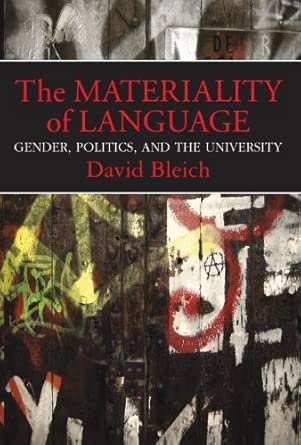
The scope and depth of Bleich’s work in The Materiality of Language are impressive. This book offers intriguing views of historical developments in language philosophies, the ways in which rigid views of language have supported institutional hegemony and androcentrism, and the positive implications of acknowledging language’s materiality. The systematic links he draws among language, gender, institutions, and politics offer generative insights that will certainly be of interest to scholars in rhetoric and composition.
― Rhetoric Review
[The author’s] thesis is interesting and provocative. He argues forcefully for the relevance of language, construed as a material entity, across a wide range of disciplines (and to life in general), and challenges the focus on treating language as a cognitive phenomenon and studying it in abstract terms.11/7/13
― New Books in Language
The Materiality of Language sees the human body, its affective life, social life, and political functions as belonging to the study of language. To recognize language as material and to treat it as such, maintains David Bleich, is to remove restrictions to language access due to historic patterns of academic censorship and unfair gender practices. Language is understood as a key path in the formation of all social and political relations. Language becomes available for study by all speakers, who may regulate it, change it, and make it flexible like other material things. The book addresses the need to end centuries of limiting access to language and to its many contexts of use, especially by universities.
The book engages the eight-century history of the university documenting how it was protected by the church, the crown, the state, and by corporate interests to this day. It describes how this protection has promoted the continuation of androcentric values that have excluded women and most men from access to language and the study of language. It shows that earlier forms of materiality, derived from nominalism, were repeatedly suppressed and censored, sometimes with death as a punishment for defiance. It suggests that even today, science and other academic subject matters, using their social and political respectability, have collaborated with universities and corporate interests to limit the study of language by depending on common abstractions such as instinct, intelligence, meaning, truth, knowledge, free market, rational choice, autonomy, and many others, treating their referents as self-evident. It offers that the historic uses and understandings of literature, which were recognized since classical times as material, have been similarly limited and censored, placed in the category of fiction, and prevented from exercising their materiality on their readerships and societies.
|
The Materiality of Language sees the human body, its affective life, social life, and political functions as belonging to the study of language. To recognize language as material and to treat it as such, maintains David Bleich, is to remove restrictions to language access due to historic patterns of academic censorship and unfair gender practices. Language is understood as a key path in the formation of all social and political relations. Language becomes available for study by all speakers, who may regulate it, change it, and make it flexible like other material things. The book addresses the need to end centuries of limiting access to language and to its many contexts of use, especially by universities.
The book engages the eight-century history of the university documenting how it was protected by the church, the crown, the state, and by corporate interests to this day. It describes how this protection has promoted the continuation of androcentric values that have excluded women and most men from access to language and the study of language. It shows that earlier forms of materiality, derived from nominalism, were repeatedly suppressed and censored, sometimes with death as a punishment for defiance. It suggests that even today, science and other academic subject matters, using their social and political respectability, have collaborated with universities and corporate interests to limit the study of language by depending on common abstractions such as instinct, intelligence, meaning, truth, knowledge, free market, rational choice, autonomy, and many others, treating their referents as self-evident. It offers that the historic uses and understandings of literature, which were recognized since classical times as material, have been similarly limited and censored, placed in the category of fiction, and prevented from exercising their materiality on their readerships and societies.
About the Author
David Bleich is Professor of English at the University of Rochester and author of Know and Tell: A Pedagogy of Disclosure, Genre, and Membership and The Double Perspective: Language, Literacy, and Social Relations, among other books.
 Wow! eBook