Wow! eBook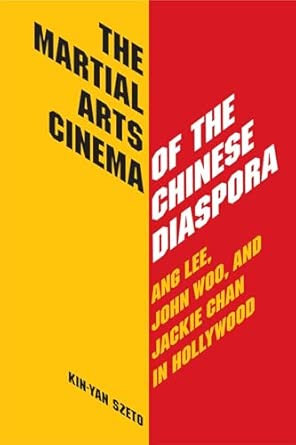
The Martial Arts Cinema of Chinese Diaspora: Ang Lee, John Woo and Jackie Chan in Hollywood
Author(s): Kin-Yan Szeto (Author)
- Publisher: Southern Illinois University Pr
- Publication Date: 2 Aug. 2011
- Language: English
- Print length: 208 pages
- ISBN-10: 0809330210
- ISBN-13: 9780809330218
Book Description
Beginning with a historical retrospective on Chinese martial arts films as a diasporic film genre and the transnational styles and ideologies of the filmmakers themselves, Szeto uses case studies to explore in depth how the forces of colonialism, Chinese nationalism, and Western imperialism shaped the identities and work of Lee, Woo, and Chan. Addressed in the volume is the groundbreaking martial arts swordplay film that achieves global success-Ang Lee’s Crouching Tiger, Hidden Dragon- and its revelations about Hollywood representations of Asians, as well as concepts of male and female masculinity in the swordplay film tradition. Also investigated is the invigoration of contemporary gangster, thriller, and war films by John Woo, whose combination of artistic and historical contexts has contributed to his global success. Szeto then dissects Chan’s mimetic representation of masculinity in his films, and the influences of his Chinese theater and martial arts training on his work. Szeto outlines the similarities and differences between the three artists’ films, especially their treatments of gender, sexuality, and power. She concludes by analyzing their films as metaphors for their working conditions in the Chinese diaspora and Hollywood, and demonstrating how through their works, Lee, Woo, and Chan communicate not only with the rest of the world but also with each other. Far from a book simply about three filmmakers, The Martial Arts Cinema of the Chinese Diaspora investigates the transnational nature of films, the geopolitics of culture and race, and the depths of masculinity and power in movies. Szeto’s interdisciplinary approach calls for nothing less than a paradigm shift in the study of Chinese diasporic filmmakers and the embodiment of cosmopolitical perspectives in the martial arts genre.
Editorial Reviews
Review
“In an increasingly crowded field of Chinese film studies, Kin-Yan Szeto clears out some space with The Martial Arts Cinema of the Chinese Diaspora: Ang Lee, John Woo and Jackie Chan in Hollywood. At once the sustained examination of three auteurs and their martial arts ouevres in Hollywood, Szeto’s study takes the subject global, looking at the production and reception of Chinese martial arts cinemas in the world, but also at the diasporas and cosmopolitanisms they effect. Szeto’s skillful maneuvers parallel the work she considers, generating a highly energetic choreography in its own right.”–Akira Mizuta Lippit, University of Southern California
“Kin-Yan Szeto’s book offers a refreshing look at an old film genre that has perpetually fascinated film audiences from around the world. This is a vigorous, insightful study of transnational cinema by focusing on three key figures from the Chinese diaspora. General readers and specialists can all learn something from Szeto’s refined film analysis and clear historical delineation.”–Sheldon Lu, editor of Transnational Chinese Cinemas: Identity, Nationhood, Gender
Szeto (Appalachian State Univ.) provides a critical examination of three major Chinese filmmakers whose work is transnational: Ang Lee, John Woo, and Jackie Chan. They reflect “cosmopolitical consciousness” as a new way to theorize identity, particularly by working transnationally in Asia and Hollywood and creating critical constructions of “Chineseness.” An initial chapter offers a brief history of martial arts cinema and an analysis of regional, diasporic, and transnational networks, film industries, and markets. The author then considers each artist individually. She offers a variety of analyses of Crouching Tiger, Hidden Dragon, especially through feminism and “double consciousness”–a critical mode of reflection on gender, ethnicity, and culture, encompassing Lee’s Taiwanese and Asian-American sensibilities. By analyzing binaries in the film, Szeto reframes it in a way that demonstrates it as both Chinese and American, and yet neither. She then offers a series of close readings of several of Woo’s films, focusing on the transnationalization of the gangster film, homosocial relations, and constructions of masculinity.
Last, she explores Chan’s “comic displacement” of both his own identity and national identity in many of his films. Though brief, this is an inspired study of three filmmakers well known in Western classrooms. Summing Up: Recommended. All readers. — K.J. Wetmore Jr., Loyola Marymount University–K.J. Wetmore Jr. “CHOICE” (12/1/2011 12:00:00 AM)
120Normal0falsefalsefalseEN-USX-NONEX-NONE
Szeto (Appalachian State Univ.) provides a critical examination of three major Chinese filmmakers whose work is transnational: Ang Lee, John Woo, and Jackie Chan. They reflect “cosmopolitical consciousness” as a new way to theorize identity, particularly by working transnationally in Asia and Hollywood and creating critical constructions of “Chineseness.” An initial chapter offers a brief history of martial arts cinema and an analysis of regional, diasporic, and transnational networks, film industries, and markets. The author then considers each artist individually. She offers a variety of analyses of Crouching Tiger, Hidden Dragon, especially through feminism and “double consciousness”–a critical mode of reflection on gender, ethnicity, and culture, encompassing Lee’s Taiwanese and Asian-American sensibilities. By analyzing binaries in the film, Szeto reframes it in a way that demonstrates it as both Chinese and American, and yet neither. She then offers a series of close readings of several of Woo’s films, focusing on the transnationalization of the gangster film, homosocial relations, and constructions of masculinity.
Last, she explores Chan’s “comic displacement” of both his own identity and national identity in many of his films. Though brief, this is an inspired study of three filmmakers well known in Western classrooms. Summing Up: Recommended. All readers. — K.J. Wetmore Jr., Loyola Marymount University–K.J. Wetmore Jr. “CHOICE” (12/1/2011 12:00:00 AM)