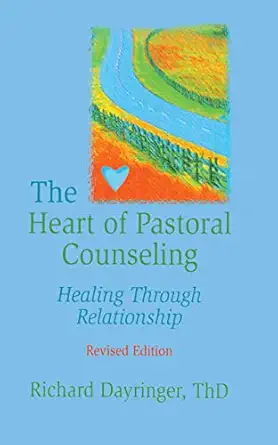
The Heart of Pastoral Counseling: Healing Through Relationship, Revised Edition
Author(s): Richard L Dayringer (Author)
Publisher: Routledge
Publication Date: March 1, 1998
Edition: 1st
Language: English
Print length: 218 pages
ISBN-10: 0789001721
ISBN-13: 9780789001726
Book Description
The relationship between pastor and parishioner is the essence of pastoral counseling--a simple truth with profound implications. Dr. Richard Dayringer explores these implications in The Heart of Pastoral Counseling: Healing Through Relationship, Revised Edition to help pastoral counselors understand how to use the relationship to bring about the desired ends in the therapeutic process. Drawing on research from the disciplines of psychiatry, psychology, marriage counseling, family therapy, and pastoral counseling, this book lays the foundation for utilizing the pastoral counseling relationship to bring about positive change as it explores topics such as observation, listening, communication, handling transference, and termination of therapy.Because the interpersonal relationship is the vehicle of therapy, it is critical that pastoral counselors understand the psychological assumptions that play a large part in the characteristics of relationships as well as the factors requiring attention in order to establish a secure counseling relationship. The Heart of Pastoral Counseling will help you attain this understanding as you also improve your knowledge on:
how pastoral relationships may be applied outside the therapeutic hour in general pastoral work
eclectic methods for clarifying feelings, developing intellectual insight, interpreting, questioning, and assigning certain behavior
employing the problem-oriented record in pastoral counseling
distinguishing relationship from transference and countertransference
the unique problem that counseling acquaintances presents
personality traits that attract people to the minister/pastoral counselor
counselor attitudes that foster relationship
how a client’s view of the counselor has an impact on the effectiveness of therapyThe Heart of Pastoral Counseling brings a solid base of research to pastoral counselors, seminary students, graduate students in counseling, professors of counseling, and specialists in pastoral psychotherapy so that you might better understand the nature of pastoral counseling relationships and how they are helpful and constructive in people’s lives. You will be challenged to rethink your role in initiating and carrying out therapeutic change and realize why you should build your ministry on relationships, rather than on friendships.
The Heart of Pastoral Counseling: Healing Through Relationship, Revised Edition
Author(s): Richard L Dayringer (Author)
Publisher: Routledge
Publication Date: March 1, 1998
Language: English
Print length: 140 pages
ISBN-10: 3032014816
ISBN-13: 9783032014818
Book Description
The book illustrates the most recent acquisitions in the field of motor learning and their applications in the treatment of atypical deglutition.
Since weaning, the variation in foods and methods of food intake induces a modification of tongue movement patterns that progressively leads to the transition from infant to adult swallowing. In some children, however, this transition does not occur, resulting in the onset of atypical swallowing.
This volume presents an innovative method for treating this disorder, the ABAED® method (Amitrano Benso Attention Executive and Swallowing), that was developed on the basis of the latest findings in motor learning. In ABAED®, the intervention for atypical swallowing is not directed towards re-educating orofacial musculature but towards the brain, focusing on learning the correct motor behaviour of adult swallowing. This is facilitated through conscious maneuvers that require significant executive attention and working memory resources.
This book will be of interest to professionals and experts in the fields of motor learning, speech-language pathology, and dysphagia.
Editorial Reviews
From the Back Cover
The book illustrates the most recent acquisitions in the field of motor learning and their applications in the treatment of atypical deglutition.
Since weaning, the variation in foods and methods of food intake induces a modification of tongue movement patterns that progressively leads to the transition from infant to adult swallowing. In some children, however, this transition does not occur, resulting in the onset of atypical swallowing.
This volume presents an innovative method for treating this disorder, the ABAED® method (Amitrano Benso Attention Executive and Swallowing), that was developed on the basis of the latest findings in motor learning. In ABAED®, the intervention for atypical swallowing is not directed towards re-educating orofacial musculature but towards the brain, focusing on learning the correct motor behaviour of adult swallowing. This is facilitated through conscious maneuvers that require significant executive attention and working memory resources.
This book will be of interest to professionals and experts in the fields of motor learning, speech-language pathology, and dysphagia.
About the Author
Antonio Amitrano is an educationalist, speech therapist, and professional counselor, specialized in clinical work and research in the field of swallowing and language disorders. He is a lecturer in post-basic training courses and in first-level master's programs in Deglutology at the Universities of Pisa and Turin. Additionally, he is the author and co-author of numerous scientific publications.
Francesco Benso is a consultant for research on executive attention functions at the University of Trento. He is a lecturer, trainer, and consultant in cognitive and clinical neuroscience. He has taught neuroscience subjects at the Universities of Trento and Genoa. He is the creator of a wide range of tests and the Benso® Method treatment, applied in developmental disorders, adult traumatic brain injury, neurodegenerative diseases in the elderly, learning phases in education, and enhancing individuals involved in arts and sports. His research activities primarily focus onthe management and creation of neurocognitive models.
 Wow! eBook