 Wow! eBook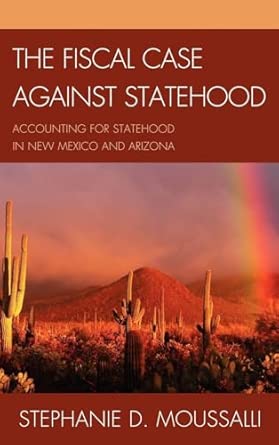
The Fiscal Case Against Statehood: Accounting for Statehood in New Mexico and Arizona
Author(s): Stephanie D. Moussalli (Author)
- Publisher: Lexington Books (UK)
- Publication Date: 12 Mar. 2012
- Edition: 1st
- Language: English
- Print length: 224 pages
- ISBN-10: 0739166999
- ISBN-13: 9780739166994
Book Description
Moussalli examines New Mexico’s and Arizona’s financial reports before and after statehood, and compares them to the state of Nevada’s reports as a control. Through detailed, systematic analysis, Moussalli reveals the fiscal costs and accountability gains of statehood for the residents of New Mexico and Arizona.
Editorial Reviews
Review
Moussalli’s book is truly an interdisciplinary study. . . . Historians of the development of nations, and in particular the transition of US territories into States of the Union, will find Moussalli’s analysis of Arizona an New Mexico’s road to statehood informative and innovative. … A significant contribution of this book to accounting historians, especially those studying US governmental accounting, is the explanations and historical analysis of the financial reporting practices that were in place or were introduced during this period.
Stephanie D. Moussalli’s study of spending changes that occurred when the territories of New Mexico and Arizona became states in 1912 tests the ‘Leviathan’ model that predicts that with more independence under statehood their governments would increase their taxing and spending. . . Moussalli documents how Arizona and New Mexico after statehood increased their spending over and above what they lost in federal finding. . . . Interesting sidelights in Moussalli’s study include how government funds were lost through bank failures, such as occurred during the depression of 1920-21.
The Fiscal Case against Statehood is an interdisciplinary delight. Moussalli deftly blends accounting, history, economics, and public administration into a compelling story about the effects of statehood. Scholars interested in better understanding the growth of government or the evolution of accounting standards will benefit from a close read.
The Fiscal Case Against Statehood clearly shows the diffeculties engendered of getting politics out of property taxes in order to accomplish needed reforms. . . .The resulting book, The Fiscal Case Against Statehood, is a wonderful mix of history, economics, eithics, politics, accounting, and taxation. . . .Moussalli offers strong evidence that citiens’ tax burdens did increase as a ‘price’ for statehood. . . .The list of people who woulod benefit from reading this book is quite long. First, the text is a must-read for state and local officals and politicians of Arizona and New Mexico; residents of both states will also find this account of their predecessors’ opposition to statehood enlightening. Second, researchers in the sreas of tax, governmental accounting, history, policial science, economics, and ethics will also find a wealth of information. Third, this book will be a refreshing supplement to many university classes. Fourth, other potential users of this text include those teaching classes in United States history, political science, ethics, and economics who will enjoy the detailed supply of facts, figures and personalities involved in these territories’ quest for statehood.
This book is both history of accounting as well as accounting for history. Through her meticulous research into interplay between political structure, politics, fiscal management and accounting, Moussalli’s work makes an impressive contribution to the sparsely populated branch of scholarship–political accounting. Although accounting is often depicted as an afterthought to structure of business and political organizations, Moussalli’s work tells the story of their co-evolution. Students of accounting, organizations, politics, and history will find it a rewarding reading and source of rich examples. A hundred years after creation of the states of New Mexico and Arizona out of territories, this highly readable book could inform the on-going political debate in India on breaking up large states of the union into smaller ones.


