Wow! eBook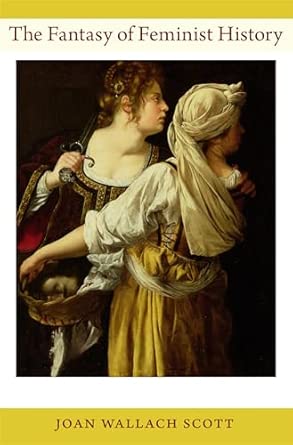
The Fantasy of Feminist History
Author(s): Joan Wallach Scott (Author)
- Publisher: Duke University Press Books
- Publication Date: 11 Nov. 2011
- Language: English
- Print length: 200 pages
- ISBN-10: 0822351137
- ISBN-13: 9780822351139
Book Description
Editorial Reviews
Review
“
The Fantasy of Feminist History remains a fascinating and timely engagement with important questions concerning the rhetoric and ideology of historical representation, and it will undoubtedly have broad appeal for scholars working in and across a range of disciplines and fields of study, including history, gender studies, critical theory, cultural studies, psychoanalysis, and postcolonialism. Scott is particularly adept at rendering complex theoretical concepts in eminently clear, readable terms, as well as at providing concise genealogies of the institutional, intellectual, and social contexts in which those concepts were initially developed and have been put to use subsequently.” – Theo Finigan, Reviews in Cultural Theory“Against Scott’s formulation, historians may continue to assert that there is little empirical foundation for psychoanalytic concepts of fantasy, although it is difficult to argue that the histories she discusses are not informed by emotional investments that cannot be explained ideologically or empirically. The epilogue, which reminds us that archives are a repository of passion as well as information, should give all historians a reason to examine the scenes into which they may have written themselves.” – Carolyn J. Dean,
Journal of Modern History“
The Fantasy of Feminist History is Joan Wallach Scott’s most important intervention in the field of gender history since her classic article of 1986. In her usual lucid prose, she invites us to rethink gender analysis in psychoanalytic terms and thus enrich our analytic vocabulary for understanding human existence. Her critiques of sexual difference and cultural construction dramatically change our notions of gender norms. Her elucidation of fantasy as a historical category of analysis is also groundbreaking. This book is a must-read for all historians and gender scholars.”—Mary Louise Roberts, author of Disruptive Acts: The New Woman in Fin-de-Siècle France“Joan Wallach Scott is not merely a historian of gender. Gender also proves a useful tool in her history of our present. To preserve its ‘critical edge,’ she summons psychoanalysis, convincingly arguing that gender studies need not be limited to cold reason. From paradox to dilemma, indeed, there is madness in Scott’s method, and it is exhilarating.”—
Éric Fassin, École Normale Supérieure“This elegant collection of Joan Wallach Scott’s recent essays on feminist history and critique is her best book yet. Relentlessly pedagogical, bracingly reflexive, and breathtakingly creative, each essay makes good on the book’s premise that ‘psychoanalysis animates the concept of gender for historians.’ The introduction—a perspicacious narrative of feminist theory’s complex relationship with sexual difference and psychoanalysis—is worth its weight in gold, and the five essays that follow, on topics ranging from secularism to seduction theory, are polished gems of historical-theoretical inquiry. Together they reinvigorate feminist theory with brilliant new ideas, juxtapositions, and engagements.”—
Wendy Brown, University of California, Berkeley“
The Fantasy of Feminist History remains a fascinating and timely engagement with important questions concerning the rhetoric and ideology of historical representation, and it will undoubtedly have broad appeal for scholars working in and across a range of disciplines and fields of study, including history, gender studies, critical theory, cultural studies, psychoanalysis, and postcolonialism. Scott is particularly adept at rendering complex theoretical concepts in eminently clear, readable terms, as well as at providing concise genealogies of the institutional, intellectual, and social contexts in which those concepts were initially developed and have been put to use subsequently.” — Theo Finigan ― Reviews in Cultural Theory“This is a provocative volume and will be of particular interest to those seeking a bridge between sociology’s measurable quantities and psychology’s emphasis on the unknowable. With connections to an array of disciplines including history, women’s studies, literary theory, and psychology, it holds promise for broad reach across the academy.” ―
On Campus with Women“Against Scott’s formulation, historians may continue to assert that there is little empirical foundation for psychoanalytic concepts of fantasy, although it is difficult to argue that the histories she discusses are not informed by emotional investments that cannot be explained ideologically or empirically. The epilogue, which reminds us that archives are a repository of passion as well as information, should give all historians a reason to examine the scenes into which they may have written themselves.” — Carolyn J. Dean ―
Journal of Modern History“Scott’s undertaking should be commended for its daring attempt to tease out new ways of analysing historical material.” — Michael Kuur Sørensen ―
European Review of History“The importance of Scott’s book lies in its refusal of a damaging spatial binary of surface and depth. Surface readers accuse ‘depth’ readers of not being aware of their own fantasies as readers, in turn, they are agnostic about knowing such entanglements in their surface readings. It is precisely the entanglements of the reader and text and the fantasies of historical knowledge that Scott engages. Her critical reading practice insists not only on close reading of the text, but also close reading of the reader herself.” — Kathleen Biddick ―
Journal of Social History“The impressive yield of this anthology is that it deals with supposedly familiar subjects but still succeeds in opening up a new discussion. . . . Scott delivers interesting discussions over many theoretical concepts, and her diagnosis, with the help of psychoanalysis, of the discipline’s shortcomings is striking.” — Angelika Epple ―
History and Theory“I choose to conclude by mentioning one aspect that I consider of special relevance: the critique of the fantasy of continuity in historical constructions. This critique concerns not only the temporal categories of history and its periodisation, but is tightly linked with the critique of essentialism. This is why I consider it foundational for any innovative historical practice, including the multifarious forms of feminist history.” — Luisa Passerini ―
Gender & History“
The Fantasy of Feminist History deal with one of the oldest and most difficult problems faced by feminist historians across the generations: how is it possible to account for emotions, passions, feelings, desires and fantasies while doing historical research? It is easy to predict that the arguments – and the book – will play a central role in theoretical and methodological debates among scholars working on gender issues in years to come.” — Paola Di Cori ― European Journal of Women’s StudiesAbout the Author
Joan Wallach Scott is the Harold F. Linder Professor of Social Science at the Institute for Advanced Study. Her many books include The Politics of the Veil, Parité: Sexual Equality and the Crisis of French Universalism, Only Paradoxes to Offer: French Feminists and the Rights of Man, and Gender and the Politics of History.
Excerpt. © Reprinted by permission. All rights reserved.
The Fantasy of Feminist History
By JOAN WALLACH SCOTT
Duke University Press
Copyright © 2011 Duke University Press
All right reserved.
ISBN: 978-0-8223-5113-9
Contents
Acknowledgments………………………………………………………………………viiIntroduction. “Flyers into the Unknown” Gender, History, and Psychoanalysis…………………11. Feminism’s History…………………………………………………………………232. Fantasy Echo History and the Construction of Identity………………………………….453. Feminist Reverberations…………………………………………………………….684. Sexularism On Secularism and Gender Equality………………………………………….915. French Seduction Theory…………………………………………………………….117Epilogue. A Feminist Theory Archive…………………………………………………….141Notes……………………………………………………………………………….149Bibliography…………………………………………………………………………169Index……………………………………………………………………………….181
Chapter One
Feminism’s History
IN 1974, LOIS BANNER AND MARY HARTMAN published a book of essays they called Clio’s Consciousness Raised. Consisting of papers from the 1973 Berkshire Conference on Women’s History, it was a rallying cry for many of us, an assertion of our intention to make women proper objects of historical study. If the muse of history had too long sung the praises of men (“glorifying the countless mighty deeds of ancient times for the instruction of posterity”), it was now time to bestow a similar glory on women. The second of the nine daughters of Zeus and Mnemosyne (the goddess of memory), Clio’s special province was history (or epic poetry, a historical genre in ancient Greece). Our challenge to her seemed simple: make women’s stories central to the memory she transmitted to mortals. In order to ease her task, we would supply the materials she needed, the histories of the lives and activities of women.
Of course, no challenge to the gods is simple, nor was our effort without hubris, for we were presuming to tell Clio what to say. The muses have meted out dire punishment to those who sought to interfere or compete with them. The Pierides were turned into magpies, ducks, and other squawking birds for trying to outsing the muses. When the sirens claimed to sing better, the muses plucked their feathers to make crowns for themselves. The minstrel Thamyris was blinded and sent to Hades for having boasted that he could sing more beautifully. And, less cruelly, the muses had the last word when Prometheus claimed that he, not they, had created the letters of the alphabet. This could have been a matter of dispute, the chroniclers tell us, “had not the Muses invented all tales, including that of Prometheus.”
Our goal was not so much to compete with Clio as to become her agents, though there is always an element of competition in such identification. Like her, we wanted to tell edifying stories whose import went beyond their literal content to reveal some larger truth about human relationships—in our case, about gender and power. Like her, we wanted to be recognized as the source of those stories. Like her, too, we wanted all of history as our province; we were not just adding women to an existing body of stories, we wanted to change the way the stories would be told. Clio was our inspiration, but we wanted also to be her, inspiring others to document the memory we were uncovering.
The last few decades have seen some progress toward these goals. Of course they haven’t been completely achieved: neither women’s history nor women historians have become fully equal players in the discipline, and we have by no means rewritten all the stories. Indeed, the temporal and geographic unevenness of our accomplishment—far greater success in modern European and American history than in ancient, medieval, early modern, or non-Western history; far more success in introducing women into the picture than in reconceiving of it in terms of gender—clearly shows that there is more to be done. Still, the gains are undeniable. Unlike Clio, we can’t punish those who would deny our accomplishment; nor can we afford to be amused by the folly of those brothers of Prometheus who claim to be the real innovators, treating us as imitators or usurpers. (We still get angry.) We can, however, point to an enormous written corpus, an imposing institutional presence, a substantial list of journals, and a foothold in popular consciousness that was unimaginable when Banner and Hartman published their book. If we have not taken over history, we have claimed a rightful position in it; once viewed as pretenders, we now have legitimate claim to Clio’s inspiration.
But legitimacy, for those who began as revolutionaries, is always an ambiguous accomplishment. It is at once a victory and a sellout, the triumph of critique and its abandonment. This is difficult for feminists who, despite all the derision cast on them by socialists in the nineteenth and twentieth centuries, have been revolutionaries dedicated to overturning patriarchy, breaking the oppressive chains of sexism, liberating women from the stereotypes that confine them, and bringing them onto the stage of history. The realization of at least some positive change since the early 1970s—which I have just characterized for historians of women as gaining a legitimate claim to Clio’s inspiration—has produced some ambivalence and uncertainty about the future. Have we won or lost? Have we been changed by our success? What does the move from embattled outsider to recognized insider portend for our collective identity? Has our presence transformed the discipline, or have we simply been absorbed into it? Ought we to be content with maintaining and reproducing what we have gained, or should we be responding to new challenges that may threaten our legitimate standing? Does women’s history have a future, or is it history? How might we imagine its future? These are questions also being asked about women’s studies and feminism.
As the millennium approached, a number of forums were organized in the United States to speculate about the future. To cite only two examples: In 1997 I edited a special issue of the journal differences called “Women’s Studies on the Edge”—a title meant to evoke Pedro Almodovar’s film Women on the Verge of a Nervous Breakdown. Although we chose it playfully, the allusion turned out to be an apt characterization of how edgy some of us feel when asked to think about the future. In 1999 the Journal of Women’s History organized a terrific intergenerational exchange among the Americanists Anne Firor Scott, Sara Evans, Elizabeth Faue, and Susan Cahn. (The four constitute a lineage: Scott was Evans’s teacher; Evans taught Faue and Cahn.) In an otherwise rich and wide-ranging discussion, these historians kept avoiding the topic of the future, although that was the stated purpose of the conversation. At one point, Scott confessed that in thinking about “where women’s history should, or might, go from here,” she found herself “running up against a wall” (“Part 1,” 29). Faue thought that we needed to “take time out to dream,” to exercise imagination and creativity to get beyond the impasse (“Part 2,” 211). But Evans summed up what appeared to be a general reluctance among them. “Ah, the future,” she sighed. “I agree … that this is the part of the conversation I find most perilous” (205).
Futures
Why would the future of a successful movement be so difficult to envision?
In some ways we already know the answer—it’s a form of social movement analysis. An aging generation of feminist scholar-activists looks back nostalgically on its wild youth, wondering (but not daring to ask aloud) if all the gains we’ve made were worth it. The institutionalization of women’s history implies its end as a campaign. Our research and professional activities seem to have lost their purposive political edge and their sense of dedication to building something larger than an individual career. The community of feminist scholars, whose vitality was manifest in fierce divisions no less than in shared commitments, now seems diffuse. And, at least among historians of women, the theoretical and political stakes no longer seem as high, while disagreements seem more personal or generational. If there is relief at the end of the need to conspire in late-night strategy sessions and to constantly have to justify one’s scholarship and that of one’s students to skeptical or hostile colleagues—as well as pleasure in the quantity, quality, and diversity of work produced under the rubric of women’s history—there is also a sense of loss. For many of us, being embattled was energizing; it elicited strategic and intellectual creativity unmatched by our earlier experiences in graduate school. Inspired by Clio, we sought to change the received version of history. Appeals to Clio consolidated our identity as historians and feminists; activism confirmed agency. We were producers of new knowledge and transmitters of revised memory, fashioning tales to inspire ourselves and the generations to come—all in the face of opponents more formidable than the Pierides or the sirens, opponents who had the power to discipline us for what they took to be our pretensions and misdeeds. No longer insurgents, we have become disciplinarians, and I suspect that inevitably there’s something of a letdown in this change of identity. It is one thing to criticize disciplinary power from the outside, another to be inside, committed to the teaching of established bodies of scholarship. That kind of teaching necessarily seeks to reproduce feminist history in rising generations of students, but it is often resistant to the kind of critical challenges that was its defining characteristic.
As academic feminism has gained institutional credibility, it also has seemed to lose its close connection to the political movement that inspired it. In the 1970s and 1980s, we were the knowledge-producing arm of a broad-based feminist movement devoted to radical social change. During the 1990s, there were critical attacks on, and guilt-ridden condemnations of, the diminished contact between scholars and the grass roots, as well as injunctions to maintain or rebuild those ties. But that effort has foundered. This is not, as is sometimes alleged, because feminist scholars have retreated to ivory towers; the opposition between academic and political feminism was always a mischaracterization. Rather, it is because the political movement itself has become fragmented, has dispersed into specific areas of activism. This does not mean, as some journalists have claimed, that feminism is dead. In fact, concerns about the status and condition of different kinds of women have infiltrated many more realms of law and policy than was the case at the height of the movement, just as questions about gender have bled into areas of study that were resistant to feminism in the early days of women’s studies.
Discontinuous, individually coordinated strategic operations with other groups have replaced a continuous struggle on behalf of women represented as a singular entity. This change is tied to the loss of a grand teleological narrative of emancipation, one that allowed us to conceive of the cumulative effect of our efforts: freedom and equality were the inevitable outcomes of human struggle, we believed, and that belief gave coherence to our actions, defined us as participants in a progressive movement. We were on the side of redemptive history. Although discontinuity and dispersed strategic operations are eminently political in nature (and, for a younger generation, a familiar way of operating), the loss of the continuity that came with the notion of history as inevitably progressive helps explain the difficulty an older generation has in imagining a future. They take discontinuity to be regressive—the opposite of progressive, which indeed it was for those who watched fascism in Europe destroy liberal institutions in the 1930s—when in the twenty-first century, discontinuity seems to me to be more closely allied to radical (Left) critiques.
Another aspect of the successful institutionalization of women’s history is the dulling of the critical edge that comes with being on the margin. There was much debate in the 1980s, perhaps a bit more among literary scholars than historians, about the ultimate benefits of integration. Was the absence of women in the curriculum simply a gap in knowledge that needed to be filled? Or did it reveal something more pernicious about the patriarchal or phallogocentric organization of knowledge itself? What kind of impact would women’s studies have on the university? Would we simply provide information now lacking, or would we change the very nature of what counted as knowledge? And were these necessarily contradictory aims? “As long as women’s studies doesn’t question the existing model of the university,” Jacques Derrida told a meeting of the Pembroke Center seminar in 1984, “it risks to be just another cell in the university beehive.” Some feminists insisted that, by definition, a female presence in history textbooks and history departments, from which women had usually been excluded, was a subversion of the status quo. Wasn’t becoming visible itself a challenge to the prevailing historical orthodoxy that maintained women’s absence from politics and history? Others of us argued that the radical potential of women’s history would be lost without a thoroughgoing critique of the presumptions of the discipline: for example, its notion that agency is somehow inherent in the wills of individuals; its inattention to language in the construction of subjects and their identities; and its lack of reflection on the implicit interpretive powers of narrative. It is significant, I think, that the lively reform-versus-revolution debate has receded from discussions among women’s historians. With at least some measure of reform achieved, the troubling issues now are more mundane: overspecialization, overproduction, and fragmentation, all of which undermine the cohesiveness of the community of feminist scholars and make impossible any mastery of the entire corpus of women’s history. Even those who do share a common reading list are more likely to debate the merits of a particular interpretation than to ask how it advances a feminist critical agenda. Preoccupied with the details of administering programs, implementing or adjusting curricular offerings, supervising undergraduate majors, and placing doctoral candidates, we imagine the future as a continuation of the present rather than as a liberation from it.
Still another reason it is so difficult to look forward is that the university into which we have been incorporated is itself undergoing major structural change. Having been critics on the outside, we are now advocates on the inside, looking to preserve the institution—as a faculty-governed, tenure-granting, knowledge-producing space of critical inquiry—from those who would reorganize it according to corporate models in which, as Bill Readings puts it, “clients are sold services for a fee.” The need to prevent the “ruin” of the university casts feminists more often as defenders of the status quo than as agents of change. The temptation is to use our analyses of power to shore up what we’ve won, protecting it from erosion by chief executive officers in the guise of presidents and by trustees who treat ideas as commodities and scholars as their retailers, rather than producers. There is a new need to cooperate with colleagues, some of whom were once our adversaries, on a common agenda committed to the preservation of the academy as we have known it. In this context, demands for radical reform of the entire enterprise seem out of place, if not dangerous. Instead, we vigilantly guard the boundaries of our field, protesting unfair distributions of resources, alert to incursions on our turf from new and sexier areas of scholarship, and wary of surveyors who might redraw the maps we have followed so well. Our protectionism sometimes even leads us to collaborate with those administrators who are intent on commodifying the life of the mind. If we are indeed one of the cells in the university beehive, our interest now is in maintaining both the position of that cell and the health of the entire hive. Defense of the status quo, and of the humanist principles that underlie it, seems far more urgent than holding onto dreams of radical transformation. We are, I think, witnessing a version of what Nancy Cott, referring to the postsuffrage era, called “the grounding of modern feminism”—the practical implementation, which necessarily falls short, of ideals and emancipatory claims; the acceptance of what is, instead of a continued quest for what ought to be; the domestication of fervent desire.
Fervent Desire
Fervent desire is a gift of the muses, a kind of madness that takes over, igniting and transforming the subject. According to Plato, “it seizes a tender, virgin soul and stimulates it to rapt passionate expression … but if any man come to the gates of poetry without the madness of the Muses, persuaded that skill alone will make him a good poet [we might substitute “a good historian by discipline”], then shall he and his works of sanity … be brought to naught.”
(Continues…)
Excerpted from The Fantasy of Feminist Historyby JOAN WALLACH SCOTT Copyright © 2011 by Duke University Press. Excerpted by permission of Duke University Press. All rights reserved. No part of this excerpt may be reproduced or reprinted without permission in writing from the publisher.
Excerpts are provided by Dial-A-Book Inc. solely for the personal use of visitors to this web site.