Wow! eBook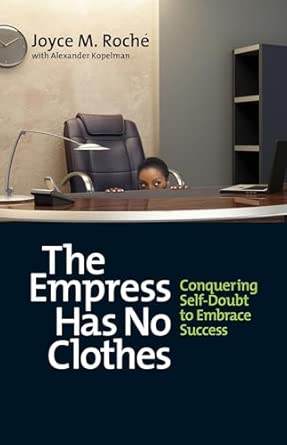
The Empress Has No Clothes; Conquering Self-Doubt to Embrace Success: Conquering Self-Doubt to Embrace Success
Author(s): Joyce M. Roche (Author), Alexander Kopelman (Author)
- Publisher: Berrett-Koehler Publishers
- Publication Date: 16 July 2013
- Edition: First Edition
- Language: English
- Print length: 192 pages
- ISBN-10: 1609946367
- ISBN-13: 9781609946364
Book Description
Joyce Roché rose from humble circumstances to earn an Ivy League MBA and become the first female African-American vice president of Avon, president of a leading hair care company, and CEO of the national nonprofit Girls Inc. But despite these accomplishments, she felt like a fraud. She worked more and more, had less and less of a personal life, and was never able to enjoy her success.
In this deeply personal memoir, Roché shares her lifelong struggle with what she now recognizes as "the impostor syndrome," a condition that plagues successful people in all walks of life. Based on her own experiences and those of top executives from organizations such as Eileen Fisher, Citigroup, BET, Pepsi, and Tupperware, she offers practical advice and valuable coping strategies that can help you embrace your own worth and live a life of joy, zest, and fulfillment.
Editorial Reviews
Review
--Rick Goings, Chairman and CEO, Tupperware Brands Corporation
"Whether you are just starting your career or are nearing its pinnacle, this book will do more than help you navigate effectively; it will help you enjoy the journey."
--Earl "Butch" Graves Jr., President and CEO, Black Enterprise
"This is a book that is so needed by women--especially younger women. [It] offers hope, guidance, and gentle mentorship to all of us who have ever confronted the fear of not measuring up."
--Rosina L. Racioppi, President and CEO, Women Unlimited, Inc.
"Silence and isolation are the hallmarks of the impostor syndrome. Joyce's courage in speaking out will be tremendously helpful to all those who have ever experienced these feelings by letting them know that they are not alone."
--Pauline Rose Clance, PhD, psychotherapist who, with Suzanne Imes, PhD, first identified the impostor syndrome
About the Author
Alexander Kopelman has written or cowritten ten books.
Excerpt. © Reprinted by permission. All rights reserved.
The Empress Has No Clothes
Conquering Self-Doubt to Embrace Success
By Joyce M. Roch, Alexander Kopelman
Berrett-Koehler Publishers, Inc.
Copyright ©2013 Joyce M. Roch and Alexander Kopelman
All rights reserved.
ISBN: 978-1-60994-636-4
Contents
Foreword by Edward E. Whitacre, Jr.........................................ixPreface....................................................................xiiiAre You an Impostor? (Take the Test).......................................xviChapter 1 Breaking the Silence.............................................1Chapter 2 It's Not What You Wear...........................................15Chapter 3 What If You Have No Silver Spoon?................................31Chapter 4 Gender Matters...................................................47Chapter 5 What Color Is Your Parachute?....................................65Chapter 6 But You Are So Young.............................................79Chapter 7 Climbing the Ladder..............................................93Chapter 8 What If the Naysayers Are Right?.................................109Chapter 9 The Weight of the World..........................................125Chapter 10 What Did You Do to Get Here?....................................141Chapter 11 Listen to Your Heart............................................157Chapter 12 Joy, Zest, and Power............................................173Afterword: Strategies for Confronting the Impostor Syndrome and Embracing
Success....................................................................187Acknowledgments............................................................195Index......................................................................197About the Authors..........................................................203
Excerpt
CHAPTER 1
Breaking the Silence
The impostor syndrome, at its core, is a distortion in the way wesee ourselves. The trouble is that we believe the warped image tobe reality—the "truth" we've somehow managed to hide fromthe rest of the world. We are petrified that we will be discoveredand spend nearly all our energy guarding against that possibility.
One of the most difficult aspects of the impostor syndrome isthe fact that it demands that we keep our feelings a secret. Don'tstay silent. Find a way to speak about your fears. Whether you do itwith a trusted friend, a coach, a mentor, your partner, a therapist,or in a journal, give voice to all the feelings churning inside.(Writing to yourself can be one of the most effective methods toface the impostor syndrome. It was for me and many others.)
* * *
I looked out the wall of windows of my corner office at themasts of the tall ships tied up at South Street Seaport and at thespan of the Brooklyn Bridge just beyond. Cool, wintry early-morningsunshine filled the large room. The city was waking upbut still quiet. And I had the entire office and the next hour anda half to myself.
"I have the best job in the world," I said out loud, filledwith the contented knowledge of being in just the right placeat the right time. I had been President and CEO of Girls Inc.,the nonprofit organization dedicated to inspiring all girls to bestrong, smart, and bold, for just over five years and was moreexcited than ever to get up every morning and go to work.Helping hundreds of thousands of girls shape their futures wentway beyond job satisfaction, it fed my soul. At long last, I feltlike a real success.
It had not always been so. In over twenty-five years ofsingular achievements in corporate America, I had risen tounprecedented heights for an African American woman,becoming the first to be named an officer of Avon Products, aFortune 500 company. Just about every new accomplishment,however, came with the stultifying doubt that I did not deservethe success and that sooner or later I would be discovered as animpostor.
I glanced at the book galleys on my desk. The journalist andauthor Ellyn Spragins had asked me to contribute to her bookWhat I Know Now: Letters to My Younger Self and had just sentme the proofs as the book neared the final stages of production.I picked up the galleys and reread the letter addressed to Joyceat thirty-three.
Dear Joyce,
You may not have set out to be a pioneer, but here you are,out front, one of the few African American women working upthe corporate ladder. You achieve more every year, but each leapexerts more pressure. Who would have thought success could feelso much like a burden?
Yes, you thrive on it. You love marketing, and the more youwork, the more you're consumed and fascinated by it. Here atRevlon, you're setting a personal record, working morning tillnight—and both days on weekends. Exercise? Forget about it.You can't even plan a lunch, because chances are a meeting will becalled at noon.
You're not complaining, because, strangely, there's agiddiness in such hard work. You risked a lot every time you seizedan opportunity that presented itself. Laboring ever more intenselyshows you're worthy of the chances you've been given. It alsoprops open the door for every African American woman whomight be coming behind you.
This is what you tell yourself—and it's all true. But it onlygoes so far. The way you drink up that steady stream of praise andrecognition is a tip-off. You did a good job. You belong here. Wewant to make you an officer of the company.
Ever wonder why the glow wears off so soon? Becausesomewhere, deep inside, you don't believe what they say. Youthink it's a matter of time before you stumble, and "they" discoverthe truth. You're not supposed to be here. We knew you couldn'tdo it. We should have never taken a chance on you.
The threat of failure scares you into these long hours. Yetsuccess only intensifies the fear of discovery.
Stop. It. Now. You're not an impostor. You're the genuinearticle. You have the brainpower. You have the ability. You don'thave to work so hard and worry so much. You're going to do justfine. You deserve a place at the table.
And at the end of it all, people will remember you not forhours you worked but for the difference you made in the world.
Love,
Joyce
That letter was a turning point for me. As I had thoughtabout it, an odd phrase kept popping up in my mind: "TheEmpress has no clothes. The Empress has no clothes." It wasso strange and seemingly out of context. But it was insistentenough that I thought I had better pay attention to whateverits message might be. The only thing I could think of was to goback and reread Hans Christian Andersen's The Emperor's NewClothes, in which the Emperor really has no clothes.
What I—as most of us, I think—remember about thefamous fable was that the vain Emperor goes parading throughhis realm naked because neither he nor any of his peoplewant to admit that they cannot see the new "suit" the griftersposing as weavers had "made" for him. What struck me now,however, was the clothes' purported magical quality: "[Theweavers] proclaimed that they knew how to weave cloth ofthe most beautiful colors and patterns, the clothes manufacturedfrom which should have the wonderful property of remaininginvisible to everyone who was unfit for the office he held, orwho was extraordinarily stupid."
In the story, it is the fear of being seen as unfit for one'soffice or as being stupid that keeps everyone, except an innocentchild, silent. I recognized that fear immediately as the one I hadencountered so frequently throughout my life—the terror ofbeing unmasked as an impostor "unfit" for my post. I thoughtabout all the times that fear had kept me from speaking out, hadinsisted that I work twenty-hour days, had whispered in my earthat I did not deserve the promotions and recognition. "They'llfind you out," it kept saying. The letter for Ellyn's book camestraight from all those memories and a newfound confidence toconfront my fear of being an impostor.
That quiet morning in my office, as I took in the words, I felta new sense of pride. I had not only succeeded in spite of all thesefears, I had learned how to quiet them enough to enjoy my success.
I leaned back in my chair and looked at a brightly coloredtugboat guiding a barge downriver. In a wink, I was transportedback home to New Orleans, a young girl watching bargescarefully threading their way along the Industrial Canal. I couldalmost smell the diesel of the tugs mixing with the heavy scentof Mississippi river mud as I crossed the bridge that divided theNinth Ward from the rest of the city.
I was just a year old, the youngest of nine children, whenmy mother moved the family from our hometown of Iberville,Louisiana, to New Orleans after my father was killed in a hit-and-runaccident. She had two older sisters in the city, neitherof whom had children of their own, and figured that raising uskids would be a whole lot easier in a place where she could getsteady work and help looking after us. By the time I was oldenough to remember, our household spanned between Mama'shouse and Aunt Rose's house a few blocks away.
Neither Mama nor Aunt Rose had gone beyond the eighthgrade in school because they had had to go to work. However,they reminded us every day that education was our ticket todoing more in life, to getting beyond the limitations otherpeople would try to put on us. This was the South in the 1950s,mind you, so, as young African Americans, there were lots oflimitations we had to face.
"Joyce Marie," I heard Aunt Rose's familiar voice in mymind, "if you work hard and study, there is nothing in thisworld that can stop you. Get an education, and you can makesomething of yourself."
As I surveyed my life on that bright New York morningin 2005, I knew that Aunt Rose and Mama would have beenproud—much more so of the person I had become than justof the things I had accomplished. And I wondered why it hadtaken me so long to become proud of me and to trust that I wasworthy of success.
I flashed on the exact moment I became aware of the change,when I felt more confident and comfortable with my success.After nearly two decades at the company, I had risen to thepost of Vice President of Global Marketing at Avon. And I wasdoing a great job, leading the establishment of the company'sfirst global marketing organization and creating strategies thatgenerated close to a billion and a half dollars in worldwide sales.In spite of that, when a position with even more responsibilitybecame available, I was passed up for the promotion. Needlessto say, I was not happy. I had encountered the proverbial glassceiling on several occasions before, but this time, rather thandoubting myself, I decided to embrace my success and to stepout and believe in my abilities. I knew I deserved that position.Somehow, without even realizing it, I had internalized mysuccess as something I had earned. It was as if a spell had beenbroken.
I had traveled so far in my thoughts, I was a little startledwhen I heard Yolanda, my executive assistant, say, "Goodmorning, Joyce."
The workday had begun, and I would have to return toexploring thoughts about the meaning and the price of successat another time.
* * *
I had occasion to revisit this theme in just a few short months,when my letter, along with two others, was excerpted fromEllyn's book in advance of publication in O Magazine, in early2006. The calls, e-mail messages, and letters started coming inimmediately. Their volume only increased when the book cameout in April. Everyone, it seemed, from young women justentering college to male CEOs of blue-chip companies, wantedto talk about their own fears of being unmasked as impostors.
My very personal reflections had struck a raw nerve forthousands of people. By their very nature, impostor feelingstend to keep people silent. They are secret fears that we arelacking in some way. Who wants to admit to not being worthyof their post, right? But they are also a terrible burden to carryaround by yourself. So when they read my letter, people wantedto talk, to share, to get the weight off their chests.
One of the most surprising conversations I had at that timewas with Ed Whitacre, former chair and CEO of AT&T, onwhose board I served. Ed was as buttoned-up as they come,and was someone whom I felt could not possibly have any self-doubt.So I was more than a little taken aback when he cameup to me after a meeting and said, "Great letter, Joyce. And abrave thing to do. But you know, that feeling you describe, itdoesn't affect just women and minorities. I've had my share ofmoments when I felt people would find out I didn't make thegrade." I could see in his eyes that he had shared somethingwith me he had not told very many others and nodded myacknowledgement. With that, he moved off to shake handsaround the board table.
Through all the conversations I have had, I kept thinkingwhat a shame it was that many smart, talented, accomplishedpeople were so tortured by doubt they could not enjoy thesuccess they worked so very hard to achieve. I knew firsthandhow awful it was never to feel quite sure enough of yourself torelax, and I wondered what caused so many of us to feel suchanxiety.
I heard the term impostor syndrome for the first timeduring a panel discussion in which I participated with twoother women whose letters appeared in Ellyn's book, EileenFisher, the clothing designer, and Shannon Miller, the Olympicgymnast. During the question-and-answer session, a youngwoman directed a question to me: "Joyce, you spoke of theencouragement and support you got from your family. How doyou reconcile that with the impostor syndrome you describe inyour letter?"
"Well, it helped that I didn't know I had a syndrome," Ijoked. "Seriously, though, that's a great question. The supportand encouragement gave me the strength to take the risks Itook in the first place. Without them I would have just donewhat was expected. But that's the conundrum of this wholething. I was the one taking the risks, and yet I felt as if I wasonly getting anywhere because somebody else was giving me achance. And I had to work harder and harder to be deservingof those chances."
That evening, when I got home, I went online immediatelyand started searching for information. Now that I knew it hada name, I wanted to know what exactly the impostor syndromewas and what caused it.
I did find some references but very few, and all almostexclusively concerned with academia. The one I found the mostfascinating was what I later learned was the seminal article on thesubject published in the fall of 1978, in the journal PsychotherapyTheory, Research and Practice, by two psychotherapists, PaulineRose Clance, Ph.D and Suzanne Imes, Ph.D, "The ImpostorPhenomenon in High Achieving Women: Dynamics andTherapeutic Intervention."
The article, based on the doctors' work with "over 150highly successful women," defined, for the first time, theimpostor phenomenon:
Despite outstanding academic and professionalaccomplishments, women who experience the impostorphenomenon persist in believing that they are really not brightand have fooled anyone who thinks otherwise. Numerousachievements, which one might expect to provide ample object[sic] evidence of superior intellectual functioning, do notappear to affect the impostor belief.
The authors went on to describe the experiences of thesewomen, suggest possible root causes of the phenomenon, andpropose ways to treat it. Although I identified with many of thefeelings the women described, frankly, I found some just tooextreme to be believable, like the insistence of a woman with"two master's degrees, a Ph.D, and numerous publications toher credit" that she was "unqualified to teach remedial collegeclasses in her field." I had to remind myself to remain kind,calling to mind the kinds of mental gymnastics I had resorted toover the years to keep believing my success was a fluke.
And then I got to the last sentence, which described whathappens when a person lets go of her impostor feelings: "Shebegins to be free of the burden of believing she is a phony andcan more fully participate in the joy, zest, and power of heraccomplishments." Wow, I thought, that is how we all ought tolive, with joy, zest, and power. I just kept repeating those threewords: Joy, zest, and power. Joy, zest, and power. And everytime I said them, I felt like doing a little dance.
But it was another line from the article that really lodgeditself in my soul: "If one woman is willing to share her secret,others are able to share theirs." I had seen just how eagerpeople were to unburden themselves, and I began to hear acall. People started suggesting to me that I write a book basedon my own experience with the impostor syndrome and that ofthe people who had responded to me. What appealed most tome about this idea was the prospect of helping thousands andthousands of people break the silence that makes the impostorsyndrome such an isolating and heavy burden. I knew firsthandhow liberating it was to let go of the secret and to speak of thefear out loud, and I wanted to pave the way for others to shakeoff their stultifying secret so they could start enjoying theirsuccess earlier in life than I had.
Eileen Fisher, founder of the iconic clothing company,Eileen Fisher Inc., found that comfort as she developed effectivestrategies for quieting the voices that say, "You are not goodenough. You don't belong here." Eileen launched her businessin 1984, with $350 in savings and a desire to create simpleclothes that make the woman important, that let her relax intoherself. She is now the chief creative officer of the $300 millionemployee-owned company.
In our conversation, Eileen spoke very movingly about herown path of overcoming the feeling of being an impostor andher wish for her own children and all young people to learn howto be comfortable with who they are as human beings.
Eileen Fisher: Relaxing Into Ourselves
I grew up in the Midwest, in a suburb of Chicago called DesPlaines, the home of McDonald's. I am from a family of six girlsand one boy. My dad used to say jokingly that children shouldbe seen and not heard, and that was pretty much the idea. Myparents weren't stern or anything. It was just that our opinionsdidn't matter, and we weren't drawn out. We were part of a bundleof kids.
My mother was overwhelmed by the kids, the house. Our generalidea was to hide from her, stay out of the kitchen, stay out of herway, just be invisible and avoid what we used to call "ranting andraving."
We were a Catholic family, so I went to Catholic school fortwelve years. There, if you stepped out of line a little bit, you gotyelled at. And so you just always kept yourself small, tried not to beseen.
(Continues...)Excerpted from The Empress Has No Clothes by Joyce M. Roché. Copyright © 2013 by Joyce M. Roché and Alexander Kopelman. Excerpted by permission of Berrett-Koehler Publishers, Inc..
All rights reserved. No part of this excerpt may be reproduced or reprinted without permission in writing from the publisher.
Excerpts are provided by Dial-A-Book Inc. solely for the personal use of visitors to this web site.