Wow! eBook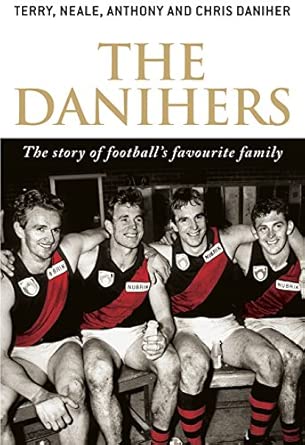
The Danihers: The Story of Football's Favourite Family
Author(s): Terry Daniher (Author)
- Publisher: Allen & Unwin
- Publication Date: 9 Jan. 2010
- Language: English
- Print length: 412 pages
- ISBN-10: 1742373240
- ISBN-13: 9781742373249
Book Description
Editorial Reviews
About the Author
Excerpt. © Reprinted by permission. All rights reserved.
The Danihers
By Terry Daniher, Neale Daniher, Anthony Daniher, Chris Daniher, Adam McNicol
Allen & Unwin
Copyright © 2009 Terry, Neale, Anthony and Chris Daniher and Adam McNicol
All rights reserved.
ISBN: 978-1-74237-324-9
Contents
Introduction: The road to Ungarie,
1 Daniher country,
2 The pride of the district,
3 You play anything when you’re young,
4 Something a bit special,
5 A young bloke coming through,
6 A kid named Terry Daniher,
7 Fair dinkum about footy,
8 A born leader,
9 Knockin’ around with blokes,
10 Making life a bit more interesting,
11 Just another Daniher,
12 The Iceman,
13 The best player in the club,
14 All the glitz and glamour,
15 This time it’s different,
16 Fingers crossed,
17 Loyalty,
18 Following in your brothers’ footsteps,
19 Hard, tough and talented,
20 Pitching in and having a go,
21 Doing the old home town proud,
22 In footy you just get on with it,
23 Grin and cop it,
24 You’re the bloody coach, mate!,
25 A fork in the road,
26 Footy 101,
27 Family ties,
28 A bit of the old, a bit of the new,
29 Sermons laced with hope and energy,
30 Footy sucks sometimes,
31 The new generation,
Football career statistics,
Author’s note,
Acknowledgements,
CHAPTER 1
DANIHER COUNTRY
On the first day of September in 1990, four boys from the bush cemented their place in Australian football folklore. On that early spring afternoon, Terry, Neale, Anthony and Chris Daniher made history by all playing for Essendon in its 6-goal win over St Kilda. Modest blokes, the Danihers never dreamed they would achieve such a feat. After all, in the 93-year history of the VFL and AFL, never before had a quartet of brothers run out in the same team. As the boys sat in the change rooms, ice-packs on their sore limbs, their knockabout demeanour suggested they might have just played for Ungarie at an oval ringed by cars rather than screaming fans. In their country drawl, they said the occasion had been ‘t’riffic’ and a ‘bloody good show’. They had capped a remarkable journey, one that began in Ungarie, their tiny home town, surrounded by Rugby League territory, amid the dusty plains of western New South Wales. But the Danihers were a football family long before Terry, Neale, Anthony and Chris became household names.
In the early part of the 20th century, when the VFL was not two decades old and contained a team called University, a farmer by the name of Jim Daniher dominated matches held in muddy paddocks in north-east Victoria. It was his grandchildren who would bring the family fame.
Jim was a first-generation Australian, and his Catholic faith and Irish ancestry were key parts of his identity. Through stories told by relatives and friends, he knew his father, John Daniher, had been part of an extraordinary exodus. John was just a child when his parents decided to leave their home county of Tipperary. It was the 1860s and the Emerald Isle was a decimated place. The Great Famine, which began 20 years prior, had resulted in the deaths of more than a million people. At least that number fled the country, most to England, the United States and Australia. Before the famine, Ireland’s population had been greater than eight million. Today, despite recent boom times, the total population (counting both the Republic and Northern Ireland) is still only 6.2 million.
Oral history passed down through the generations suggests John Daniher’s father initially worked on the docks in Melbourne before the family acquired a block of farming land near Kyneton. A subsequent dispute over its ownership led to a move north-east, to the tiny community of Miepoll outside Euroa. From there the Daniher history becomes more definite and takes a rather unlikely early turn.
In 1887, John Daniher married Miss Ellen Danaher, herself from a local Irish clan, at St John’s Catholic Church in Euroa. That Ellen’s new surname sounded just like her maiden name certainly turned a few heads. Three years later, she and John welcomed Catherine (known as Kate), the first of their three children. On 22 January 1890, Terry, Neale, Anthony and Chris’s grandfather, Jim, was born. But just as the family prepared for its third addition, John was tragically killed after being thrown from his buggy during a trip back to Miepoll from Euroa. He died at the scene, having broken his neck. Only a few days later John junior (usually referred to as Jack) was born.
Losing the head of the household placed enormous pressure on Ellen. Yet, like so many pioneering women, she possessed an unbreakable will to succeed. With the help of her community she raised the three kids and ensured they would have a positive future. Despite the later departure of her sons, and of Kate when she married farmer Patrick O’Connel, Ellen lived out her days on the property at Miepoll. She died aged 70 in 1948, and left the land to her brother Michael Danaher.
Jim first brought the Daniher name notoriety on the footy field when just a teenager. Tall and wiry, he received at least one best and fairest award while playing with the Longwood Football Club. With no reserves or juniors in those days, it was a case of taking to the field against grown men or not at all. Jim later repeated his success at nearby Euroa, where he won a premiership in 1913.
Around this time, the New South Wales government began opening up large tracts of the Riverina, to be allocated under the Closer Settlement Scheme. Since white settlement, the area had been divided into enormous sheep and cattle properties. Their leases, including that of the 15 000 acre Ungarie Station, were taken back by the government and the land subdivided. Opportunities to settle on the newly surveyed blocks were advertised all over Australia. Inspired by the idea of relocating to the wide open plains, both Jim and Jack entered the ballot for a piece of red Riverina soil. Although some were set aside for servicemen lucky enough to return from the horrors of Gallipoli and the Great War, they were both awarded 740 acre allotments. Neither of them had laid eyes on the place.
Late in 1914 the brothers finally decided to take a look at their new assets. Due to a lack of finances, they took the extraordinary step of making the 485 kilometre journey on bicycles. Pedalling their way up and down hills, over barely made dirt tracks, they took a few weeks to complete the trip. Impressed by what he saw, Jim immediately made plans for a permanent move north. But maybe due to the arduous bike ride, Jack decided it was not the place for him, handing control of his block to Jim and returning to Victoria, where he later joined the police force.
During 1915, Jim settled on the property at Ungarie, which he named ‘Hillview’ in honour of the farm at Euroa which he had left behind. Judging by stories contained in local history books, he would have lived in a rudimentary tent on his own for at least a year while the task of clearing the land began. In between felling the large eucalypt, pine and currajong trees, he constructed the first fences, necessary to prevent his horse from escaping. Given the need to cart water out to the block from the Humbug Creek, 8 kilometres away, the horse was Jim’s most valuable asset.
Along with an enormous workload and the lack of basic provisions — without running water there were no luxuries like showers or plumbed toilets — isolation and loneliness were major problems. As a consequence, the settlers were quick to establish sporting clubs in Ungarie to provide a vital social outlet. Although the tiny town was in Rugby League territory, the great number of expatriate Victorians meant an Australian Rules club was among the first to be established. Jim Daniher played a major role in its formation. According to an obituary published in the West Wyalong Advocate upon his death in 1959, Jim ‘occupied various positions in the club for many years, including that of patron’. He ensured Ungarie adopted black and white for its guernsey after he had worn these colours at Euroa. Pictured in an early team photo in which players are wearing a mixture of horizontal and vertical stripes, Jim was a tall man for his time, his broad shoulders and arms bulked up by days spent bringing down trees with an axe. Legendary for being a great storyteller, he was very popular among the players and would often entertain large numbers of men at the local pub with tales of his many experiences.
Football matches were roughly organised affairs, with teams made up of whoever felt like having a run. Some away games were held close by at now forgotten places like Girral and Calleen. On other occasions the team would travel up to 80 kilometres by horse and cart to take on men from settlements like Lake Cargelligo, while racial tensions were stirred when contests were staged against an Aboriginal side from the Murrumbidgee Reservation. Predictably, Jim Daniher was among Ungarie’s best players in its formative years. He helped them win a premiership in 1923 and the medal he received remains a treasured possession at the family farm. Surviving records from the time note that club membership was five shillings for men and two shillings and sixpence for ladies. Visiting team members and followers paid one shilling at the gate.
Having spent seven years setting up the farm on his own, Jim returned to Euroa after the 1923 footy season to marry Eileen Cullen. The service was held at St John’s Catholic Church where his parents had married. Once the celebrations had wound up, the couple returned to Ungarie and began their life together at Hillview. They had six children in the next nine years. John (once again nicknamed Jack) was born in 1925, followed by Mary in 1927. A year later, the father of Terry, Neale, Anthony and Chris arrived. Named after his father, Jim junior would become a local sporting legend in his own right, as would Leo, born in 1930. The fifth born, Joan, tragically died at three months of age. Terese rounded out the family when she entered the world in 1934.
Despite their new family commitments, the Daniher family continued to strongly support their community. Jim senior’s passion for Aussie Rules saw him play the game well into his forties, on one occasion even running out alongside his oldest son. He also embraced the rival code, serving as president of the Ungarie Rugby League Club. In later life he was a keen lawn bowler. Away from sport, he was a director of the Condobolin Pastures Protection Board for 18 years and a member of the Ungarie Hospital board of directors. Eileen also was active within many groups, among them the Country Women’s Association, the Agricultural Society, and the Patriotic Committee. She was, according to an article in the West Wyalong Advocate, ‘willing to assist every worthy and charitable organisation’.
A devout Catholic, Jim took an active role in building the first church at Ungarie, spending many hours carting timber to the site. When the church was firmly established in the district, he became a close confidant of the local priest. Jim and Eileen later played an active role in welcoming the Sisters of St Joseph when they were invited to set up a convent in the town. The Danihers subsequently helped build a primary school, to be run by the sisters. They did all this while surviving droughts, floods, mouse plagues and dust storms, not to mention trying to make the farm profitable.
Eileen died suddenly on Mother’s Day in 1950, aged just 55. ‘One of the best known and most highly esteemed ladies in the Northern Riverina,’ according to the obituary in the West Wyalong Advocate, her funeral was among the largest in Ungarie’s short history. The article written about her life also provides a glimpse of prevailing attitudes at the time. ‘Despite home ties, Mrs Daniher displayed very commendable interest in public affairs,’ it read. Unfortunately she did not live to see any of her children marry.
Nine years later Jim died, aged 69. A huge number of people attended his funeral, held in the church he helped build. Demonstrating the political leanings of the bush at the time and its broad Catholic support, wreaths were sent by the Temora Electorate Council of the Australian Labor Party and the Ungarie branch of the ALP. Of course, among many others was a floral tribute from the Ungarie Australian Rules Football Club. Jim had claimed the town for the native game. On the field his boys were already bringing local kudos to the Daniher name. And given the players that would emerge in the ensuing decades, the code has plenty to thank him for.
CHAPTER 2
THE PRIDE OF THE DISTRICT
The sons of Jim Daniher senior were a fearsome trio on the football field. Jack, Jim junior and Leo wore Ungarie’s unique black and white horizontal stripes from their early teens until they could barely walk. The boys began their love affair with the game at home on the farm where their father ensured they always had a ball to kick around the paddocks. It was never the finest piece of sporting equipment; mostly it was a leather casing stuffed with barley grass. ‘Well, he never grew a crop so he didn’t have any straw,’ jokes Jim, reminiscing about the time. At school the young lads preached the values of the Victorian game to fellow students more inclined to throwing passes. However, by growing up on the footy frontier where Rules and League met head-on, they had no option but to become proficient at both codes.
All the boys attended the Eugalong Primary School, a tiny building located close to Hillview. Later they attended Ungarie Central for a time, although Jack and Jim went on to further their education at the Forbes Catholic College. By the time football could resume in the Northern Riverina following World War II, all three brothers had finished school and returned to the family farm, although Jack would later move into town and pursue a new career as a shearer.
In 1946, when Ungarie’s team took the field for the first time in five years, the Danihers immediately established themselves as key players. In particular, Jim became the one to watch. The tallest of the trio, he was skilful, could play in any position and was renowned for his toughness. Having suffered a broken arm one season he asked the league if he could play with a cast on. When the response was no, he insisted on getting the plaster taken off each weekend so he could play. He ran around for the afternoon with the broken bone shielded by a few bandages. Upon finishing the game Jim would get the doctor to set him a new cast.
The club secretary of the time was captivated by the uniform worn by Ganmain players at a knock-out carnival. ‘They had the white shorts and a red jumper with a white V,’ Jim remembers. ‘They had all the same guernseys and all the other teams had stray guernseys.’ Desperate to smarten up his team’s on-field appearance, the secretary decided Ungarie should ditch its black and white colours. He ordered two new sets of red and white jumpers. ‘But he got it wrong,’ Jim continues. ‘Instead of being red and a white V they were white with a red V. The bloody red V ran into the jumpers. They used to call us the galahs!’ Given Jim’s appetite for a contest, few of his opponents dared rib him on field about Ungarie’s pink jumpers.
With the Danihers making their presence felt, Ungarie was competitive but couldn’t stop arch-rivals Tullibigeal, a fellow bunch of farmers and labourers from 40 kilometres north, winning three successive flags. In 1949, West Wyalong entered the Northern Riverina League and brought with it the Griff Evans Cup, to be awarded to the competition’s best-and-fairest player each season. Now an established local footy star, Jim won the cup in its first year and the Daniher name has since been engraved on a further nine occasions. Leo took it home in 1951.
Once again wearing black and white stripes, Ungarie finally broke its 15-year premiership drought in 1950. It was the first of many flags for the Daniher brothers. ‘We had a big fella playing full-forward, Norman Stidwell,’ Jim says. ‘He was like a draughthorse and he could not turn. Anyhow, we were neck and neck and it rained at three-quarter time, poured. We were into the last quarter, about half way through it. The ball came up and Norm came out to the flank, grabbed the ball. He was a strong, big bugger. He ran over about two fellas and he was going crossways across the field. He threw the ball on his boot and it went straight up and through the goals. That was the turning point of the game. Never forgot that.’
Celebrations involved warm beer (fridges were an unaffordable luxury) and a dance at the local hall. The Danihers were all among the most influential players.
Footy in the Northern Riverina was still rough and ready. Teams rarely trained. Given they all did plenty of manual labour, and the game was played at walking pace compared with today, fitness was not really an issue. Occasionally the boys would get together on a Wednesday evening and let fly with a few drop kicks. Ungarie players travelled to away games along potholed roads, standing up in the back of a truck. The starting time of the matches would vary according to the standard of each side’s transport. One week Ungarie’s truck broke down and it was 4 pm before the team arrived at its destination. A game consisting of 10-minute quarters was played, finishing in near-darkness. In later years the Ungarie boys enjoyed the relative luxury of a school bus, in which they all had a seat for the journey.
Playing fields were often marked out in a paddock. In wet years the Ungarie ground would become waterlogged and unplayable so the men would simply find a piece of higher ground in a paddock close by and mark out an oval there. Jim reckons Ungarie held matches in every paddock that adjoined the town. Away games were played on all sorts of surfaces. The patch of dirt used by the Four Corners Football Club was one of the finest examples. Flying High, a publication released for Four Corners’ fiftieth anniversary in 1987, gives an insight into its history:
Much time was spent by local men at organised working bees to prepare an oval. First they cleared the timber, which sometimes had to be cut off below ground level. This was very hard work as the dirt had to be removed from around stumps with a pick and shovel. All the fallen timber was stacked and burnt after the completion of the clearing. Then the whole area was harrowed to loosen and even out the ground. A single furrow plough, drawn by a draughthorse, marked the line of the boundary.
(Continues…)Excerpted from The Danihers by Terry Daniher, Neale Daniher, Anthony Daniher, Chris Daniher, Adam McNicol. Copyright © 2009 Terry, Neale, Anthony and Chris Daniher and Adam McNicol. Excerpted by permission of Allen & Unwin.
All rights reserved. No part of this excerpt may be reproduced or reprinted without permission in writing from the publisher.
Excerpts are provided by Dial-A-Book Inc. solely for the personal use of visitors to this web site.