 Wow! eBook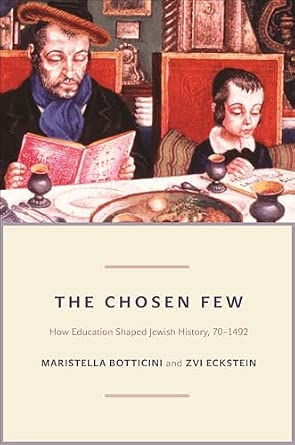
The Chosen Few: How Education Shaped Jewish History, 70-1492 (Princeton Economic History of the Western World): 42
Author(s): Maristella Botticini (Author), Zvi Eckstein (Author)
- Publisher: Princeton University Press
- Publication Date: 2 Aug. 2012
- Edition: Illustrated
- Language: English
- Print length: 344 pages
- ISBN-10: 0691144877
- ISBN-13: 9780691144870
Book Description
Editorial Reviews
Review
“[E]ventually,
The Chosen Few will have changed the course of history in the Middle East . . . as part of a broad reinterpretation of the history of the peopling of the world, underway for a century and a half, that has begun gathering force since the 1990s. . . . This may be the first you have heard about The Chosen Few, but I pretty much guarantee you that it will not be the last.”—David Warsh, Economic Principals“[P]rovocative.”– “Choice”
“[W]here so many have simply taken as a given universal literacy among Jews, [Botticini and Eckstein] find that a majority of Jews actually weren’t willing to invest in Jewish education, with the shocking result that more than two-thirds of the Jewish community disappeared toward the end of the first millennium. . . . The astonishing theory presented here has great implications for both the Jewish community and the broader world today.”
—Steven Weiss, Slate“Botticini and Eckstein’s simple yet sophisticated human capital analysis provides new insights into Jewish history for the fourteen centuries covered in this book. . . . [Their] methodology yields a very convincing Cliometric analysis that we can expect to inform all future economic histories of the Jews between 70 and 1492.”
—Carmel U. Chiswick, EH.net“I found
The Chosen Few, a book on Jewish economic history by Maristella Botticini and Zvi Eckstein, enormously enlightening and relevant to the draft-the-Haredim debate.”—Shlomo Maital, Jerusalem Report“If you’ve ever wondered how the Chosen People survived the vagaries of history, reading
The Chosen Few will give you answers you cannot find anywhere else.”– “Huffington Post”“One of Jewish Ideas Daily.com’s 40 Best Jewish Books of 2012”
“This is a trailblazing, original, illuminating and horizon-broadening book.”
—Manuel Trajtenberg, Haaretz“Winner of the 2012 National Jewish Book Award in Scholarship”
From the Inside Flap
“Maristella Botticini and Zvi Eckstein have written a remarkably interesting book with a new hypothesis about the occupational structure of the Jews. The authors adduce serious evidence for their hypothesis, which lays stress on the requirement introduced nearly 2,000 years ago for universal male literacy among the Jews. This is a fascinating and persuasive combination of history and economics, worth reading by all, even the unhappy few who like neither history nor economics.”–Stanley Fischer, governor of the Bank of Israel
“The Chosen Few is a masterpiece: an ambitious, informed, and inspirational reinterpretation of Jewish social and economic history.”–Avner Greif, Stanford University
“In this bracing work of economic history, Maristella Botticini and Zvi Eckstein demonstrate how literacy and contract law combined to give Jews a competitive advantage in urbanizing societies. Sure to generate controversy,The Chosen Few takes on one of the truly big questions in Jewish history and sheds intriguing new light on it.”–David Biale, University of California, Davis
“Botticini and Eckstein are changing the way economic historians think about Jewish history, and this seminal book will also change the way historians, Jewish studies scholars, and general readers think about the subject. Indeed, the importance of this book can scarcely be exaggerated. An excellent example of economic history that is accessible to general readers,The Chosen Few makes a compelling case for an exciting new perspective that will inspire much further research and be the focus of attention for years to come.”–Carmel Chiswick, George Washington University
“This is a mature, original, and significant new attempt to answer one of the most vexing problems in Jewish and economic history. For the general reader it provides an incisive view of the salient facts of Jewish economic history. For the economic historian it opens up a challenging new thesis. And for historians of Judaism and religion it provides a new interpretation of the social and economic impact of religion.”–Michael Toch, Hebrew University of Jerusalem
From the Back Cover
“Maristella Botticini and Zvi Eckstein have written a remarkably interesting book with a new hypothesis about the occupational structure of the Jews. The authors adduce serious evidence for their hypothesis, which lays stress on the requirement introduced nearly 2,000 years ago for universal male literacy among the Jews. This is a fascinating and persuasive combination of history and economics, worth reading by all, even the unhappy few who like neither history nor economics.”–Stanley Fischer, governor of the Bank of Israel
“The Chosen Few is a masterpiece: an ambitious, informed, and inspirational reinterpretation of Jewish social and economic history.”–Avner Greif, Stanford University
“In this bracing work of economic history, Maristella Botticini and Zvi Eckstein demonstrate how literacy and contract law combined to give Jews a competitive advantage in urbanizing societies. Sure to generate controversy, The Chosen Few takes on one of the truly big questions in Jewish history and sheds intriguing new light on it.”–David Biale, University of California, Davis
“Botticini and Eckstein are changing the way economic historians think about Jewish history, and this seminal book will also change the way historians, Jewish studies scholars, and general readers think about the subject. Indeed, the importance of this book can scarcely be exaggerated. An excellent example of economic history that is accessible to general readers, The Chosen Few makes a compelling case for an exciting new perspective that will inspire much further research and be the focus of attention for years to come.”–Carmel Chiswick, George Washington University
“This is a mature, original, and significant new attempt to answer one of the most vexing problems in Jewish and economic history. For the general reader it provides an incisive view of the salient facts of Jewish economic history. For the economic historian it opens up a challenging new thesis. And for historians of Judaism and religion it provides a new interpretation of the social and economic impact of religion.”–Michael Toch, Hebrew University of Jerusalem
About the Author
Excerpt. © Reprinted by permission. All rights reserved.
The Chosen Few
How Education Shaped Jewish History, 70–1492By Maristella Botticini Zvi Eckstein
PRINCETON UNIVERSITY PRESS
Copyright © 2012 Princeton University Press
All right reserved.
ISBN: 978-0-691-14487-0
Contents
List of Illustrations…………………………………………………………………………….xiList of Tables…………………………………………………………………………………..xiiiPreface…………………………………………………………………………………………xvIntroduction…………………………………………………………………………………….1Chapter 1 70 CE–1492: How Many Jews Were There, and Where and How Did They Live?…………………..11Chapter 2 Were the Jews a Persecuted Minority?………………………………………………………52Chapter 3 The People of the Book, 200 BCE–200 CE……………………………………………….66Chapter 4 The Economics of Hebrew Literacy in a World of Farmers………………………………………80Chapter 5 Jews in the Talmud Era, 200–650: The Chosen Few……………………………………….95Chapter 6 From Farmers to Merchants, 750–1150………………………………………………….124Chapter 7 Educated Wandering Jews, 800–1250……………………………………………………153Chapter 8 Segregation or Choice? From Merchants to Moneylenders, 1000–1500………………………..201Chapter 9 The Mongol Shock: Can Judaism Survive When Trade and Urban Economies Collapse?…………………248Chapter 10 1492 to Today: Open Questions……………………………………………………………261Appendix………………………………………………………………………………………..274Bibliography…………………………………………………………………………………….287Index…………………………………………………………………………………………..317
Chapter One
70 CE–1492
HOW MANY JEWS WERE THERE, AND WHERE AND HOWDID THEY LIVE?
Ours is not a maritime country; neither commerce nor the intercourse which it promotes with the outside world has any attraction for us. Our cities are built inland, remote from the sea, and we devote ourselves to the cultivation of the productive country.
—Flavius Josephus, c. 96 CE
The Route of the Jewish Radhanite merchants, who speak Arabic and Persian and Rumi (Greek), and Ifranji (Latin) and Andalusi (Spanish) and Slavic. They travel from [the] east to [the] west and from the west to the east, by land and by sea…. They transport from China…. sometimes they turn to Constantinople with their merchandise …; sometimes they travel with it to the king of Firanja (Frankish Kingdom) and sell it there. And if they wish, they transport their goods from Firanja … to Baghdad, and from there … to Sind and to Hind and to China.
—Ibn Khordadbeh, c. 850
Spin a globe, wait for it to stop, then put your finger on the first place you see. A Jewish community is likely to have lived there, in the ancient past or in recent times. Jews have lived in so many places, in such vastly diverse political, economic, and religious environments, that their history is difficult to summarize in multiple volumes, much less a single chapter. Familiarity with the basic facts of Jewish history from the destruction of the Second Temple in Jerusalem to the mass expulsion of the Jews from the Iberian Peninsula is critical, however, to understanding why the Jewish people came to share certain characteristics. In this chapter, we therefore illustrate and examine Jewish population and occupational trends.
For centuries, Jews lived in Judea, Samaria, and the Galilee—the three main regions in the Land of Israel. The center of Jewish religious practice was the Temple in Jerusalem, erected during the tenth or ninth century BCE. In 586 BCE, the Babylonian army demolished it under the leadership of King Nebuchadnezzar II during the military campaign to expand his empire and deported a number of Jews from Judea to Mesopotamia, particularly to its capital, Babylon (map 1.1). This marked the end of the First Temple period.
The Babylonian exile brought a number of pivotal changes, including the emergence of the central role of the Torah in Jewish life and the rise of scribes and sages as Jewish leaders. The Written Torah consisted of the Five Books of Moses (Genesis, Exodus, Leviticus, Numbers, and Deuteronomy). In 538 BCE, the Persian emperor Cyrus, who had conquered Mesopotamia, issued an edict permitting the Jews to return to Judea and rebuild the Temple in Jerusalem. Nearly 40,000 Jews returned to the Land of Israel in subsequent waves of migrations. A large number of Jews, though, remained in Mesopotamia, which in the following centuries hosted one of the largest and most prominent Jewish communities in the Diaspora—that is, outside the Land of Israel.
The reconstruction of the Temple took about twenty years; its dedication in 515 BCE initiated the period of the Second Temple. In the following four centuries, the Land of Israel fell under the control of the Hellenistic ruler Alexander the Great, the Ptolemaic dynasty ruling over Egypt, and the Hellenistic Seleucid dynasty. During this era, especially in the later part, generations of prophets, scholars, and high priests studied, clarified, and supplemented the Written Torah. Their discussions, judgments, and rulings are called the Oral Torah, which together with the Written Torah would form the backbone for the entire body of Jewish law (halakha) in the subsequent centuries. The halakha sanctioned what a Jew could and could not do, as well as what a Jew should and should not do, in every aspect of daily life—from the observance of religious and ritualistic duties to marital relations, from behavior within the community to civil and criminal law.
The Greeks granted the Jews a kind of communal autonomy as well as religious freedom, which was interrupted by a persecution around 167 BCE, which in turn precipitated a Jewish revolt. From 140 BCE, Judea enjoyed a period of freedom for almost a century under the Hasmonaean dynasty (map 1.2). In 63 BCE, Roman influence and then dominion over the region began. Rome, however, granted the Jews religious autonomy and bestowed on them some judicial and legislative rights through the Sanhedrin in Jerusalem, which functioned as a parliament, a high court, and an academy (yeshiva).
The Second Temple period came to a traumatic end in 70 CE. This is when our book starts. The focus is on three periods, each marked by a “historical accident”: the destruction of the Second Temple by the Roman army during the first Jewish-Roman war (also known as the Great Revolt); the rise of Islam during the seventh century, with the subsequent establishment of one of the largest, most urban, and most commercial empires in history; and the Mongol conquest of Mesopotamia and Persia during the early and mid-thirteenth century, which contributed to the collapse of the urban and commercial economy of the Abbasid caliphate. These exogenous events interacted with the internal dynamics of the Jewish religion to shape the unique demographic and economic traits that characterize the history of the Jews before 1500.
From Jesus to Muhammad (1 CE–622): A World of Farmers
Who was a Jew during the Second Temple period? Up to the destruction of the Second Temple, the daily lives of the Jews were similar to those of non-Jews: they dressed alike, spoke the same local languages (Aramaic, Hebrew, or Greek), and earned their living from the same occupations (mainly farming). As in other religions, including pagan cults, the central feature of Jewish religious life consisted of temple service and ritual sacrifices performed by a small elite of high priests.
Jews differed from pagans in three major ways: they believed in one God; their religious, social, and economic life was shaped by the Torah; and they practiced male circumcision, ate kosher food, and observed the Sabbath. During the later part of the Second Temple era (300 BCE–65 CE), Judaism witnessed the emergence of a variety of sects (Sadducees, Pharisees, Essenes, Samaritans, Zealots, Sicarii), increasingly differentiated by their religious norms. Christianity also grew within Judaism in the early decades of the first century. All of these Jewish sects shared the three features that distinguished them from pagan cults. Hence, up to 70 CE, all of these people are considered to be Jews. Later, especially after 200, the answer to “who is a Jew” changed drastically (see chapters 3 and 5).
Jewish Demographic Collapse
Estimates of the Jewish population in ancient times are at best crude approximations. Salo Baron, one of the most eminent scholars of Jewish history, puts the number at about 8 million on the eve of the first Jewish-Roman war, in 65 CE. Sergio DellaPergola, one of the leading scholars of Jewish demography, estimates the Jewish population in the first century BCE at 4.5 million and in the first century CE at a number between 4 and 5 million (table 1.1). Other prominent scholars, such as Magen Broshi, Gildas Hamel, and Seth Schwartz, have proposed even lower estimates, arguing that world Jewry in the early first century CE amounted to no more than 2–2.5 million. We agree with DellaPergola’s estimates, and for 65 CE, we propose an estimate of 5–5.5 million Jews—about 9–10 percent of the population of the Persian Empire in the East and the entire Roman Empire.
How were these 5–5.5 million Jews distributed geographically on the eve of the first Jewish-Roman war? The largest Jewish population was the one in the Land of Israel, where about 2.5 million Jews, including 300,000 Samaritans, lived. Two types of communities coexisted side by side. The coastal areas hosted Hellenistic towns, in which Greek was the main spoken language; the Galilee (in the north), the Jordan Valley, and South Judea hosted Jewish communities that spoke mainly Aramaic. A relatively peaceful political situation and good economic conditions during the Hasmonaean period (140–63 BCE), as well as a wave of conversions of pagans to Judaism in the 200 years before the destruction of the Second Temple, likely contributed to the growth of the Jewish population in the Land of Israel, which by 65 CE was larger than it had ever been before.
The other major Jewish population centers were North Africa under Roman rule and Mesopotamia under Parthian dominion. About 1 million Hellenistic Jews lived in North Africa (mainly in Egypt) in the early decades of the first century CE. In the same period, roughly 1 million Aramaic-speaking Jews lived in the Parthian Empire, which ruled Mesopotamia and Persia.
Jews also dwelled all over the vast Roman Empire. Circa 65 CE, the region corresponding to Syria and Lebanon likely hosted 200,000–400,000 Jews. Similarly, Asia Minor (the area corresponding roughly to modern-day Turkey) and the Balkans (Albania, Bulgaria, Greece, and the former Yugoslavia) was home to 200,000–400,000 Jews. Another 100,000–200,000 Jews likely lived in western Europe (especially central and southern Italy, France, and the Iberian Peninsula). Cities with large Jewish communities included Rome, Corinth, Ephesus, Antioch, and Damascus.
However many Jews there were on the eve of the first Jewish-Roman war, all scholars concur that the Jewish population was beginning a steep decline. By the time of Muhammad, in the early seventh century, world Jewry added up to no more than 1–1.2 million people, 1.9–2.3 percent of the total population in the regions in which they lived (figure 1.1).
Jewish communities in the Land of Israel, North Africa, Syria, Lebanon, Asia Minor, the Balkans, and western Europe had shrunk to no more than a few thousand people. The only Jewish community that remained fairly stable was in Mesopotamia (and to a lesser extent Persia), which, by the time of Muhammad, had become the center of Judaism and home to nearly 75 percent of world Jewry.
What accounts for the staggering drop of world Jewry over these six centuries? Did war-related massacres and a general dwindling of the population make the Jewish population decline? Or did something else cause the number of Jews in the world to fall by nearly 80 percent?
THE LAND OF ISRAEL
The Jewish population of Judea waged two major rebellions against the Roman Empire in the first and second centuries. The first Jewish-Roman war was sparked by a combination of religious tension and economic motives at the time that Judea became a Roman province, at the very beginning of the first century. Abuses in tax collection and the establishment of the Roman census in Judea, the theft of a large amount of money from the Temple treasury by the Roman procurator Gessius Florus, and interference with religious matters (such as the appointment of the high priest or the imperative to build statues of the Roman emperor Caligula in temples throughout the empire) all helped increase the popularity of the sect of the Zealots, who incited their fellow Jews to revolt in order to attain political and religious independence.
The revolt began in 66 CE in the town of Caesarea, apparently provoked by the failure of the Roman garrison stationed there to intercede to stop Greeks from sacrificing birds in front of a local synagogue. During the initial stages of the war, the rebels defeated the Romans.
The rebels’ fortunes changed when Emperor Nero appointed General Vespasian as head of Roman forces in the Land of Israel. In 67 CE, with nearly 60,000 professional soldiers under his command, Vespasian crushed the rebellion in the Galilee by conquering Jewish strongholds such as Gamla and Jotapata, where Flavius Josephus (henceforth Josephus), the military commander of the Jewish army, was taken prisoner. Vespasian then headed toward Jerusalem, to which the leaders of the revolt had fled and where they began preparing for the siege. While these events were unfolding, Nero’s death, in 68 CE, prompted Vespasian to return to Rome, where the political situation was precipitating a civil war. With the death of Otho and Galba and the subsequent defeat of Vitellius, Vespasian was proclaimed emperor on December 21, 69 CE, in what became known as the “Year of the Four Emperors.”
To put down the revolt in Judea, Vespasian sent his son Titus, who led the final siege and assault. Titus’s decision was to quickly give the final blow to Jerusalem instead of waiting and starving the population out. Internal fights among the Zealots and the Sicarii, who wanted to keep fighting, and Jews, including many Pharisees, who wanted to surrender to the Romans, contributed to seal the fate of Jerusalem. The war ended when Titus’s Roman legions entered and destroyed Jerusalem, looted and then burned the Temple, and massacred a large part of the Jewish population. Even if one does not take at face value the report of the Roman historian Tacitus, who reported that at least 600,000 Jews died during the first Jewish-Roman war, the number of casualties was certainly very high. Although some Jews were taken to Rome as slaves (as depicted on the Arch of Titus), there is no evidence of mass deportations or forced migrations of the Jewish population to Rome after the Great Revolt.
The first Jewish-Roman war profoundly altered the balance of power among the various Jewish religious groups. The Sadducees, the wealthy elite that dominated the Temple cult, lost their source of wealth and power. The Zealots and the Sicarii, the major instigators and supporters of the rebellion, were exterminated during the sieges of Jerusalem and of the fortress of Masada three years later. In contrast, the sect of the Pharisees to which leading scholars and sages in the academies in Jerusalem belonged, did not participate in the war. They survived the massacres and emerged as religious and political leaders. One of the key figures was Rabbi Johanan ben Zakkai, who received permission from the Romans to reconstitute the Sanhedrin in the coastal town of Jabneh, which became the most important center of Jewish learning until 135. The new Jewish leadership consisting of teachers, scholars, and rabbis replaced temple service and ritual sacrifices with learning and the study of the Scriptures.
The conclusion of the first Jewish-Roman war reinforced Roman dominion over Judea and other areas along the Mediterranean and in the Middle East. Emperor Trajan increased the pressure on the Jews, which precipitated the Diaspora revolt in 115 that was put down in 117. The second Jewish-Roman war in the Land of Israel—also known as the Bar Kokhba revolt, after the name of its leader, Simon bar Kokhba—broke out in 132 upon the departure for Greece of the Roman emperor Hadrian, who had spent three years in the Land of Israel. The Roman historian Cassius Dio—the main source of information about this event—maintains that the rebellion was fueled by several repressive edicts, including one against circumcision. According to him, the spark that ignited the revolt was Hadrian’s decision to construct a new city in Jerusalem, called Aelia Capitolina (after his own name, Aelius), in which a temple in honor of Jupiter Capitolinus was to be erected. Unlike the Great Revolt, which the Pharisees opposed, the second Jewish-Roman war was led by the Pharisees, including the head of the Sanhedrin, Rabbi Akiva, who proclaimed Bar Kokhba the Jewish Messiah.
The first phase of the revolt was successful. The Jews seized towns, which they fortified, and inflicted severe losses on the Romans, decimating an entire legion (Legio XXII Deiotariana). Emperor Hadrian reacted to this debacle by sending several legions under the command of one of his most capable generals, Julius Severus, who arrived from Britain. Severus surrounded the Jewish fortresses and defeated the rebels, following a three-and-a-half-year war. Cassius Dio reports that the Romans demolished fifty fortresses, destroyed hundreds of villages, and killed about 580,000 people. Although his estimate of the number of people killed is likely a vast exaggeration, the massacre was a major one. The Talmud (Tanit 4:5) notes that the Romans killed so many Jews “that the blood reached their horses’ noses.” Rabbi Akiva and other Jewish religious leaders were executed.
Judea ceased to exist as an independent state, becoming the Roman province of Syria Palestina. The Jewish center of gravity moved north to the Galilee, as did the hub of Jewish learning. The academy of Jabneh moved to Usha, then to Shefaram, Bet Shearim, Sepphoris, Caeasarea, and Tiberias. It is in these academies that the Tannaim and, later, the Amoraim, codified the two fundamental texts of Jewish law: the Mishna (c. 200) and the Talmud of the Land of Israel (350–400), also known as Jerusalem Talmud or Talmud Yerushalmi. Both the Tannaim and the Amoraim considered the uprising against Rome a terrible mistake by the Jewish leadership. The list of religious holidays sanctioned in the Mishna includes no commemoration of the Bar Kokhba revolt.
(Continues…)
Excerpted from The Chosen Fewby Maristella Botticini Zvi Eckstein Copyright © 2012 by Princeton University Press. Excerpted by permission of PRINCETON UNIVERSITY PRESS. All rights reserved. No part of this excerpt may be reproduced or reprinted without permission in writing from the publisher.
Excerpts are provided by Dial-A-Book Inc. solely for the personal use of visitors to this web site.


