Wow! eBook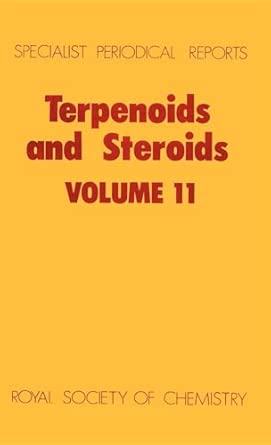
Terpenoids and Steroids: Volume 11 Edition. ed. Edition
Author(s): James R Hanson
- Publisher: Royal Society of Chemistry
- Publication Date: 1 Jan. 1982
- Edition: Edition. ed.
- Language: English
- Print length: 254 pages
- ISBN-10: 9780851863467
- ISBN-13: 0851863469
Book Description
Reflecting the growing volume of published work in this field, researchers will find this book an invaluable source of information on current methods and applications.
Editorial Reviews
About the Author
Professor Hanson is Emeritus Professor of Chemistry at the University of Sussex.
Excerpt. © Reprinted by permission. All rights reserved.
Terpenoids and Steroids Volume 11
A Review of the Literature Published between September 1979 and August 1980
By J. R. Hanson
The Royal Society of Chemistry
Copyright © 1982 The Royal Society of Chemistry
All rights reserved.
ISBN: 978-0-85186-346-7
Contents
Part I Terpenoids,
Chapter 1 Sesquiterpenoids By J. S. Roberts, 3,
Chapter 2 Diterpenoids By J. R. Hanson, 91,
Chapter 3 Triterpenoids By R. B. Boar, 110,
Chapter 4 Carotenoids and Polyterpenoids By G. Britton, 133,
Part II Steroids,
Chapter 1 Physical Methods By D.N. Kirk, 165,
Chapter 2 Steroid Reactions and Partial Syntheses By B. A. Marples Section A: Steroid Reactions, 187,
Author Index, 229,
CHAPTER 1
Part I
TERPENOIDS
1
Sesquiterpenoids
BY J. S. ROBERTS
1 Farnesane
The continuing search for new marine natural products has led to the discovery of the farnesic acid glycerides (1) — (3) in the nudibranch Archidoris odhneri and the two hydrocarbons (4) and (5) from the gorgonian Plexaurella grisea Kunze. Other new farnesyl/nerolidyl sesquiterpenoids include (6)–(11) and the interesting acetal eremoacetal (12) from Eremophila rotundifolia.
Epi-7-hydroxymyoporone (13) has been synthesized by a route which makes use of the dianion (14) as a crucial intermediate. Dendrolasin (15) has been prepared by reaction of homogeranyl iodide with lithium di-(3-furyl)cuprate.
β-Sinensal (18) and β-farnesene (19) have both been synthesized from the thioncarbamate (16), which undergoes a [3,3] sigmatropic rearrangement to produce the allylic thiolcarbamate (17) (Scheme 1). The Grignard reagent from homogeranyl bromide has been added to 3-methyl-β-propiolactone in the presence of copper(1) iodide to produce dihydrofarnesic acid (20) which could be elaborated in two steps to farnesol.
One mechanism which has been advanced for the 1’–4 condensation between isopentenyl pyrophosphate and an allylic pyrophosphate is that shown in Scheme 2. This mechanism involves an enzyme-assisted coupling with nucleophilic attack at C-3 followed by a subsequent elimination reaction. By using 2-ftuoroisopentenyl and 2,2-diftuoroisopentenyl pyrophosphate as substrates Poulter and Rilling sought to intercept an X-containing intermediate (either bound or unbound to avian liver farnesyl pyrophosphate synthetase). In neither case was this detected and hence it is suggested that the X-group mechanism is an unlikely process (see Ref. 12 for a comprehensive review of allylic pyrophosphate metabolism). In a continuing investigation of the substrate specificity of farnesyl pyrophosphate synthetase, Ogura et al. have studied the enzyme-catalysed condensation of homologues of isopentenyl pyrophosphate (21) with dimethylallyl and geranyl pyrophosphate. As a result of varying the parameters R1 — R3 and n, it has been shown that for pig liver farnesyl pyrophosphate synthetase R1 can be Me or Et, R2 and R3 can be H, Me, or Et, R1 and R2 can be part of a five- or six-membered ring system, and n should be 1 or 2.
A method for the asymmetric synthesis of R-(-)-[1- R2H]farnesol has been described, based on the reduction of [1-2H]farnesal with the optically active hydride reagent (22). The cyclic analogue (23) of juvenile hormone-II has been synthesized starting from R-(+)-limonene. This compound is less active than the natural hormone.
2 Mono- and Bi-cyclofarnesane
Full details of the structural determination of nigakialcohol (24) have been published. Co-occurring with aplysistatin (25) in Laurencia cf. palisada Yamada are the marine sesquiterpenoids palisadin A (26) and B (27), 5- acetoxypalisadin B (28), 12-hydroxypalisadin B (29), and palisol (30). 3β-Bromo-8-epi-caparrapi oxide (32) has been synthesized by a procedure which involves brominative cyclization of the hydroxy-ester (31) as a key step. The marine sesquiterpenoid (33), in which a methyl migration has taken place, has been synthesized in four steps. All eight racemic diastereoisomers of the marine metabolite dactyloxene-B have been synthesized and this work shows that natural dactyloxene-B has the relative configuration (34) whereas dactyloxene-C is considered to be (35). Interestingly all eight compounds have individually different odours. In a related area of olefaction eight stereoisomeric sesquirose oxides, which have yet to be discovered in nature, have been synthesized. These compounds correspond to the eight possible stereoisomers (36) according to the chiralities at C-2 and C-4 and to the E/Z configuration of the Δ-double bond. The same authors have also methodically synthesized eighteen sesquiter-penoid theaspirane derivatives, of which (37)–(39) are representative examples.
New drimane sesquiterpenoids include polyonal (40), isodrimeninol (41) (from the seeds of Polygonum hydropiper), uvidin A (42), uvidin B (43) (from Lactarius uvidus Fries), and 7 α, 8β,11-trihydroxydrimane (44) (from Fomes annosus). Three new indolosesquiterpenoids, polyavolensin (45), polyavolensinol (46), and polyavolensinone (47), have been identified in the stem extract of Polyathia suaveolens.
A second synthesis of the marine sesquiterpenoid pallescensin A (49) has been achieved by acid-catalysed cyclization of the furanodiene (48). Continued interest in the synthesis of warburganal (52) has resulted in two very similar syntheses (Scheme 3). In both cases the troublesome step was the homologation of the bicyclic keto-aldehyde (50). In Kende’s synthesis this was solved by using the Magnus reagent, lithium methoxy(trimethylsilyl)methylide, which ultimately led to both warburganal (52) and isotadeonal (51). In the other synthesis by Goldsmith the extra carbon was introduced by methyl-lithium followed by dehydration with the Burgess reagent. Additional routes to confertifolin (53), isodrimenin (54), in namodial (55), and cinnamosmolide (56) have also been reported.
The dihydro-derivative (58) of the unique sesquiterpenoid spiniferin-1 (57), which incorporates the novel 1,6-methano[10]annulene skeleton, has been synthesized (Scheme 4) and this confirms beyond doubt its precise structure.
3 Bisabolane
New bisabolane sesquiterpenoids include (59), (60), and the perezone derivatives (61)–(63). Based on mass spectral evidence structures (64) and (65) have been assigned to two minor constituents of Chinese cinnamon oil; both ketones have been synthesized from α-curcumene. Dihydroxydeodactol (66), a derivative of deodactol, has been isolated from the mollusc Aplysia dactylomela. A related metabolite, 8-desoxy-isocaespitol (67), is a minor constituent of the marine alga, Laurencia caespitosa. This compound has been synthesized from farnesol acetate in low yield (Scheme 5).
A careful study of the mechanism of the oxy-Cope rearrangement of 1,5-diene alkoxides has provided a neat synthesis of erythro-juvabione (68) (Scheme 6). This work has shown that the (3,3] sigmatropic process proceeds in a concerted fashion predominantly via a chair transition state.
A number of relatively short and straightforward syntheses of bisabolane sesquiterpenoids have been reported ; these include E- and Z-α- bisabolene, (69) and (70) (together with the isopropenyl analogues), α-curcumene (71), β-curcumene (72), ar-turmerone (73), iso-α-curcumene (74), and delobanone (75). Last year a synthesis of (-)-α-bisabolol (76) was reported in which intramolecular 1,3-dipolar addition of a nitrone of 6Z-farnesal was used as a key step (Vol. 10, p. 13). This route has been achieved independently, thus confirming the structure of abisabolol. Compound (77) and its oxidation product (78) have been prepared from R-(+)-citronellal; the former is the enantiomer of a naturally occurring enone and the latter is identical to a metabolite from the plant Lasianthaea podocephala and the coral Pseudop-terogorgia rigida.
4 Sesquipinane, Sesquicamphane
The two α-santalene derivatives (79) and (80) are constituents of the aerial parts of A ya pana amygdalina. (+)-Epi-cis-β-santalol (81) has been identified as a new minor component of East Indian sandalwood oil. Treatment of (+)-α-santalyl acetate (82) with hydrogen chloride followed by dehydrochlorination with basic alumina produces a mixture of β-santalyl acetate (83) and the acetate of (81). Last year Christenson and Willis reported the acid-catalysed rearrangement of (84) to give (85) (Vol. 10, p. 18). In an attempt to intercept the rearranged cationic intermediates in this process, the rearrangement has now been carried out in the presence of acetonitrile. Three bicyclic ester-amides (86)–(88) were isolated after esterification. The major isomer (86) undergoes a retro-Ritter reaction with toluene-p-sulphonyl chloride in pyridine to produce the esters (89) and (90) in a ratio of 23 : 2. The ester (89) serves as a useful precursor to epi-β-santalene (91), epi-cis-β-santalol (81), epi-trans-β-santalol (92), and dihydroepi-β-santalol (93), and (90) can be converted into α-santalene (94).
5 Cuparane, Laurane, Trichothecane
A short synthesis of the ketone (95) has been reported and this constitutes a formal synthesis of cuparene (96), since (95) has been converted into (96) previously. As an alternative strategy to the cuparane skeleton a three-carbon annulation process has been applied to the synthesis of cuparenone (99) (Scheme 7).50 A more direct approach involving an initial Diels–Alder reaction between (97) and the olefin (100) failed because of steric hindrance. Another synthesis of the cuparenone precursor (98) involves Friedel–Crafts acylation of E-1-trimethylsilyl-2-(4-methylphenyl)ethene with β,β-dimethylacryloyl chloride in the presence of aluminium chloride to afford (101). Acid-catalysed cyclization of (101) with boron trifluoride etherate produces the enone (98) in rather low yield. Reduction of the tosylhydrazone of the aldehyde (102) with catecholborane followed by treatment with sodium acetate yields both laurene (103) and it epimer (104) in the ratio of 65:35.
The red algal genus Laurencia is a rich source of halogenated sesquiter penoids. Further work in this area has resulted in the identification of the first examples of iodinated sesquiterpenoids, namely the laurene derivatives (105) and (106) which co-occur with (107). The Japanese varieties of Laurencia are also well endowed with related compounds as revealed by the isolation of (108)–(112), the first three being metabolites of L. glandulifera Kutzing and the last two being extracted from L. okamurai Yamada.
Both (-)-aplysin (117) and (-)-debromoaplysin ( 116) have been synthesized (Scheme 8).57 The initial step involves the coupling of the chlorocyclopentenone (114) with the optically active metalated bromo-ether (113), which was derived from (+)-α-pinene. This reaction produces (115) together with the diastereoisomeric chlorohydrin. In another synthesis of aplysin (117) (Scheme 9) the key step is the acid-catalysed rearrangement of the trichothecane-type precursor (118). Interestingly the corresponding epoxide (119) undergoes an acid-catalysed aryl migration to yield (120). Hydrogenation of (118) affords filiformin (121).
New trichothecane sesquiterpenoids include trichodermadiene (122), satratoxin F (123), and satratoxin G (124). An X-ray analysis has established the absolute configuration of verrucarin B (125). This result means that the process of conversion of mevalonic acid (126) into verrucarinic acid (128) via 2S,3R-2,3-epoxyanhydromevalonic acid (127) is placed on a firm footing (Scheme 10).
The wide range of important biological properties of a number of trichothecane sesquiterpenoids has stimulated a considerable flurry of synthetic interest in this area. An important paper in this context describes the facile conversion of anguidine (129), a readily available fermentation product, into verrucarol (130) and trichodermol (131) (Scheme 1l). In a new approach to the synthesis of trichodermol (131), Still and Tsai have constructed a bicyclic intermediate (132) with the correct relative stereochemistry by a Diels–Alder reaction followed by a subsequent β-oxido fragmentation (Scheme 12). Acid-promoted diol formation of (133) followed by an intramolecular Michael addition was used to form the tricyclic precursor (134) of trichodermol. A different strategy has been used by Roush and D’Ambra in the synthesis of 13,14-dinor-15-hydroxytrichothec-9-ene (135) (Scheme 13). Aromatic analogues of trichothecenes have also been synthesized and these include (136)–(138). Compound (137) shows significant cytotoxicity in the 9KB assay and anti-leukaemic activity in the P388 assay. Model studies in trichothecane synthesis have also been reported in which the tricyclic ether (141) was elaborated from the tricarbonyliron complex (140), which, in turn, was obtained from the reaction of the salt (139) with the potassium enolate of methyl 2-oxocyclopentane-carboxylate. Treatment of the secondary alcohol derived from (140) with dehydrated ferric chloride on silica gel results in an oxidative cyclization to give (142).
Within the space of two months, no fewer than five independent syntheses of the liverwort sesquiterpenoid gymnomitrol (144) have been reported. This must constitute some kind of record. In three of the syntheses the key building block was the known bicyclic ketone (143) and from that point the three syntheses converged to gymnomitrol (144) (Schemes 14–16). In the fourth synthesis (Scheme 17) the crucial step was the acid-catalysed addition of the p-quinone acetal (145) to 1,2-dimethylcyclopentene to produce, after borohydride reduction, the diastereoisomeric tricyclic compounds (146) and (147). Finally, the fifth synthesis (Scheme 18) hinged upon the rearrangement of the tricycl0[5.2.2.O]undecyclo mpounds (149) and (150) to produce the tricyclo[5.3.1.0] undecyl precursors, (151) and (152), of gymnomitrol (144) as well as α-(153) and β-barbatene (154). In a more recent paper the trio1 (148) has been converted into bazzanene (155), which is considered to be the biogenetic precursor of the gyrnnornitrane class of sesquiterpenoids (Scheme 19).
6 Chamigrane, Widdrane, Thujopsane
As mentioned earlier the Laurencia algae provide a rich source of halogenated sesquiterpenoids whose various carbon skeletons are related by biogenetically plausible rearrangement. Since the inter-relationships cannot be directly studied by proper biosynthetic methods the next best criterion for the validity of the postulated schemes is to study in vitro rearrangements which might simulate the in vivo pathways. To this end a number of biogenetically motivated transformations have been examined recently (Scheme 20). These include the rearrangement of obtusane (1 56) into (+)-isobromocuparane (157) and subsequently into (+)-isolaurene (158); the conversion of obtusol (159) and perforene (160) into the perforane-type compound (161), the obtention of perforene (160) from (162) and perforenol (163), and the isomerization of (164) into the naturally occurring alcohol (165). The absolute stereochemistry of obtusol(l59) has been verified by X-ray crystallographic analysis. Two additional chamigrane-type metabolites from Laurencia nipponica Yamada are (166) and (167), which co-occur with pacifenol (168). A full report on the structure of spirolaurenone (169) and the biogenetically significant rearrangement of the naturally occurring glanduliferol (170) to spirolaurenone with silver oxide has appeared. The marine sesquiterpenoid kylinone (171), with a new carbon skeleton, has been identified as a constituent of the red seaweed Laurencia pacifica. It co-occurs with aplysin (117), debromoaplysin (1 16), pacifenol(168), and pacifidiene (172). Kylinone (171) can be obtained by treatment of deoxyprepacifenol (173) with boron trifluoride etherate, thus suggesting a biogenetic link between the two compounds.
Photolysis of widdrol hypoiodite (generated in situ with the alcohol, iodine, and mercuric oxide) yields the bicyclic ether (174) in high yield.
7 Acorane, Cedrane, Carotane, Zizaane
A new strategy for the synthesis of spiro[4,5] decane sesquiterpenoids has been developed which relies upon the activating and meta-directing effects of the tricarbonylchromium group in π-anisoletricarbonylchromium complexes with cyano-stabilized nucleophiles. This new methodology is nicely illustrated in the synthesis of acorenone (175) and acorenone B (176), which combine both inter- and intra-molecular variants of the process (Scheme 21).
The absolute stereochemistries of α- and β-pipitzol have been unambiguously established as (177) and (178) respectively by the chemical transformation of α-pipitzol into (-)-α-cedrene (179) and by X-ray analysis of α-pipitzol benzoate.
An examination of the minor constituents of Cupressus duprezianu has resulted in the isolation of the three alaskane-type sesquiterpenoids (180)–(182) together with the two 1,7-diepi-cedrane derivatives (183) and (184). In view of the importance of absolute stereochemistry in these and related compounds it is regrettable that the [aID value of only one of them (183) is quoted. Indeed this is all the more surprising when the comparison of αD values has played an important role in the proposals of the same authors to account for the distribution and biogenesis of acorane, alaskane, cedrane, 1,7-diepi-cedrane, and 2,5-diepi-cedrane sesquiterpenoids in Cupressaceae, Taxodiaceae, and Gramineae species.
The thermal rearrangement of the β-cyclopropyl-α,β-unsaturated ketone (185) to afford (186) has been used as the starting point for a synthesis of the tricyclic ketones (187) and (188) (Scheme 22). Previously these two compounds have been converted into (+)-zizaene (189). Another method of constructing this tricyclo[6.2.1 .0]undecyl skeleton involves the intramolecular photocycloaddition of (190) to give (191) followed by a subsequent Grob fragmentation (Scheme 23). A very similar and independent result has been obtained by Oppolzer and Burford.
(Continues…)Excerpted from Terpenoids and Steroids Volume 11 by J. R. Hanson. Copyright © 1982 The Royal Society of Chemistry. Excerpted by permission of The Royal Society of Chemistry.
All rights reserved. No part of this excerpt may be reproduced or reprinted without permission in writing from the publisher.
Excerpts are provided by Dial-A-Book Inc. solely for the personal use of visitors to this web site.